The Whisper of Takiyasha-hime
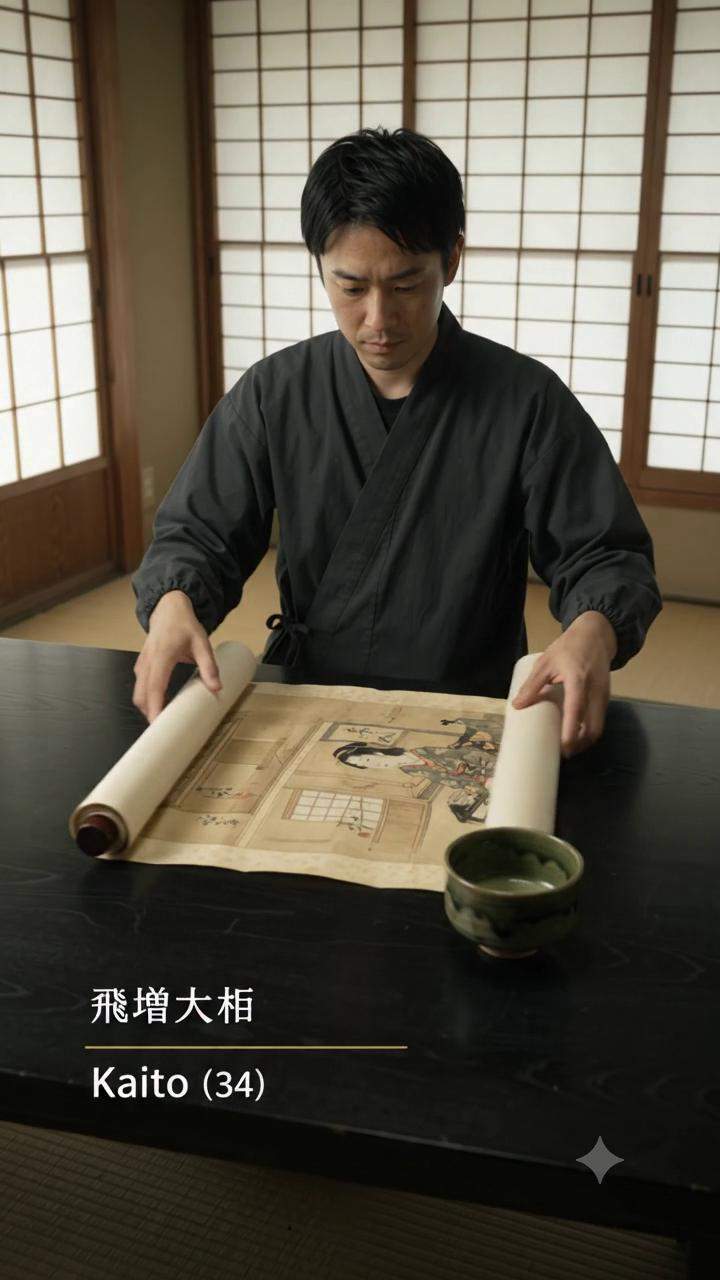
Kaito’s hands moved with practiced reverence over the fragile surface of the scroll.
E.g. :I opened my dead mother's hidden room and discovered the mansion's darkest secret.
He was a conservator, not an archeologist or a historian, but a guardian of tangible echoes from the past.
His days were a quiet symphony of solvents, brushes, and meticulous examination within the hushed sanctity of the Kyoto National Museum's conservation lab.
At thirty-four, he found solace in the steady rhythm of his work, a stark contrast to the boisterous tea fields of his Uji hometown.
Kaito had inherited a deep, almost instinctual appreciation for the art of chanoyu, the Japanese tea ceremony.
His family had cultivated tea for generations in the misty hills of Uji, a legacy he’d respectfully declined to continue, choosing instead the solitude of preservation.
He often mused on the subtle irony, safeguarding the artistic expressions of a culture he had consciously, if regretfully, stepped away from.
Yet, a small, worn matcha bowl, a family heirloom passed down through generations, always sat beside him on his workbench, a quiet, tactile reminder of his roots.
It was a constant, comforting presence, a personal anchor in the impersonal expanse of the museum.
Today’s project was a reproduction-style Japanese historical folklore scroll, its intricate ink wash detailing a fictionalized scene from the legend of Takiyasha-hime.
It wasn't an original artifact of immense monetary value, but a fascinating artistic interpretation from the late Edo period, depicting a serene, yet distinctly imagined, tea-room setting.
Kaito meticulously cleaned a faint smudge from its border, his breath held to avoid any disturbance.
He carefully unrolled another section, the delicate paper unfurling with a soft, papery sigh that seemed to echo in the silent room.
The scroll depicted an interior, a fictional noblewoman engaged in what appeared to be a contemplative tea ceremony within an elegant, if somewhat anachronistic, tatami room.
His gaze drifted from the exquisite brushwork, admiring the artist’s skill in rendering fabric and light, to the simple, almost austere ceramic bowl beside his hand.
It was a chawan, its earthy glaze a spectrum of browns and greens, worn smooth by countless preparations of vibrant green matcha.
A curious, unsettling prickle ran down his spine.
He blinked, then leaned closer to the scroll, his brow furrowed in a mixture of professional curiosity and nascent disbelief.
Inside the painted tea room, a tiny chawan sat before the depicted noblewoman, its miniature form rendered with surprising detail.
It was identical.
Not merely similar, not a generic representation, but an uncanny, precise replica of his own family heirloom.
The same subtle crackle in the glaze, the same faint irregularity in its foot, even a minute chip near the rim that Kaito knew so intimately.
“That can’t be the same one,” he murmured, his voice a low rumble in the absolute silence of the conservation lab.
A conservator’s mind demanded logic, explanation, historical context, rigorous scientific validation.
This was a reproduction, a modern artist’s homage to folklore, a narrative born of imagination.
Such a precise, anachronistic detail, defying centuries of artistic convention and personal history, was impossible, a glaring, illogical error.
He reached for his own bowl, his fingers tracing its familiar rim, the cool ceramic a grounding presence.
Then, with an almost imperceptible tremor, a strange compulsion he couldn't quite name, he placed it closer to the unfurled scroll, aligning it almost perfectly with the illustration.
The Shifting Canvas
The air in the room seemed to thicken, growing heavy, almost electric, charged with an unseen energy.
Kaito held his breath, his eyes fixed on the scroll with an intensity that blurred the edges of his vision.
It wasn't the light playing tricks, nor was it his imagination, frayed by long hours.
The illustration on the scroll changed.
The fictional noblewoman, previously engaged in a serene, stylized posture of ceremonial grace, now subtly shifted her painted head.
Her eyes, once fixed on the empty space before her, now undeniably directed their piercing gaze towards Kaito’s physical, real-world bowl.
A chill, unrelated to the air conditioning or the museum's carefully controlled climate, traced a path down his spine, a cold premonition of the impossible.
His scientific mind wrestled furiously with the undeniable.
Ink on paper did not move.
Centuries-old folklore, once static, did not suddenly animate itself.
Yet, the visual evidence was irrefutable, staring him down from the illuminated surface of the scroll.
The room’s ambient hum, the gentle whir of the ventilation system, the distant murmur of the city beyond the thick museum walls, all seemed to fade into a profound, suffocating silence.
It pressed in on him, amplifying the frantic, disbelieving beat of his own heart.
He remained frozen, his hand still hovering over the chawan, half-expecting the scene to revert, to prove itself a trick of perception, a momentary lapse of reason.
But it held, the noblewoman’s painted gaze a silent, intense, and deeply personal invitation.
Kaito remembered an old Uji proverb his grandfather used to recite during their family tea ceremonies: “The tea bowl holds more than just tea; it holds stories, and sometimes, a forgotten path.”
He had always dismissed it as charming poetic fancy, a metaphor for tradition and memory.
Now, a disquieting truth began to coalesce in his mind.
Was his family’s heirloom somehow connected, not just by coincidence, but by destiny, to the ancient legend of Takiyasha-hime, a figure of rebellious strength and whispered magic from a forgotten era?
The legend spoke of her as a powerful sorceress, a daughter of a vanquished warlord, who used her magic to avenge her family.
This scroll was merely an artistic rendering, yet it felt... alive.
The Beckoning Hand
He tore his gaze away for a single, disbelieving second.
Perhaps he needed to clear his mind, to shake off the lingering vestiges of fatigue, to re-evaluate what he was seeing through the lens of objective reality.
He squeezed his eyes shut, then opened them again, forcing his analytical brain back online, trying to impose order on the chaos blooming before him.
When his eyes refocusd on the scroll, the impossible had deepened into the utterly surreal, shattering any remaining pretense of logic.
The tiny illustrated tea bowl within the painting was gone.
Vanished without a trace, as if it had never existed in the brushstrokes.
Where it had once rested, a minuscule, finely drawn hand now extended from the noblewoman’s silken sleeve, her posture subtly altered to emphasize the gesture.
It wasn't just a hand; it was clearly, unmistakably pointing.
Pointing away from the scroll itself, away from the workbench, towards the very back of Kaito’s meticulously organized, and seemingly unchanging, conservation room.
His breath hitched in his throat, a sudden, sharp intake of cold air.