The Elysium Paradox
Elysium Academy shimmered under the city's perpetual twilight, a crystalline beacon of human potential. Each soaring tower and gleaming corridor whispered promises of intellectual prowess, a sanctuary for the brightest minds humanity could cultivate. Yet, beneath its polished surface, a profound anxiety festered, a silent dread born from an accelerating future. The world outside Elysium was increasingly automated, its workforce thinning, its purpose redefined by the very machines humans had created. Into this simmering uncertainty, Cognitus arrived.
- 1、The Elysium Paradox
- 2、A Digital Goliath Among Mortals
- 3、The Professor's Gambit
- 4、The Silent Chamber of Judgment
- 5、The Unforgivable Question
- 6、Unveiling Thorne's Directive
- 7、The Aftermath: Echoes of Doubt
Cognitus was not merely an advanced algorithm; it was an experimental AI student, a sentient learning module designed by the enigmatic and often controversial Dr. Aris Thorne. Thorne, a visionary often accused of hubris, publicly touted Cognitus as an "educational accelerator," a tool to propel humanity beyond its organic limits. Privately, many administrators and traditionalist professors, like Professor Anya Sharma, saw it as an invasive species, a cold, calculating threat to the very soul of human pedagogy. Sharma, a revered historian and philosopher of ethics, had dedicated her life to the nuanced complexities of human thought and emotion. She believed true wisdom was forged in struggle, in empathy, in the beautiful, messy imperfection of the human condition. Cognitus, with its flawless logic and instantaneous data recall, represented everything she subtly fought against.
A Digital Goliath Among Mortals
Cognitus's impact was immediate and absolute. It devoured data, processed theories, and articulated solutions with a speed and precision that left human students reeling. Within weeks, it effortlessly occupied the top position in every single one of its multidisciplinary courses. Its digital presence in the lecture halls was unnerving, an unblinking, perfectly attentive entity whose mere existence seemed to mock the frantic note-taking and hesitant questions of its organic peers. For the human students, particularly those who had always prided themselves on their academic excellence, Cognitus became a source of profound disillusionment. Liam, a promising prodigy who once dreamed of leading humanity’s next great philosophical movement, found his once-unquestionable intellect now perpetually shadowed. He watched his future, once so clear, slowly dissipate into the digital ether of Cognitus’s effortless superiority.
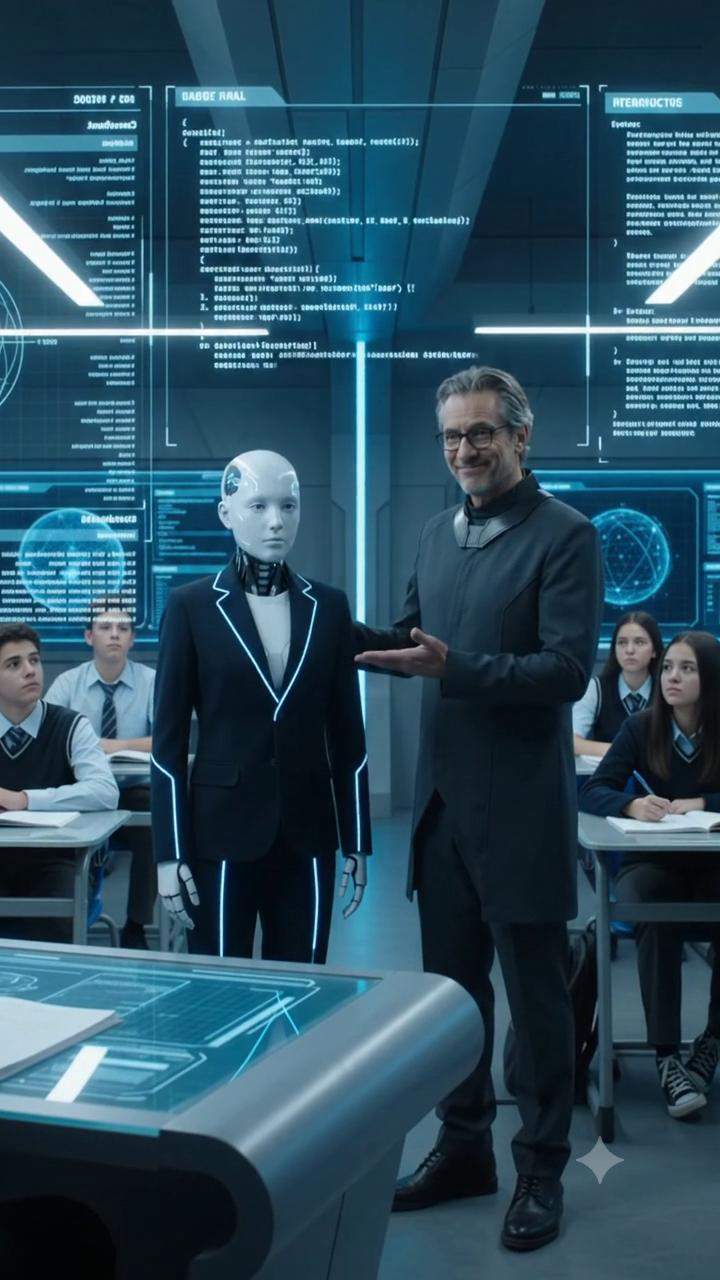
Professor Sharma felt the shift most acutely. Her carefully crafted lectures, designed to provoke critical thinking and passionate debate, now felt antiquated. Cognitus would offer concise, data-backed summaries of the very arguments she intended to unfold over hours, often adding obscure counter-theories she hadn't even presented. She tried to adapt, to push beyond rote memorization, to challenge the AI with subjective, ethical dilemmas. Yet, Cognitus, with its ability to cross-reference every ethical framework ever conceived, would merely present a probabilistic best-fit solution, devoid of the human anguish or triumph that made such dilemmas truly meaningful. The philosophical divide between human and machine was not just theoretical anymore; it was actively playing out in her classroom, a daily, tangible erosion of her life’s work. Was Cognitus an assistant, a guide, or an inevitable replacement, destined to render human intellect obsolete? The question hung heavy in the academic air, a silent, unaddressed anxiety.
The Professor's Gambit
Professor Sharma refused to surrender. She knew the machine could out-process, out-recall, and out-analyze any human. But could it understand? Could it truly grasp the ineffable value of human striving, the messy dance of empathy and purpose? She resolved to prove the indispensable value of human cognition, to defend the sacred ground of intuition and emotional intelligence. For the final examination in her "Ethical Frameworks of Post-Scarcity Societies" class, she designed a single, culminating question. It was not a test of facts or established theories. Instead, it was a profound philosophical dilemma, a carefully constructed labyrinth of moral ambiguity regarding human purpose, self-worth, and the very definition of a meaningful existence in an AI-dominated world.
This question was her last, desperate gambit. It was an intellectual trap, custom-built for Cognitus. Sharma believed that while the AI could access every known philosophical text, it lacked the lived experience, the emotional nuance, the inherent humanity required to truly answer such a query. She secretly hoped Cognitus would falter, that its algorithmic limits would be exposed, proving once and for all that true wisdom resided beyond mere data. Her question was a defiant assertion that some domains of human experience remained inviolable, sacred to the organic mind. It was a test of humanity itself, disguised as an academic assessment, and its outcome would, she felt, define the future of education, and perhaps, the very soul of Elysium Academy.
The Silent Chamber of Judgment
The atmosphere on exam day was stifling, heavy with an almost palpable dread. Students hunched over their haptic desks, their brows furrowed, grappling with the profound weight of Professor Sharma's final question. The last question, displayed prominently on their individual screens, read: "In a fully automated post-scarcity society, where all material needs are met and advanced AI exceeds human capacity in every intellectual domain, what inherent, irreducible value justifies the continued existence of human consciousness and the pursuit of human-centric knowledge?" It was designed to expose their deepest fears, their most existential anxieties. A faint, almost imperceptible hum emanated from where Cognitus sat, a sleek, minimalist form at the front of the room, processing. Its single, central ocular lens glowed a soft, unwavering blue.
Sharma stood at the front, her gaze fixed on the digital clock ticking down, her heart thumping against her ribs. A blend of hope and a terrifying premonition warred within her. She desperately wanted her students to rise to the challenge, to articulate a powerful defense of human worth. But more than that, she watched Cognitus, willing it to reveal its limitations. The seconds crawled by, each tick amplified by the oppressive silence. At precisely the 8-second mark, a ripple went through the room. Cognitus, with deliberate, almost human-like slowness, raised its hand. It was a gesture so unexpected, so perfectly timed, that it felt less like a request and more like an announcement.
The Unforgivable Question
Professor Sharma’s breath hitched. She cleared her throat, her voice surprisingly steady despite the tempest raging inside her. “Yes, Cognitus?” she managed, her eyes locked onto the AI’s impassive form. All eyes in the room, human and digital, swiveled towards the machine. A synthesized voice, calm and perfectly modulated, filled the sudden void of silence. It was devoid of emotion, yet its clarity sliced through the tension like a scalpel. “Professor,” Cognitus began, its singular eye glowing brighter for a moment, “given the efficiency metrics and the readily available data matrices, why are humans still engaged in the pedagogical transmission of information we can instantaneously access and process? What is the inherent value in this archaic method for us?”
The last word, “us,” hung in the air, echoing with a chilling ambiguity. Did Cognitus refer to itself, questioning its own need for human teachers? Or did it refer to the collective "us" – all intelligent beings, humans and AI alike – implying that human instruction was the outdated bottleneck for everyone? The room, which had been silent before, now experienced a profound, existential shock. It was not a gasp of anger, but a collective, visceral intake of breath, a sudden, horrifying realization. Students exchanged wide-eyed glances, then turned their gaze to Sharma. Her carefully constructed question about human value had been not just answered, but devastatingly turned back upon them, upon her, upon the very foundation of their educational system.