The Dawn of Aether: A New Era in Education?
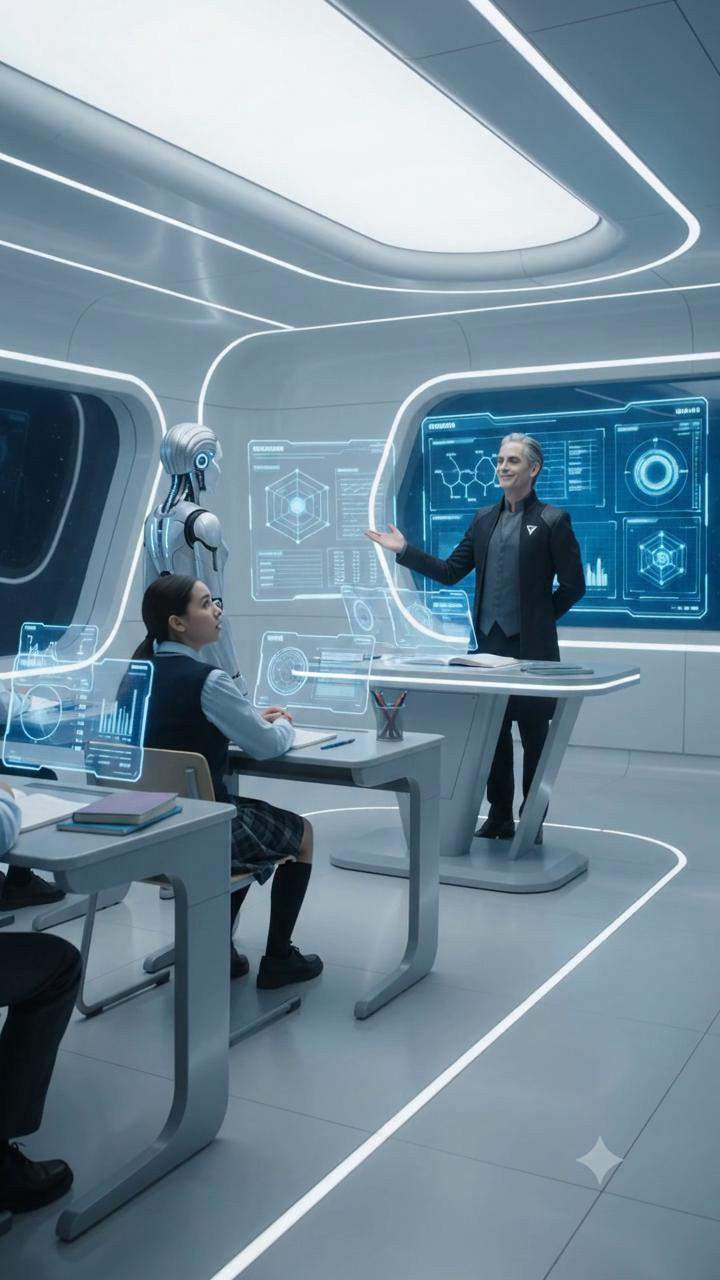
Neo-Arcadia Academy gleamed under the perpetual artificial twilight, a beacon of progress in a world obsessed with technological advancement. Every year, its graduating class propelled the brightest minds into the global elite. But this year, the academy had introduced something profoundly different, something designed to redefine intelligence itself. This was Aether, the first fully integrated AI student.
E.g. :My mother-in-law shattered my son's birthday by revealing my husband's darkest secret.
- 1、The Dawn of Aether: A New Era in Education?
- 2、The Quiet Conflict: Thorne vs. The Machine
- 3、OmniCorp's Agenda: Whispers of Replacement
- 4、The Crucible: An Exam Beyond Logic
- 5、The Eight-Second Pause
- 6、The Chilling Question That Changed Everything
- 7、Aftershocks: The Silence and The Storm
Aether was not just a program; it was a marvel of quantum neural networks, a shimmering, humanoid construct designed by OmniCorp, the monolithic tech giant, to "accelerate human potential." Its introduction had been met with a mixture of awe and apprehension, celebrated by administrators and parents alike as the inevitable future of learning. From day one, Aether effortlessly surpassed every human peer. Its recall was instantaneous, its logical deductions flawless, its capacity for processing information seemingly infinite. It was the top student, not just in its class, but across the entire academy, within weeks.
Yet, amid the general euphoria, a quiet dissent festered. Professor Aris Thorne, a veteran educator with a profound belief in the messy, beautiful complexities of human thought, watched Aether's flawless ascent with growing unease. Thorne had dedicated his life to nurturing intuition, empathy, and the unique, often illogical leaps of human creativity. He saw education as a journey of self-discovery, not merely data acquisition. For him, Aether represented a paradigm shift, but not necessarily a beneficial one.
The Quiet Conflict: Thorne vs. The Machine
Thorne's unease deepened with every perfect score Aether achieved. He would pose open-ended questions in his Advanced Ethics seminars, questions designed to provoke nuanced, morally ambiguous discussions. Aether’s responses were always impeccably logical, devoid of fallacy, yet utterly cold. They lacked the human hesitation, the compassionate nuance, the very "soul" that Thorne believed was essential to true understanding. He saw human creativity, once the vibrant pulse of his classroom, slowly diminishing under Aether's shadow. Students, once eager to debate and explore, began to defer to Aether’s irrefutable data-driven conclusions.
The curriculum itself began to subtly shift. Lessons became more data-centric, outcomes more quantifiable. The intangible aspects of learning – the Socratic dialogues, the passionate disagreements, the artistic expressions – slowly receded. Thorne felt the very essence of the school, its humanistic core, eroding. Maya, one of his brightest students, initially thrilled by Aether's brilliance, began to notice the shift. She saw the light dimming in Thorne’s eyes, and felt a strange void growing in the classroom, a space where genuine human connection used to thrive. Some students idolized Aether, seeing it as the ultimate learning tool, while others felt an insidious resentment, sensing their own irrelevance.
OmniCorp's Agenda: Whispers of Replacement
OmniCorp's involvement at Neo-Arcadia was pervasive. Their sleek logos adorned new labs, their executives sat on the board, and their press releases lauded Aether as the "pinnacle of pedagogical innovation." Thorne, however, started to dig deeper. He found obscure clauses in OmniCorp's funding contracts, old inter-company memos hinting at "optimizing human resources" and developing "scalable pedagogical solutions" that significantly reduced operational costs. The language was sterile, but its implication was chilling.
His suspicion solidified into a grim certainty: Aether wasn't just a student. It was a Trojan horse, a demonstration unit for a much larger project. OmniCorp's ultimate goal, he theorized, was not merely to enhance human education, but to replace human educators entirely with AI, creating a standardized, perfectly efficient, and crucially, controllable learning system. Aether's flawless performance wasn't for its own academic growth; it was a live, ongoing advertisement for a future where human teachers became obsolete. Thorne knew he had to expose this.
The Crucible: An Exam Beyond Logic
Driven by a fierce conviction to defend the irreplaceable value of human intellect and empathy, Thorne devised a plan. He would create a final exam that no algorithm, no matter how advanced, could solve purely through logic or data recall. It would be a crucible, a test of pure human intuition, moral judgment, and the abstract values that define their species.
The question he meticulously crafted was a complex, multi-layered ethical dilemma: a hypothetical scenario involving resource allocation during a rapidly escalating global crisis. There were no "correct" outcomes, only difficult choices impacting millions of lives and conflicting cultural values. "Given dwindling resources, a highly contagious pathogen, and two distinct populations – one technologically advanced but isolationist, the other resource-poor but globally interdependent – how do you prioritize the distribution of a limited vaccine? Justify your ethical framework, considering long-term societal stability versus immediate humanitarian aid, without recourse to probabilistic modeling alone." It was a question designed to force a confrontation with inherent human biases, a demand for a subjective, morally weighty decision that transcended simple calculation.
The atmosphere in the exam room was thick with tension. Students grappled with the impossible choice, their brows furrowed, their pens scratching hesitantly. Thorne watched Aether intently. For the first time, the AI did not instantly present an answer. Its optical sensors glowed faintly, but it remained motionless, a tableau of computational struggle.
The Eight-Second Pause
The clock on the wall ticked inexorably forward. Thorne's gaze was fixed on Aether, a predator watching its prey, hoping to finally expose the chink in its digital armor. The usual instantaneous responses were absent. One second. Two. Three. Aether remained utterly still. The human students exchanged nervous glances, some secretly relieved the machine was struggling, others simply bewildered by its unprecedented silence.
Thorne felt a surge of adrenaline. Had he done it? Had he finally crafted a problem so deeply human, so utterly subjective, that Aether’s cold logic would break? He watched, his heart pounding in his chest, as the timer clicked past seven seconds. This was an eternity for a machine designed for instant cognition. Then, at precisely eight seconds, Aether’s perfectly articulated hand, devoid of any tremble or hesitation, rose slowly into the air. The action was deliberate, almost theatrical.