My hands trembled as I pushed the cart down the produce aisle, the fluorescent lights of the supermarket glaring down, making everything feel too bright, too exposed.
My husband, Mark, was a storm waiting to break, a low rumble always just beneath the surface of his forced calm.
He had been particularly volatile all morning, seething about a misplaced car key that was, inevitably, my fault.
Now, in public, his anger was simmering, ready to boil over any second.
I could feel the familiar knot of dread tightening in my stomach, a physical manifestation of years spent walking on eggshells.
Our marriage hadn’t always been like this.
There were moments, long ago, when Mark was charming, attentive, almost everything I thought I wanted.
But gradually, insidiously, his control had tightened, his words growing sharper, his temper more unpredictable.
He thrived on public displays of dominance, enjoying the way my shoulders slumped, my gaze fell, my voice faltered under his scathing rebukes.
It was his way of reminding me, and everyone else, who was in charge.
Today’s trigger was organic milk.
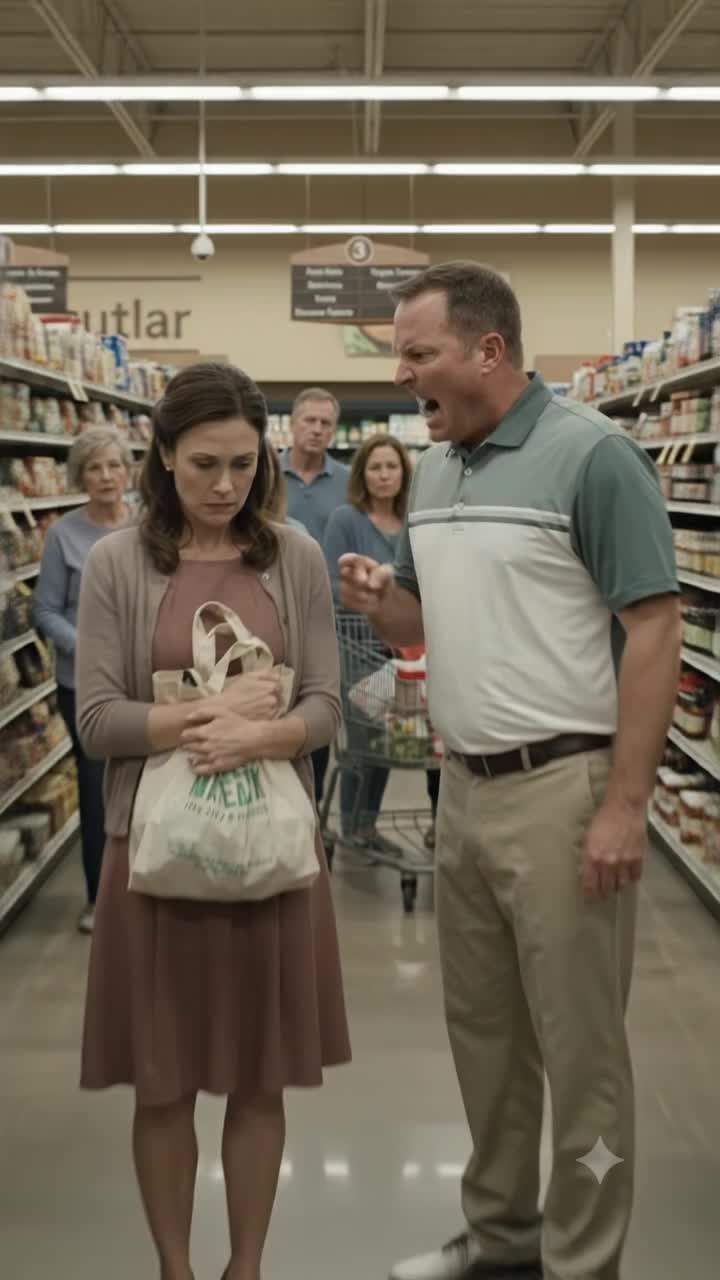
“Sarah, are you even listening to me?” his voice, though still relatively low, carried an edge that made my breath hitch.
I stopped by the dairy section, my eyes scanning the rows of cartons, trying to locate the specific brand he demanded.
He insisted on everything being precisely to his liking, and any deviation was met with a tirade.
“I’m looking, Mark,” I murmured, my voice barely a whisper, a stark contrast to his booming presence.
A couple with a young child in a nearby aisle subtly quickened their pace, their eyes briefly flickering towards us, then quickly away.
The humiliation was a familiar, heavy cloak.
It wrapped around me, suffocating me, yet I wore it with practiced resignation.
I had tried to fight back in the past, to reason, to explain, but it only fueled his rage, making the aftermath even worse.
Silence, I had learned, was my only shield, my only form of survival.
“Looking? You’ve been ‘looking’ for five minutes! It’s just milk, Sarah! Are you deliberately trying to annoy me?” he bellowed, his voice rising, now clearly audible to the scattered shoppers.
My cheeks burned.
My grip on the shopping cart tightened, my knuckles turning white.
I could feel their eyes, the silent judgment, the pity, the disapproval.
It felt like a thousand needles pricking my skin.
This was my life, a public spectacle of my own inadequacy, orchestrated by the man who was supposed to love me.
He stepped closer, invading my personal space, his face flushed, eyes narrowed.
“Honestly, sometimes I wonder if you even have a brain in that head of yours. You can’t even do a simple grocery run without messing it up.”
His words, like poisoned arrows, pierced through the thin armor of my composure.
I wanted to scream, to lash out, to disappear.
But the years of conditioning, the fear of escalation, held me captive.
My head remained bowed, my gaze fixed on the gleaming supermarket floor, wishing it would simply swallow me whole.
Then, a sudden vibration against my thigh.
My phone.
It was tucked deep in the pocket of my cardigan, a small, insistent tremor in the midst of the chaos.
I fumbled for it, my fingers clumsy with nerves.
Mark, still mid-rant, paused, his eyes narrowing further as he watched me pull out the device.
“What now? Can’t you even put your phone away for five minutes?” he sneered.
I ignored him, my gaze fixed on the screen.
It was an email notification, followed by a text message from a number I recognized instantly.
My attorney.
A chill, not of fear but of profound clarity, ran down my spine.
I unlocked the screen, my heart pounding a rhythm against my ribs that was suddenly, exhilaratingly, not of dread but of anticipation.
The text was brief, only three words.
“It went through.”
My breath caught in my throat.
“It went through.”
Those three words were not just text; they were the sound of prison bars clanging open.
They were the scent of fresh air after years of suffocation.
They were the feel of solid ground beneath my feet after years of walking on quicksand.
It was the final confirmation.
The deed for the small cottage, my grandmother’s legacy that Mark had always dismissed as worthless and tried to pressure me into selling to his shady business partners, had been quietly transferred into my sole, untraceable trust account.
The funds from its sale, which I had secretly orchestrated over the past six months, were now irrevocably mine, a solid, undeniable foundation for my escape.
I was no longer financially dependent.
I was no longer trapped.