My name is Sarah Jenkins, and for the past five years, I have been the host of "Legacy Builders," a prime-time show dedicated to chronicling the lives of America's most inspiring entrepreneurs.
I always believed in the power of a compelling narrative, especially one about achieving success against all odds.
Our show celebrated those who embodied the true spirit of the American Dream, and I genuinely felt privileged to share their stories with millions.
Richard Vance, the formidable CEO of Vance Industries, was scheduled to be our season finale, a segment I had personally championed.
His public image was impeccable: a self-made billionaire, a visionary leader who had supposedly built his vast empire from absolutely nothing.
Every business journal lauded him, every major news outlet profiled him, painting a picture of unwavering determination and sheer genius.
His personal story, as told, was equally compelling: orphaned at a young age, he had overcome early adversity through sheer grit and an unshakeable belief in his own capabilities.
This was the kind of story that truly resonated with our audience, and with me, deeply.
I had spent weeks, perhaps even months, immersed in his biography, poring over every detail of his ascent.
My team and I meticulously crafted each question, aiming to illuminate the depth of his character and the brilliance of his entrepreneurial journey.
The morning of the live broadcast was electric, the air in the studio thick with anticipation and the hum of sophisticated equipment.
Richard arrived with an entourage, exuding an almost palpable aura of success and polished charm.
He moved through the studio like royalty, shaking hands, exchanging pleasantries, his smile flawless and seemingly genuine.
He was in his early forties, handsome, with sharp, intelligent eyes, and he wore a bespoke suit that spoke volumes about his immense wealth and impeccable taste.
As the countdown ended and the red light above the camera flickered on, Richard transformed, becoming the charismatic, confident figure the world recognized.
He spoke eloquently about the genesis of Vance Industries, recounting tales of sleepless nights, arduous negotiations, and the relentless pursuit of his vision.
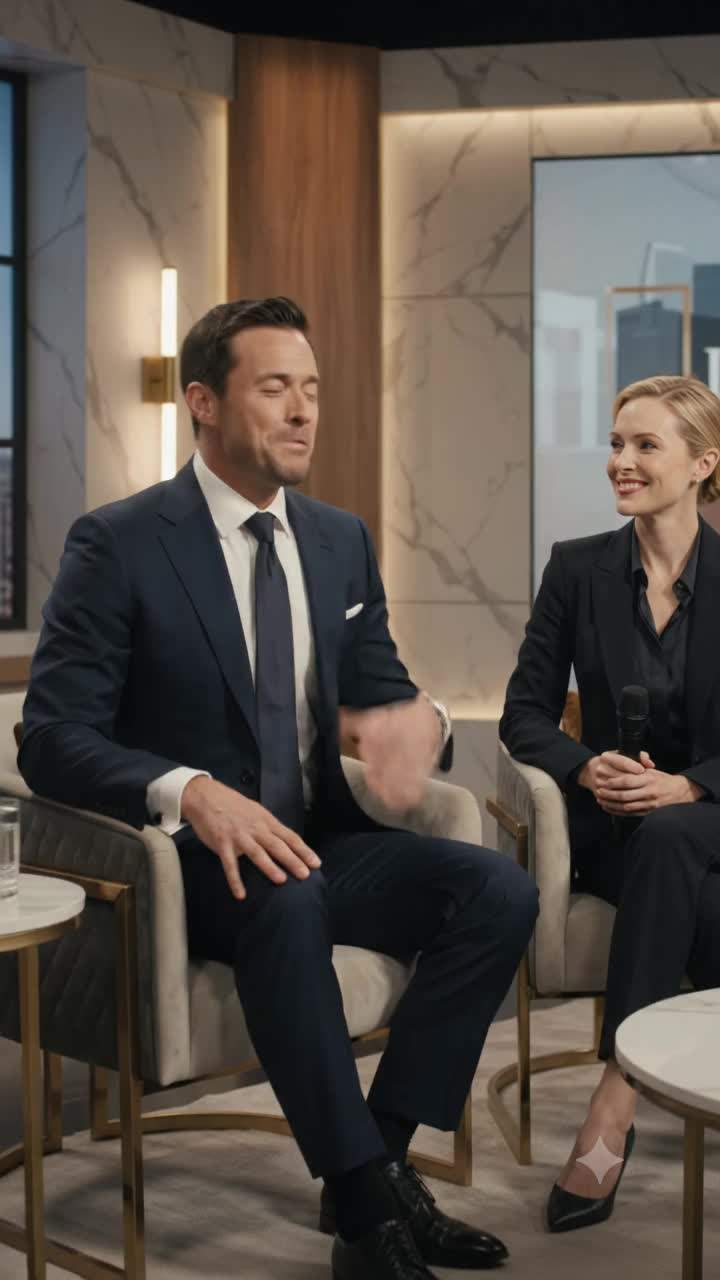
Each answer was a masterclass in storytelling, reinforcing the powerful legend of the self-made man.
"People always ask me, 'Richard, how did you build such an empire from nothing?'" he articulated, leaning slightly forward, his gaze direct and engaging with the camera, then me.
"My answer is always the same: grit, determination, and never forgetting where you came from."
I listened, my professional smile in place, but also with a genuine sense of admiration for his journey.
"A true testament to the American Dream, Mr. Vance," I replied, my voice a reflection of the collective respect I felt for his accomplishments.
The interview was proceeding flawlessly, a seamless narrative unfolding for our eager audience.
The floor director gave me the cue for our next segment, everything perfectly on schedule.
Then, a sudden, jarring commotion erupted from the studio entrance, a low, confused murmur escalating into an undeniable scuffle.
My internal alarm bells began to ring, a flicker of unease disturbing my practiced composure.
My eyes instinctively darted towards the disturbance, catching sight of a security guard struggling with an elderly man.
The old man, surprisingly tenacious despite his apparent frailty, pushed past the larger guard with a singular focus.
He hobbled with purpose straight towards our brightly lit interview set, his gaze locked onto Richard.
Richard's confident smile evaporated instantly, replaced by a fleeting, chilling expression of pure, unadulterated panic in his eyes.
He tried to quickly regain his composure, forcing a dismissive, annoyed frown onto his face.
"Security! What is the meaning of this? Get this man out of here!" Richard demanded, his voice now sharp, harsh, and utterly devoid of his earlier charm.
But the old man, undeterred, spoke, his voice not loud, but carrying an unmistakable weight and clarity that cut through the studio noise.
"Richard Vance! You talk about 'where you came from'?" he challenged, ignoring the flustered security guard who was still trying to apprehend him.
My heart began to pound a frantic rhythm against my ribs; live television was always a tightrope walk, but this felt like an entirely different, more dangerous kind of precipice.
The old man, whose weathered face told stories of a long and difficult life, finally stood just a few feet from our interview desk.
He looked at Richard with an unsettling mixture of profound sorrow, disappointment, and burning accusation.
Richard's complexion had turned a ghastly shade of ashen, and I could see beads of sweat forming on his forehead, betraying his shattered composure.
"You... you know nothing! This is a setup!" Richard stammered, his voice thin and desperate, a stark contrast to his earlier eloquence.
I sat there, utterly frozen, the microphone feeling impossibly heavy and alien in my hand, my mind racing to comprehend the surreal reality unfolding before me.
"I was your family's driver for thirty years, Richard," the old man continued, his voice gaining a quiet, formidable strength, his gaze unwavering and holding Richard captive.
"I drove your father to every meeting, every 'deal'. I saw everything."
The words hung in the studio air, heavy with decades of unspoken secrets and hidden histories, silencing every single person in the room.
Richard tried to interrupt again, a choked, desperate sound escaping his throat, but the old man, whose name I would soon learn was Arthur Finch, would not be silenced.
He slowly, with deliberate, almost theatrical slowness, opened a worn, brown leather satchel he carried, its old buckles creaking softly in the sudden, profound silence.
From inside, he carefully pulled out a stack of yellowed, brittle papers: faded stock certificates and a fragile document that unmistakably resembled a last will and testament.
My professional instinct, honed over years of live broadcasts, screamed at me to take control, to cut to a commercial, to do anything to stop this unfolding disaster.
But a powerful, almost morbid fascination, coupled with an undeniable sense of moral urgency, held me captive, unable to move.
Arthur Finch, the humble driver, held up the documents, his hands trembling slightly with age, but his voice was now steady as a rock, ringing with absolute conviction.
"Your 'empire from nothing'?" Arthur declared, his gaze sweeping from Richard's horrified face to the camera lens, and finally to me, ensuring his message reached everyone.