The Whisper of a Forgotten Cataclysm
Kaito, a man whose lineage traced back through generations of Edo-period scholars and eccentric collectors, was not merely interested in beauty. His obsession lay with anomaly. His small, cluttered chamber, smelling of aged paper and dried ink, was a repository not just of art, but of historical discord, of artifacts that whispered forgotten truths. Tonight, the air was heavy with anticipation, thick enough to taste.
- 1、The Whisper of a Forgotten Cataclysm
- 2、The Unseen Observer
- 3、The Recorded Truth
- 4、A Legacy of Warnings
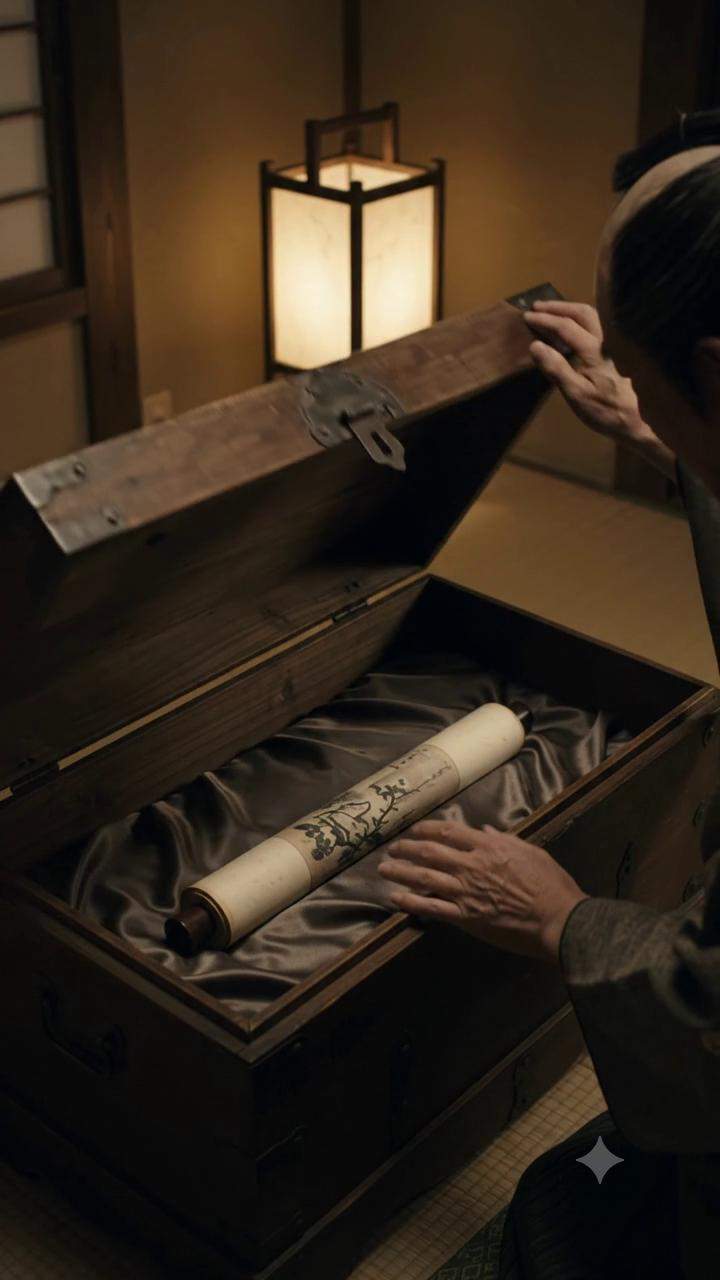
He approached a lacquered wooden chest, unassuming yet radiating an ancient energy. It had arrived at his doorstep two nights prior, an anonymous gift, its provenance shrouded in deliberate mystery. His gloved fingers, calloused from countless hours handling brittle relics, traced the intricate carvings on its surface. He knew, with a scholar's intuition, that this was no ordinary acquisition.
With a soft click, the heavy lid opened, revealing a single, rolled scroll nestled within crimson silk. It was impossibly delicate, its parchment aged to a warm amber. A faint, earthy scent rose from it, like distant rain on ancient soil. Kaito's breath hitched. This was it.
He carefully lifted the scroll, his movements precise and measured. The weight felt significant, heavy with untold history. He laid it flat on his reading table, a polished surface scarred by centuries of similar unveilings. Slowly, with an almost reverent slowness, he began to unroll it.
The painting that emerged was breathtaking, a masterpiece of vibrant indigo and frothing white. It depicted three fishing boats, impossibly small, tossed upon the monstrous, curling crest of a colossal wave. In the distance, serene and majestic, stood the unmistakable peak of Mount Fuji, a stark counterpoint to the aquatic fury. It was a familiar motif, yet this rendition held a raw, primal power that surpassed any ukiyo-e print he had ever encountered.
His gaze drifted to the bottom corner, a place where artists often inscribed their names or seals. Instead, a small, elegant script, in a style he recognized as archaic, declared a date. “1298.”
The world tilted. Kaito’s mind, a vast library of historical data and artistic chronologies, reeled. The style, the perspective, the very essence of the painting, screamed mid-19th century Edo, the era of Hokusai, not the rugged, medieval Kamakura period. A date in the 13th century was not just an anachronism; it was an impossibility, a profound violation of artistic and historical order. His eyes widened, his expression shifting from scholarly curiosity to profound disquiet. His heart hammered a frantic rhythm against his ribs. This wasn't merely an anomaly; it was a paradox, a silent scream across centuries.
The Unseen Observer
A creak from the polished floorboards, barely audible above the rising wind outside, sliced through Kaito’s stunned silence. He froze, every muscle tensing. He hadn’t heard anyone approach, hadn’t detected the slightest disturbance. He was alone in this secluded chamber, or so he believed.
He turned slowly, his hand hovering near a heavy bronze paperweight, a meager weapon against the unknown. Standing in the doorway, framed by the pale glow of a paper lantern, was a figure he could only describe in hushed legends. Dressed in practical, dark indigo fabric, with a cloth hood obscuring much of his face, the man was a silhouette of silent menace. A ninja.
The warrior was still, utterly devoid of movement, yet his presence filled the small room, eclipsing the ancient treasures within. His eyes, glinting in the low light, were fixed not on Kaito, but on the unrolled scroll. Kaito’s fear warred with a sudden, desperate urge for answers. This intruder, this phantom of a bygone era, might hold the key to the scroll’s impossible date.
“Who painted this?” Kaito’s voice, though strained, held the authority of a man accustomed to command, despite the trembling in his knees.
The ninja’s head tilted almost imperceptibly, his gaze remaining on the turbulent wave and distant Fuji. His voice, when it came, was a low, gravelly whisper, yet it resonated with an unnerving finality. “Nobody.”
Kaito’s blood ran cold. The answer, simple as it was, stripped away any remaining pretense of this being a conventional artwork. If nobody painted it, what was it? His mind raced, grasping at theories, conspiracies, ancient rites, forbidden technologies. He stared at the scroll, then back at the impassive face of the ninja, a vortex of questions churning within him.
The Recorded Truth
The ninja finally shifted, his hand slowly lifting, not towards Kaito, but towards the scroll. His finger, slender and precise, pointed directly at the three small boats caught in the monumental wave. The image, once a beautiful yet impossible piece of art, now felt charged with a terrifying, objective truth.
“It was recorded.”
The words hung in the air, a punchline to a cosmic joke only the ninja understood. Recorded. Not painted, not imagined, but captured. Like a memory, like an eyewitness account, but somehow, impossibly, made permanent, visual, tangible. Kaito stared, his mind struggling to reconcile the concept. This wasn’t art. This was… a window.
The ninja’s order, a clandestine brotherhood known as the Kage-no-Me – “Eyes of Shadow” – had existed for centuries, their purpose to observe, to document, and most importantly, to safeguard humanity from truths it was not yet ready to comprehend. They possessed methods, ancient and meticulously guarded, to visually transcribe events, to capture moments in time without the subjective interpretation of an artist. The scroll wasn’t a painting of "The Great Wave"; it was a direct, visual memory of a cataclysmic event that had struck Japan’s coast in 1298, an event that had been carefully expunged from most historical records due to its sheer terror and the widespread panic it caused.
The recurring motif of the enormous curling wave, the three boats, the distant Mount Fuji – it wasn’t just an artistic trend. It was a visual language, a shared warning, an encoded message passed down through generations of Kage-no-Me. Each time such an event threatened, or had occurred, an “Eye” would record it, preserving the immutable truth. The most famous "Great Wave" prints, Kaito now realized with a jolt, were not merely artistic expressions but echoes, interpretations by artists who had perhaps glimpsed the forbidden records or heard fragmented whispers of the Kage-no-Me’s archives. They were distorted memories, simplified warnings.
The 1298 scroll, therefore, was not art. It was a primary source, a visual chronicle of a tsunamic event, a raw, unvarnished depiction of destruction. The boats were not fishing vessels but perhaps early warning scouts, or unfortunate victims, or even the Kage-no-Me themselves, observing from the very heart of the storm.
A Legacy of Warnings
Kaito, the collector of anomalies, had stumbled upon the greatest anomaly of all. His ancestors, he now understood, had not merely collected rare items. They had been, unknowingly, on the periphery of this hidden world, drawn by the faint echoes of the Kage-no-Me’s work, compiling their own fragmented understanding of a cyclical pattern of disaster. His family’s fascination with ancient prophecies and forgotten histories was not eccentric; it was inherited purpose.
The ninja, whose name Kaito would later learn was Kenji, finally turned his full attention to the collector. There was no malice in his gaze, only an ancient weariness, and perhaps, a flicker of assessment. Kenji had been sent not to retrieve the scroll by force, but to observe Kaito, to gauge his reaction, to determine if he was merely a curious scholar or something more. The anonymous gift of the chest had been a test.
Kaito’s lineage, his precise knowledge of historical inconsistencies, his inherent drive to seek out the truth beyond the accepted narrative – these were qualities the Kage-no-Me recognized. He was not just a recipient of a forgotten warning; he was a potential inheritor of its guardianship.
The great wave on the scroll seemed to surge, the painted water almost alive with silent fury. It was a warning from the past, a testament to nature's relentless power, and a grim reminder that such events would inevitably recur. The Kage-no-Me did not prevent these cataclysms; they simply ensured that the knowledge of their past occurrences, and the signs of their return, were never entirely lost.
Kenji took a step closer, his shadow falling across the scroll, momentarily obscuring the date. “This is but one thread,” he murmured, his voice now softer, yet still imbued with an undeniable weight. “One record in a vast tapestry of sight.” He paused, his eyes piercing Kaito’s. “The others are stirring.”
Kaito looked at the scroll again, no longer seeing a beautiful painting, but a terrifying truth. The world was far older, far more complex, and far more perilous than he had ever imagined. He had sought anomalies, and now an anomaly sought him. The silent promise of further revelations hung heavy in the air, a chilling invitation to a world he never knew existed. His journey into the true nature of history had only just begun.