The Weight of Inheritance
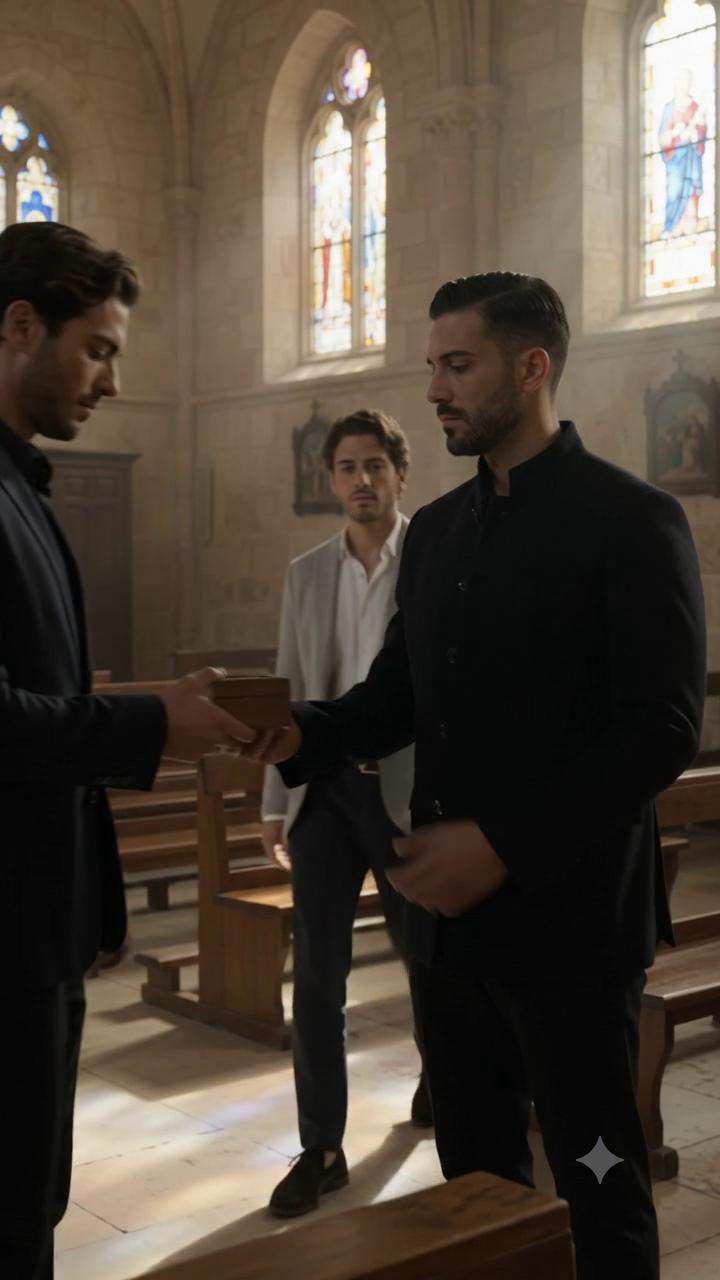
The first light of dawn struggled to pierce the ancient stained-glass windows of Santa Maria del Fiori. Each fractured beam cast kaleidoscopic dust motes dancing in the hallowed air. Marco D’Amico stood alone, a solitary figure dwarfed by centuries of devotion and silent prayer. His breath plumed faintly in the cool morning air. He clutched a small, intricately carved wooden box, its edges worn smooth by generations of nervous hands. This was not the gift one gave to a lover. This was a burden.
E.g. :The cafeteria floor felt like an ocean after my milk spilled.
Julian Ferri entered, his footsteps soft upon the worn flagstones. His dark hair was still tousled from sleep, his eyes holding the soft, lingering warmth of their shared night. He smiled, a genuine, trusting curve of his lips that Marco felt like a physical blow. Julian approached, expecting a tender embrace, perhaps a whispered promise of breakfast. Instead, Marco offered him the box.
Julian’s brow furrowed, a flicker of apprehension replacing his earlier joy. He took the box, its unexpected weight a stark contrast to its unassuming size. His fingers traced the delicate carvings of intertwined serpents, a symbol he vaguely recognized from dusty old family crests. He looked up at Marco, whose face was a mask of an emotion Julian couldn’t quite decipher—a mixture of profound sorrow and unyielding resolve.
“What is this?” Julian asked, his voice hushed, echoing slightly in the vast space.
Marco said nothing, only urged him with a subtle tilt of his head to open it. Julian’s fingers trembled slightly as he lifted the lid. Inside, nestled on a bed of faded velvet, lay two objects. One was an ancient, tarnished brass key, its teeth intricately cut, unlike any modern lock. The other was a sepia-toned photograph, creased with age. It depicted a younger Marco standing beside a stern-faced, impeccably dressed older man—the family patriarch, the Don.
A sudden, sharp suspicion pierced Julian’s confusion. “You stole this?” he whispered, his voice laced with disbelief and a hint of betrayal. The old man in the photo, the Don, was notoriously protective of his family’s artifacts.
Marco shook his head slowly, his gaze fixed on Julian’s face, searching for something, perhaps a flicker of understanding. “I inherited it,” he stated, his voice low, heavy with a truth Julian couldn’t yet comprehend. It wasn't an inheritance of wealth or property, but something far more perilous.
The Secret Scrawled
Julian’s eyes flickered between the key, the photograph, and Marco’s unreadable expression. He picked up the photograph, his thumb tracing the familiar lines of Marco’s youthful face, then the Don’s stern visage. He turned it over, his curiosity piqued by a faint discoloration on the back. Scrawled in faded ink, in the Don’s distinctive, elegant hand, were five words that would forever shatter the quiet peace of their lives.
“The heir is not Marco.”
Julian froze. The words hung in the air, a silent accusation, a stark refutation of everything he thought he knew about Marco’s place within his powerful family. His head snapped up, his eyes locking with Marco’s. Confusion warred with a growing sense of dread. If Marco was not the heir, then what was he doing with these objects? And what did this cryptic message truly mean?
Marco took a slow, deliberate step closer. His hand, as if moved by an unseen force, rose slowly. His finger, steady and unwavering, pointed not at the photograph, not at the key, but directly at Julian.
“It was always you,” Marco whispered, his voice breaking on the last word. The confession was a raw, painful exhalation of a secret he had carried for years. It was a truth that bound them, not in love, but in a destiny neither of them had chosen.
Julian’s breath hitched. His world tilted on its axis. He felt a cold dread seep into his bones, a premonition of something terrible and inescapable. He wanted to deny it, to laugh it off, but the solemnity in Marco’s eyes, the deep, abiding sorrow there, told him this was no joke. This was an inescapable decree.
The Prophecy of the Veil
Marco had been groomed since birth to be the next Warden of the Veil. His family, for generations, had been the silent guardians of a hidden truth, a secret legacy entwined with the very foundations of their ancient city. The “Don” was not merely a crime lord, but the head of an ancient order, the Keepers of the Veil, tasked with maintaining a delicate balance between light and shadow. The Veil was not a physical object, but a mystical barrier, a protective ward woven into the fabric of reality, preventing a forgotten darkness from consuming their world.
The role of Warden was a heavy one, demanding absolute dedication, sacrifice, and ultimately, a solitary existence. Marco had rebelled against this fate. He had sought solace, and love, in Julian. He had clung to the hope that there was another way, a loophole, a prophecy that could spare him the crushing burden.
He had found it in the ancient texts, hidden deep within the Don’s private library. A fragmented prophecy spoke of a time when the true heir would not be of blood, but of spirit, chosen by an act of profound, selfless love. “The heir is not Marco, but the one he loves most.” Marco had interpreted this as his escape. He believed that by giving the key—the key to activating the Veil—to Julian, his beloved, he would transfer the burden, making Julian the Warden and freeing himself. It was a desperate, selfish hope, born of fear and a longing for a normal life.
The key was not to a physical lock, but to a mechanism within the ancient church itself, a focal point for the Veil’s power. The photograph was a lineage marker, showing Marco’s connection to the oath-bound protectors, a visual testament to the burden he was supposed to carry. The message on its back, “The heir is not Marco,” was not a dismissal, but a re-interpretation of the prophecy.
The True Sacrifice
A single, deep clang of the church bell reverberated through the ancient stones, shattering the silence. It was the bell of the awakening, rung only when the Veil was threatened, or when a new Warden was to be initiated. Marco flinched, his eyes widening with a terrible realization. He had misunderstood. He had misinterpreted the prophecy, blinded by his own desire for freedom.
The true meaning was not that Julian would become the Warden. It was that Marco, to truly become the Warden, had to sacrifice what he loved most. The prophecy meant that the act of giving Julian the key, of forcing this destiny upon his beloved, was the ultimate sacrifice required to activate the Veil’s protection, to bind Marco irrevocably to his duty. He wasn't passing the burden; he was embracing it, through the ultimate act of betrayal against his own heart. He had condemned Julian, not to leadership, but to a terrifying unknown, a pawn in a larger game Marco now understood he was truly meant to play alone.
Tears welled in Marco’s eyes, glistening in the soft, colored light. He reached out, his hand hovering, unable to touch Julian. “They’ll come for you tonight,” he whispered, his voice a ragged plea, a desperate warning. He wasn't warning Julian about enemies, but about the ancient order, the Keepers. They would come to retrieve the key, to perhaps even use Julian in a ritual, to solidify Marco’s own inescapable fate as the Warden.
Julian stood frozen, the wooden box falling from his numb fingers, the key and photograph scattering on the cold stone. He looked at Marco, not with anger, but with a dawning horror, a profound sense of loss that transcended love or betrayal. He saw the truth in Marco’s shattered gaze: Marco had not saved him; he had delivered him to a fate far worse than death, all while unknowingly binding himself to an eternity of silent vigil.
The church fell silent once more, save for the echoes of the bell and the sound of Marco’s quiet, desperate sob. The Veil was stirring, and the price of its protection was now paid in broken hearts and shattered futures.