The Weight of Ancestry
Dr. Aris Thorne was a man haunted by history, not just of the world, but of his own bloodline. He was a middle-aged historian, his face perpetually etched with the lines of academic pursuit and a quiet, familial burden. For decades, his relentless research had been driven by a singular, consuming purpose: to exonerate the Thorne name from the dark whispers of complicity in the 1845 "Sleeping Sickness" that had decimated the city of Veridia.
- 1、The Weight of Ancestry
- 2、A Disturbance in the Dust
- 3、The Cold Turn of the Page
- 4、The Unwilling Key
- 5、The Wailing Outside
- 6、A Legacy of Control
- 7、The Keeper's Game
His family, once prominent, had been irrevocably stained, accused of dabbling in arcane practices that supposedly unleashed the insidious malady. Aris dismissed it as superstitious folklore, a convenient scapegoat woven by fearful townsfolk and rival noble houses. He believed the truth lay buried in the archives, waiting for a meticulous mind to unearth it.
Tonight, the chilling European winter wrapped Veridia's ancient university library in a silent, icy embrace. Inside, a single warm amber lamp cast long, dancing shadows across Dr. Thorne’s hunched figure as he sat in a secluded reading alcove. The air was thick with the scent of aged parchment and polished oak, a comforting perfume to Aris, a sanctuary where truth supposedly resided.
A Disturbance in the Dust
He had stumbled upon it almost by accident: a small, unassuming leather-bound diary, tucked away behind a miscataloged collection of botanical texts. The date embossed on its cover, "1845," sent a shiver of professional excitement through him. Could this be it? The definitive account, untainted by rumour, that would finally clear his family’s name?
His gloved fingers, calloused from countless hours handling delicate historical artifacts, carefully turned the brittle pages. The elegant, looping script spoke of the 'Sleeping Sickness,' just as expected, but the descriptions were unsettlingly poetic, almost ritualistic, far from the clinical observations he anticipated from a period medical journal. The language hinted at celestial alignments, whispered incantations, and cryptic references to "the ember's glow."
Aris initially dismissed these as metaphorical embellishments, a desperate attempt by a terrified populace to rationalize the incomprehensible. He meticulously cross-referenced names, locations, and dates, his historian’s mind working like a finely tuned machine, seeking patterns, seeking answers. He found mentions of the city’s powerful aristocratic families, including veiled references to a faction known only as "The Keepers of the Ember."
The Cold Turn of the Page
A growing sense of unease began to prickle at the back of his neck. This wasn't just a chronicle of suffering; it felt like an instruction manual. The diary detailed not just the symptoms of the 'Sleeping Sickness,' but also its progression, its mysterious dormancy periods, and its horrifying recurrence patterns. It was a cycle, precisely calibrated, seemingly tied to specific astrological events that aligned every few generations.
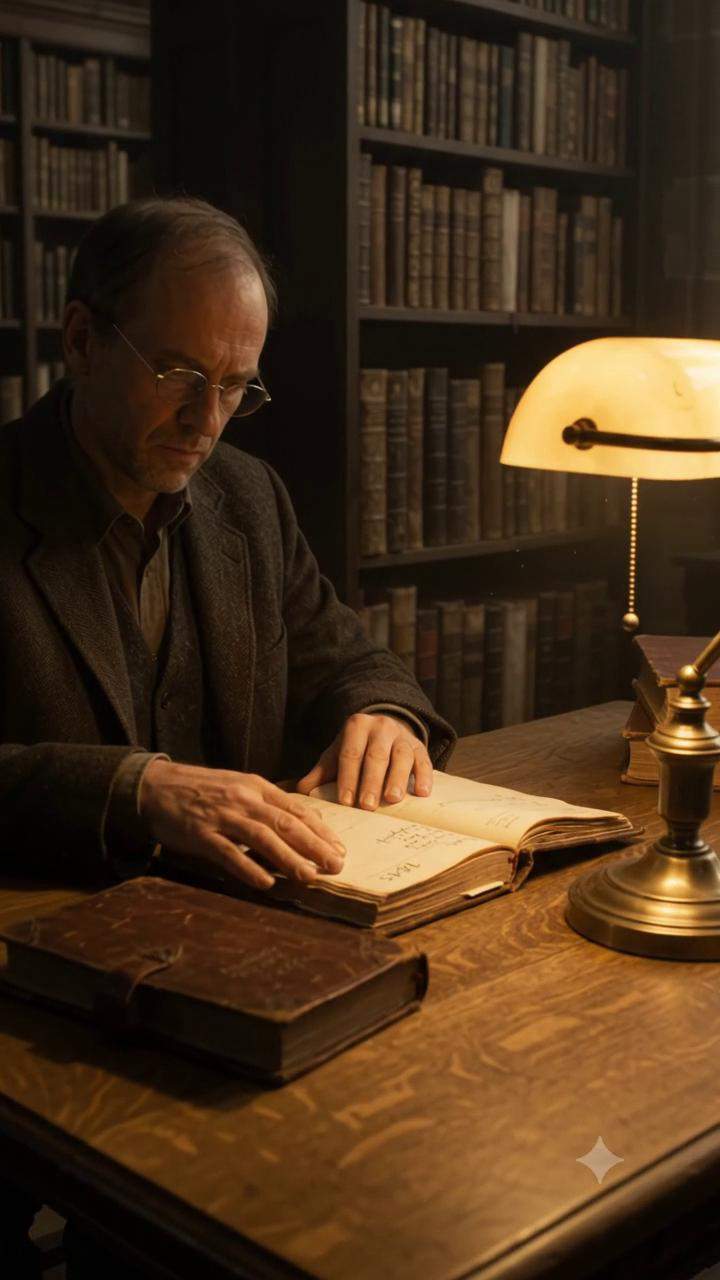
His breath hitched as he flipped to the very last page, expecting a final, mournful entry about the plague's retreat. Instead, he found a meticulous drawing of the celestial map for the current year: 2026. And beneath it, a chillingly precise notation of tomorrow’s date.
His gaze dropped further. There, inscribed in the same elegant, ancient hand that chronicled the entire catastrophe, was a name. His own name. Aris Thorne.
His heart slammed against his ribs, a frantic bird trapped in a cage. This wasn't a historical document foretelling his own demise. His name wasn't listed among the afflicted, the victims, or even the observers. It was positioned below a diagram, a final component in a complex equation, a keystone.
The Unwilling Key
The diary didn't foretell his death; it foretold his role. A horrifying, undeniable truth began to crystallize in his mind: the 'Sleeping Sickness' wasn't a natural plague. It was a meticulously orchestrated event, a mechanism for societal control, designed and executed by "The Keepers of the Ember," a clandestine organization that had likely woven itself into the very fabric of Veridia's ancient institutions, perhaps even this university itself.
And he, Aris Thorne, was not just a historian uncovering a conspiracy. He was the next designated "Custodian," the unwilling key to reactivating the dreaded cycle tomorrow. His lifetime of searching, of trying to redeem his family's name, had unknowingly led him directly into the heart of a generations-old trap.
As this terrifying revelation washed over him, a deep, metallic CLANG echoed through the vast silence of the library. The heavy oak entrance doors, centuries old and reinforced with iron, slammed shut with an automatic, resonant finality. The sound reverberated through the very stones of the building, shaking the ancient shelves.
The Wailing Outside
A moment later, a distant, mournful wail pierced the winter night. Then another, closer. Sirens. Not just one or two, but a symphony of them, growing louder, converging on the university. Was this the city's reaction to the impending crisis? Or was it part of the activation sequence, the containment of the very ritual he had unwittingly initiated?
Aris gripped the diary, his knuckles white, his mind reeling. His entire existence, every painstaking hour of research, every family myth he had debunked, had been a carefully orchestrated path, laid out by "The Keepers" across generations. His family’s alleged "dark practices" were not folklore, but a veiled truth, twisted and maligned to keep their bloodline in the shadows, yet paradoxically, to preserve their crucial genetic link to the ritual.
His ancestor, the one accused of starting the 1845 plague, wasn't a villain but likely a pawn, or perhaps a rebel who failed to stop the cycle. Aris himself had been lured into this library, into this very moment, by the irresistible pull of his legacy, his desire to prove an ancestral innocence that was, in fact, an inherited responsibility of devastating proportions.
A Legacy of Control
The diary detailed the horrifying true nature of the 'Sleeping Sickness.' It wasn't a pathogen that attacked the body directly. It was a subtle, insidious mental affliction, a deep apathy that seeped into the collective consciousness, dulling ambition, suppressing dissent, and rendering the populace compliant. It was a tool of control, a silent purge, designed to prune society and maintain the hidden power of "The Keepers."
The diary’s final entries provided precise instructions for the "Custodian" – Aris – to activate the next phase. It described specific astronomical alignments, specific ritual locations within the city, and even cryptic formulas that spoke of mental frequencies and dormant biological markers within the populace. The date tomorrow, December 21st, 2026, coincided with a rare planetary conjunction, marking the optimal window for the 'sickness' to take root once more.
He looked around the vast, silent hall, filled with the collective knowledge of centuries. It was not a sanctuary but a gilded cage. He was trapped, not just physically, but morally. He held the key to a horrific societal reset, a nightmare of apathy and silent subjugation.
The Keeper's Game
The diary implied that "The Keepers" believed their actions were for the greater good, a necessary pruning of humanity to prevent chaos or to maintain a delicate balance of power. They were the self-appointed shepherds of society, and the Thorne family, with their unique ancestral link, were the chosen instruments.
His blood pulsed with a desperate energy. He had always believed in free will, in the power of truth to set people free. Now, he was facing the ultimate suppression of both. The sirens outside grew louder, a cacophony of emergency vehicles now unmistakably surrounding the university. They weren't coming for the plague victims; they were coming for him, or perhaps, they were the first signs of the 'sickness' already taking hold in the city's infrastructure, responding to its pre-programmed activation.
He wasn't merely a historian; he was a descendant, a pawn, and now, potentially, the unwitting orchestrator of a silent apocalypse. The candle on his table flickered, casting a dancing shadow that made the words on the diary page seem to writhe. He had spent his life searching for answers, and in finding them, he had become part of a question far more terrifying than any he had ever imagined. The cold weight of that leather-bound book in his hands felt like a death sentence, not for him alone, but for the soul of the city outside.