The Day the Colors Lied
The air vibrated with an electric current of joy, a symphony of laughter and music that echoed through the narrow, ancient streets of Vrindavan.
Holi, the festival of colors, was in full, glorious swing, a breathtaking spectacle of communal delight.
Lena, her face already a vibrant canvas of fuchsia and sapphire, moved through the throng with an almost reverent energy.
As a third-generation volunteer for the sacred festival, she felt the weight of tradition and the lightness of pure celebration equally.
Her family had for decades helped organize the grand 'Rang Leela,' the central color play that drew thousands.
This year, a new, highly anticipated organic dye supplier, 'PranaPrakriti,' had promised the most brilliant, environmentally friendly pigments yet.
The initial explosion of colors was everything they had hoped for – a blinding, intoxicating blizzard of pinks, yellows, greens, and blues.
Then, it began.
Not with a bang, but with a silent, eerie whisper.
A circular patch, perhaps twenty feet in diameter, in the very heart of the main street, started to lose its brilliance.
It wasn't merely fading; the colors were actively, unnaturally receding, leaving behind a stark, bleached-out grey.
The sudden absence of color was like a black hole sucking the joy from the atmosphere.
Lena, her heart quickening, pushed through the momentarily stunned crowd, a knot of unease tightening in her stomach.
“What in the world is happening?” she murmured, her voice barely a whisper, yet it felt deafening in the creeping silence.
She instinctively clutched a packet of the PranaPrakriti pink gulal, its vividness now seeming almost aggressive against the desaturated zone.
With a surge of defiant hope, she hurled the handful of brilliant powder into the colorless expanse.
For a split second, it hung in the air, a beautiful, impossible burst of defiant pink.
Then, as if caught in an invisible current, the powder shimmered, twisted, and dissolved into a fine, greyish mist, vanishing before it could even touch the ground.
A collective gasp, primal and raw, rippled through the stunned onlookers.
The joyous cacophony of moments ago had been replaced by an unsettling, almost reverent hush.
A subtle, dark ripple, like an oil slick on water, began to spread outward from the colorless zone.
It wasn't supernatural; it moved with a chilling, chemical precision, slowly neutralizing every hue it touched.
Faces that had been smeared with joyous red now seemed to wear masks of ashen grey.
The vibrant banners above sagged, their colors leached into pallid ghosts of themselves.
Lena felt a cold dread seep into her bones, a feeling far deeper than mere disappointment.
This wasn't just a prank; it was an act of desecration, an attack on the very spirit of Holi.
Her gaze fell upon her own white volunteer sleeve.
Amidst the creeping greyness, one tiny, stubbornly vibrant spot of electric pink remained, a perfect circle of defiant color.
Advertisement
It was from the small, personal pouch of homemade pigment her grandmother had given her, a secret blend passed down through generations.
She reached out, her finger trembling slightly as she touched the resilient pigment.
At that precise moment, a deep, resonant vibration pulsed through the cobbled street, a low, guttural hum that seemed to originate from beneath the earth itself.
It wasn't a spiritual tremor; it sounded like distant machinery, like a powerful system coming to life.
A voice, calm and laced with an unnerving conviction, cut through the terrified whispers of the crowd.
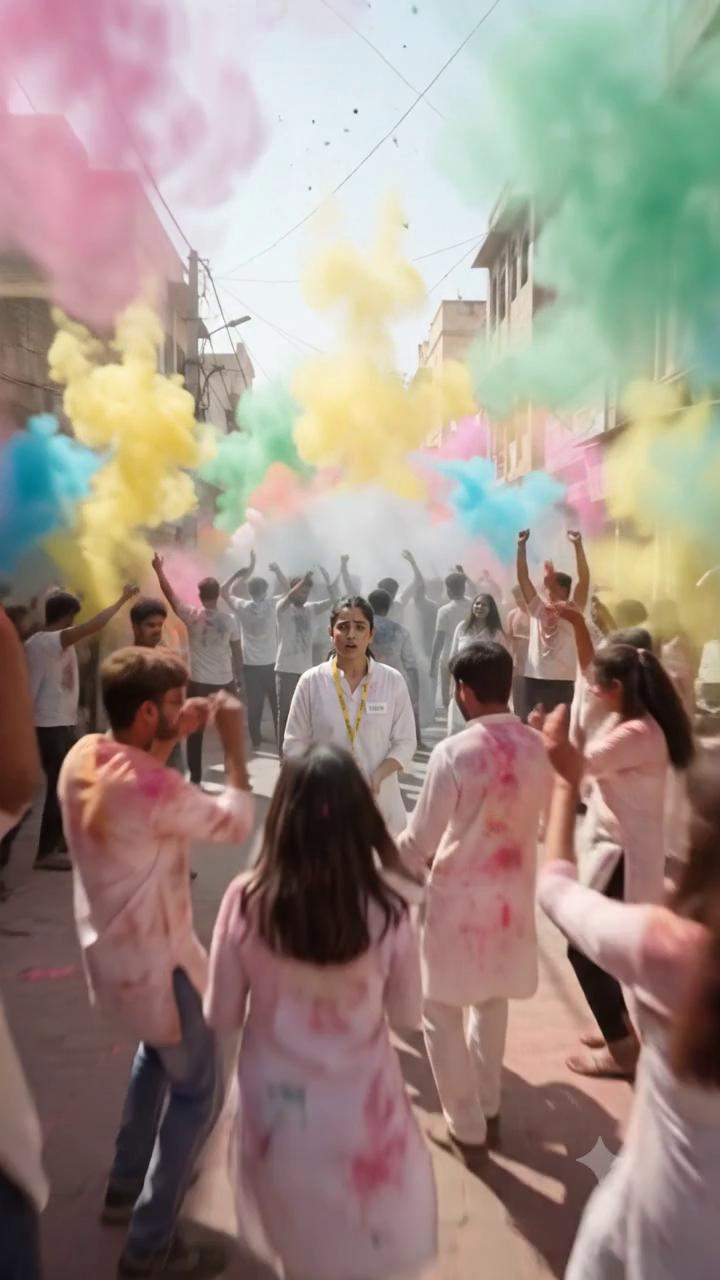
“The truth cannot be contained by illusion,” it announced, amplified by some unseen device.
Lena’s head snapped up, her eyes scanning the sea of desaturated faces.
And then she saw him.
Standing perfectly still in the epicenter of the fading colors, pristine and untouched by any pigment, was a man in simple white clothes.
He was unfamiliar, yet his gaze held a chilling intensity that seemed to pierce directly into her.
He wore a knowing, almost pitying smile, as if he possessed a secret that the entire jubilant crowd was oblivious to.
MAN: “Because the real color was never yours to trust.”
As he spoke, his eyes briefly flickered to the pink spot on Lena's sleeve, a subtle acknowledgment.
Then, with an almost imperceptible shiver, the tiny, defiant mark on Lena's sleeve, her grandmother's precious pigment, dissolved into nothingness, leaving behind only the stark white fabric.
It was as if the pervasive influence of whatever was dissolving the other colors had finally consumed even this last bastion of purity.
The festival, the heart of their community's joy, had been attacked, its very essence stripped away.
But this was no random act of vandalism.
This was a calculated, devastating exposure.
The man in white, Lena would later learn, was Rohan, a disgraced environmental chemist who had been relentlessly warning about the synthetic and harmful additives hidden within many commercially sold Holi dyes.
He claimed that 'PranaPrakriti,' the very supplier lauded for its 'organic' colors, was secretly using a cheap, highly toxic chemical filler to enhance vibrancy and volume.
His methods were extreme, an act of public destruction, but his message was undeniably clear.
He had developed a specialized, highly reactive agent that targeted and neutralized this specific toxic compound, causing the colors to dissolve instantly.
The vibrating hum Lena felt was a network of hidden diffusers Rohan had meticulously placed under the streets, activated to release his neutralizing agent.
His motivation wasn't malice against the festival itself, but a desperate, radical attempt to force people to confront an uncomfortable truth.
He had approached authorities, presented his findings, even tried to speak directly to the festival committee, including Lena's own family.
Each time, he had been dismissed, his warnings brushed aside as the ravings of a disgruntled scientist threatening a lucrative supply chain.
The festival committee, under pressure from powerful corporate interests, had repeatedly vouched for PranaPrakriti's purity, citing falsified certificates.
Lena's own grandfather, a respected elder on the committee, had been fiercely protective of the supplier, convinced of their integrity.
Rohan's act was a desperate plea for recognition, a theatrical expose designed to leave no room for denial.
The 'last color' on Lena's sleeve, her grandmother's handmade pigment, had been immune to Rohan's agent because it contained none of the toxic additives.
Its eventual disappearance was not caused by his agent directly but by the sheer chemical saturation of the air, a symbolic final surrender to the pervasive pollution he was fighting against.
Lena felt a sickening lurch in her gut.
The joyous tradition she had dedicated her life to was built, in part, on a dangerous lie.
Her family, pillars of the community, had unknowingly, or perhaps knowingly, become complicit in this deception.
The once vibrant street was now a muted testament to a shattered illusion.
Children looked up at their parents with confused, fearful eyes, their hands still clutched around packets of now-grey dust.
The music had died completely, replaced by a low murmur of disbelief and betrayal.
Rohan, his mission accomplished, stood defiant, his white clothes a stark symbol of his perceived moral purity against the 'dirty' truth he had revealed.
He wasn't a supernatural entity; he was a disillusioned idealist, driven to extreme measures by a deep-seated desire for justice and environmental safety.
The conflict wasn't magical darkness versus light; it was an ethical battle, a devastating clash between cherished tradition and uncomfortable truth, between corporate greed and public safety.
Advertisement
Lena realized that Rohan hadn't stolen their color; he had merely exposed its dangerous camouflage.
The true darkness wasn't the vanishing pigments, but the deception that had allowed them to thrive for so long.
The celebration was ruined, but in its ashes, a new, starker truth had emerged.
The vibrant spectacle of Holi had given way to a chilling revelation.
The question now wasn't just about restoring the colors, but about rebuilding trust.
What would the community choose?
To cling to a beautiful lie or embrace a painful, yet necessary, truth?
The silence that fell over Vrindavan was heavier than any color.
It was the silence of a community grappling with the profound betrayal of its most cherished ritual.
The Aftermath: A Community Divided
The immediate chaos after Rohan's dramatic revelation was immense.
Panic and confusion quickly gave way to anger and fear.
Festival-goers, initially bewildered, now understood the terrifying implication of what had occurred.
They had been playing with colors that were potentially harmful, exposing their children to toxic chemicals.
The joyous atmosphere had curdled into a palpable sense of betrayal.
Lena found herself caught in the eye of the storm, torn between her loyalty to her family and the searing truth Rohan had exposed.
Her grandfather, when confronted by the furious crowd, had initially tried to deny everything, clinging to the narrative of sabotage.
But the sheer visual evidence, coupled with Rohan's meticulously prepared evidence packets he had distributed in the chaos, was overwhelming.
The 'PranaPrakriti' brand was instantly vilified.
Investigations quickly followed, uncovering a web of corruption and falsified documents confirming Rohan's claims.
The beautiful, vibrant colors had indeed been laced with dangerous heavy metals and industrial dyes, cheaper alternatives that boosted profits at the expense of public health.
The festival committee, including Lena's grandfather, faced severe legal and social repercussions.
Lena felt a profound sadness, watching her beloved tradition crumble, but also a fierce sense of resolve.
Rohan, despite his destructive methods, was hailed by many as a whistleblower, a radical hero who had exposed a grave injustice.
Others condemned his actions, arguing that he had irreparably damaged a cultural institution, causing panic and distrust where diplomacy could have prevailed.
The Holi festival of Vrindavan was canceled that year, a somber first in its long history.
Its future hung precariously in the balance.
Lena knew that the colors could be restored, new, truly organic dyes sourced.
But the innocence, the pure, unburdened joy that once defined their celebration, that was far harder to reclaim.
The incident sparked a nationwide debate about traditional festivals, corporate ethics, and the responsibility of organizers.
It was a stark reminder that sometimes, the most dangerous darkness hides not in shadows, but in the most brilliant, deceptive light.
The vibrant celebration had become a stark symbol of how easily beauty could mask peril.
Lena, forever changed by that day, vowed to ensure that the next Holi, whenever it might be, would be a celebration rooted in absolute truth and unwavering integrity, no matter how painful that journey might be.
The color that defeated the darkness wasn't a pigment; it was the stark, unvarnished truth.