The air in the Grand Ballroom was thick with anticipation and the scent of expensive perfume, a symphony of hushed conversations and clinking glasses.
I adjusted my silk scarf, feeling a thrill of journalistic pride as I surveyed the glittering crowd.
Tonight was Arthur Sterling’s night, the culmination of decades of tireless work, a testament to what a man could achieve through sheer will and profound generosity.
I was Eleanor Vance, a reporter for "The City Watch," and I was here to write the glowing feature piece everyone expected, a tribute to our city’s beloved humanitarian.
Arthur Sterling, a man often called "The City’s Conscience," was receiving the "Humanitarian of the Year" award.
His Sterling Foundations had built hospitals, funded schools, and pioneered medical research that saved countless lives.
He was, to me and so many others, an unimpeachable figure, a beacon of hope in a cynical world.
I had even interned briefly for his PR firm years ago, fresh out of journalism school, mesmerized by his charisma and vision.
He had always treated me with a paternal warmth, inviting me to these lavish events, subtly encouraging my career, perhaps hoping for favorable coverage.
I remembered once, during a contentious business deal years ago, overhearing a rival mumble something about Sterling’s "unconventional beginnings" and "a past best left buried," but I had dismissed it as bitter jealousy.
Arthur had always been so polished, so reassuringly upright.
Now, as the ceremony began, I saw him standing backstage, exchanging warm smiles with dignitaries, a picture of grace and quiet power in his perfectly tailored tuxedo.
The lights dimmed, spotlights hit the stage, and the evening’s host introduced Arthur with a flourish.
The applause was thunderous, an outpouring of genuine affection and respect.
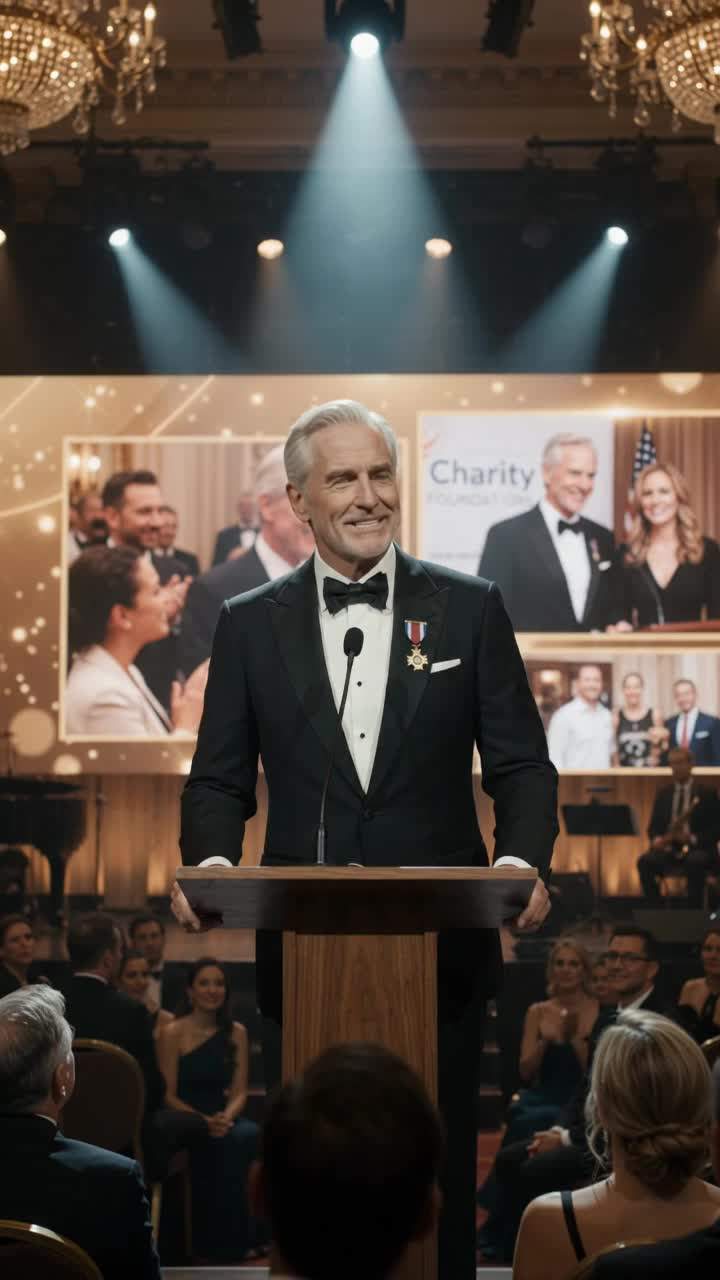
Arthur walked to the podium, his posture regal, his silver hair catching the light, and took the microphone.
His eyes swept over the audience, a gentle, knowing smile playing on his lips, radiating confidence.
"Tonight," he began, his voice a rich baritone that filled the immense hall, "we celebrate not just success, but the shared spirit of generosity that builds a better world."
I felt a swell of inspiration, already formulating my opening paragraphs in my mind, words of praise for his integrity and vision.
"Every life touched," he continued, his gaze unwavering, "every dream realized, is a testament to what we can achieve, together."
He paused, a master of timing, letting his words resonate.
It was in that moment, as his triumphant smile reached its peak, that a flicker caught my eye on the massive LED screen behind him.
The beautiful, serene Sterling Foundations logo, usually a symbol of hope, suddenly glitched.
A sharp, violent static filled the screen, an ear-splitting electronic shriek that drowned out the soft background music.
Arthur’s smile faltered, a tiny crease forming between his brows, a flicker of confusion in his eyes.
The static continued for what felt like an eternity, then abruptly snapped, replaced by grainy, timestamped surveillance footage.
My breath hitched.
The image was undeniably a casino, dimly lit, a high-stakes poker table at its center.
And then, the figure in the footage became clear: a younger Arthur Sterling, his face sharper, leaner, his eyes glinting with a cold, calculating intensity I had never seen.
The video showed him, with chilling precision, subtly palming a card from his sleeve, replacing it with another, all under the guise of casual play.
Advertisement
His movements were practiced, almost artistic in their deception, a silent ballet of fraud.
The room, moments ago filled with warmth and applause, was now plunged into an eerie silence, broken only by the faint, muffled sounds of chips clinking and cards shuffling from the screen, amplified into the stunned silence.
On stage, Arthur was frozen, a statue of horror.
His jaw had gone slack, his eyes wide and vacant, fixed on the screen where his younger self systematically cheated.
The color drained from his face, leaving his skin ashen, and a sheen of sweat instantly appeared on his forehead.
His hand, still clutching the microphone, began to tremble violently, a tremor that spread through his entire frame.
"No… not possible…" he croaked, a raw, strangled whisper that barely reached my ears, yet resonated with abject terror.
A collective gasp rippled through the audience, quickly followed by a cacophony of shocked murmurs and disbelieving whispers.
My own heart pounded against my ribs, a sickening lurch in my stomach as if I had been physically struck.
My hero.
My mentor.
The City’s Conscience.
I scanned the rows of faces, seeing similar expressions of betrayal and outrage, a few prominent socialites openly gasping, some pointing accusatorily at the screen.
Then, my eyes landed on Marcus Thorne, an old business rival of Arthur’s, who sat discreetly near the back.
His face was a mask of cold satisfaction, a faint, almost imperceptible smirk playing on his lips as he met Arthur’s horrified gaze for a fleeting second.
He had waited for this.
With a heavy thud, the microphone slipped from Arthur’s numb fingers, clattering against the podium.
He swayed precariously, gripping the edges of the stand as if to prevent himself from collapsing, his eyes still fixed on the looping footage of his past transgressions.
The elegance of the evening shattered, the room erupted into a deafening roar of angry shouts, accusations, and the incessant clicking of reporters' cameras.
Arthur Sterling’s world, and by extension, my perception of it, had just disintegrated.
The immediate aftermath was chaos.
Arthur was quickly, almost violently, escorted off stage by his security detail, his head bowed, not meeting anyone’s eyes.
The gala dissolved into a frenzy, with reporters swarming, demanding answers, and guests evacuating, their faces etched with disgust.
My editor, a hardened veteran, called me the moment the news broke, not for the glowing profile, but for "The Unmasking of Sterling."
My journalistic instincts, dulled by admiration, were now fully awake, pulsating with a fierce need for the truth.
The man I had idolized, whose foundations I had genuinely believed in, was a fraud.
That single video was not just an exposé of a past misdeed; it was a crack in the carefully constructed facade of an entire empire.
I started digging, relentlessly, following every lead, every whisper I had once dismissed.
Marcus Thorne, the man in the audience, became my first target.
He was notoriously reclusive, but years of patient investigative work finally paid off.
I learned that Marcus had been Arthur’s partner in a series of cutthroat business ventures decades ago, before Sterling Foundations even existed.
Their partnership dissolved acrimoniously, with Arthur allegedly using his ill-gotten gains from high-stakes, rigged gambling, as seed money to push Marcus out of their shared enterprise, effectively ruining him.
Marcus had meticulously pieced together the evidence, not just of the casino cheating, but of how Arthur leveraged those early, tainted funds to build his initial fortune, which then, ironically, became the bedrock of his "philanthropic" endeavors.
The casino footage was merely the most visually damning piece, carefully saved and timed for maximum public impact.
It wasn't just about a past mistake; it was about the very foundation of his character, rotten from the start.
Arthur’s publicists initially tried to spin it as a youthful indiscretion, a moment of weakness, but the sheer coldness in the younger Arthur’s eyes on screen betrayed that narrative.
His apologies were hollow, devoid of true remorse, more about damage control than genuine regret.
The investigations into Sterling Foundations began.
While many of the projects were genuinely beneficial, the source of the initial colossal wealth that funded them was now under intense scrutiny.
Donors began to withdraw their support, terrified of being associated with the scandal.
Advertisement
The charity, once a symbol of integrity, was now tainted, facing an uncertain future, its good work overshadowed by its founder's deceit.
Arthur Sterling, once untouchable, faced a cascade of lawsuits, criminal fraud charges, and the ultimate public humiliation.
His empire crumbled, piece by agonizing piece.
I wrote the exposé, a painful but necessary truth, detailing not just the casino incident but the darker, more complex story of how a man’s ambition, fueled by early deception, could build a seemingly benevolent empire on a shaky moral ground.
It was a story that shook the city, forcing us to re-evaluate our heroes, our institutions, and the fine line between ambition and avarice.
My faith in simple heroes had been irrevocably shattered that night.
But in its place, a deeper, more profound understanding of the complex, often contradictory nature of humanity had begun to form.
And for me, as a journalist, the pursuit of that uncomfortable, unsettling truth became my new, unwavering purpose.