My name is Eleanor, and for nearly forty years, I was more than just a housekeeper to Arthur Sterling; I was his confidante, his silent observer, and, in many ways, the keeper of his most profound sorrows. Arthur was a titan of industry, a man whose name commanded respect and fear in equal measure, yet beneath the polished exterior lay a cavernous well of loneliness and regret. I saw it in the way he stared out of his study window at dusk, a half-empty glass of amber liquid in his hand, his eyes distant, haunted by ghosts I could only dimly perceive.
He was a man of immense wealth, built from nothing, but he lived a life largely devoid of genuine warmth, especially from his surviving family. His sister, Caroline, and her son, Richard, were vultures, circling his fortune with thinly veiled greed, their visits always preceded by a request for funds or an appeal for a position in one of his many companies. They saw Arthur not as a brother or uncle, but as a vault, and me, his loyal assistant, as nothing more than a glorified servant who stood inconveniently close to the treasure.
Arthur rarely spoke of his youth, his early life before the money, before the empire. He kept a small, tarnished silver locket on his bedside table, always closed, and a single, faded photograph tucked inside an old leather-bound journal. Sometimes, I would catch him tracing the edges of that photo, a profound sadness etched on his face, a silent lament. I sensed a lost love, a deep sorrow he carried, but he never offered details, and I never pressed. My role was to serve, not to pry, though my intuition, honed over decades, told me a significant piece of his past was missing, or perhaps intentionally buried.
He often spoke cryptically in his later years, musing about what truly constituted a legacy, lamenting the absence of genuine connection, and once, when he was particularly frail, he whispered, "I tried, Eleanor. God knows, I tried." I understood then that whatever secret he held, it involved an active, painful search, a yearning for something—or someone—he couldn't find. He became increasingly meticulous about his will, often spending hours with Mr. Davies, his lawyer, poring over documents in hushed tones behind closed doors, a process that made Caroline and Richard twitch with thinly disguised impatience.
When Arthur finally passed, quietly in his sleep, I was the one by his side, just as I had been for most of his adult life. His last breath was a gentle sigh, and I imagined it was a release from the burden he had carried for so long. His final mumbled words, almost inaudible, sounded like "my boy," and a chill ran down my spine. I knew, with a certainty that settled deep in my bones, that his life's great secret was about to finally be revealed.
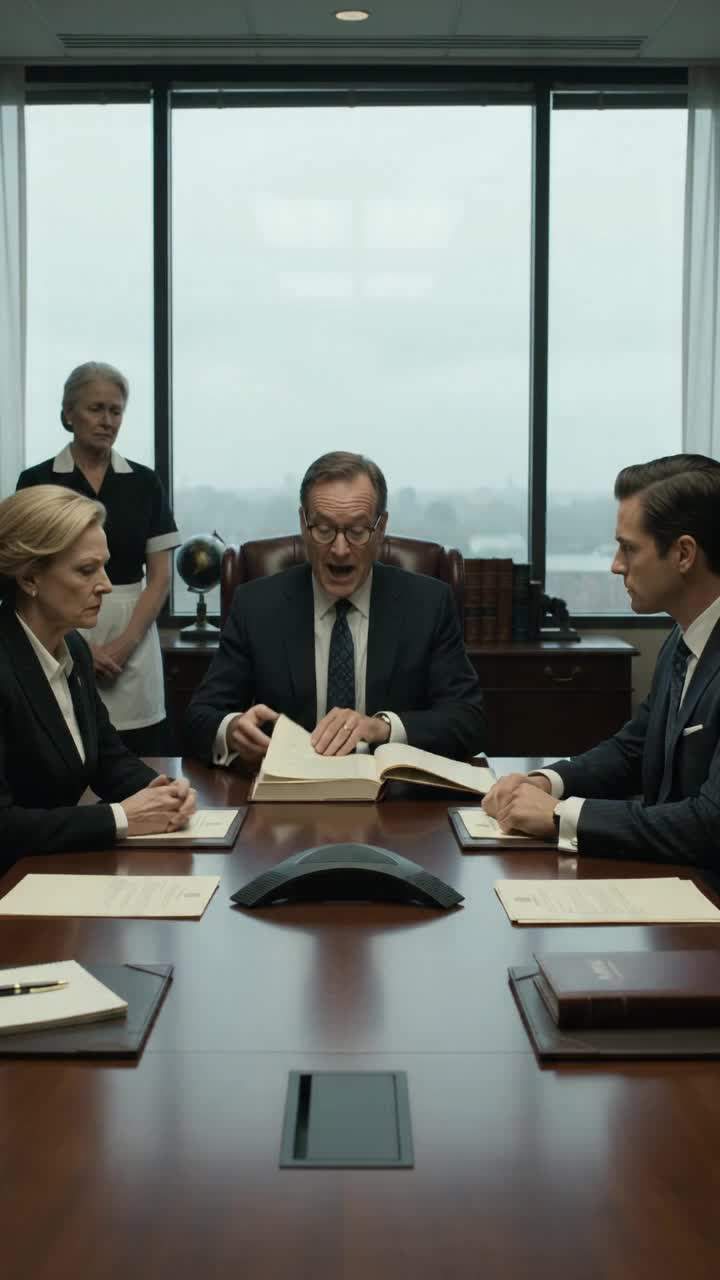
The day of the will reading was precisely as I had predicted: a tense assembly of his estranged family in Mr. Davies’ opulent conference room. The atmosphere was thick with a mixture of solemnity and barely contained anticipation. Caroline, in her sharp black suit, sat with her back ramrod straight, her eyes darting to the heavy oak doors, ensuring no unwelcome guests. Richard, ever the arrogant one, was already fidgeting, his expensive watch catching the dull light. Mr. Davies, an unreadable man with an air of discreet power, sat at the head of the polished mahogany table, a thick sheaf of documents before him. I stood discreetly in a corner, as always, an invisible presence, yet seeing everything.
Mr. Davies cleared his throat, his voice resonating through the silent room. "As per the last will and testament of Arthur Sterling, I shall now proceed to read its contents." Caroline adjusted her spectacles, a smug little smile playing on her lips, and Richard leaned forward, a predatory glint in his eyes. Just as Mr. Davies began to articulate Arthur’s initial provisions, the heavy double doors of the conference room burst open with a jarring crash that made everyone jump.
A young man, perhaps in his late twenties, stood framed in the doorway. He was dressed plainly, a worn jacket, faded jeans, his hair a little dishevelled, but his eyes held an unnerving intensity, a fierce determination. He was breathless, as if he had run a great distance, yet his gaze was unwavering as he swept across the stunned faces in the room, finally locking onto Mr. Davies. "Stop!" he declared, his voice cutting through the stunned silence. "This cannot proceed!"
Caroline gasped, clutching her chest, her face contorting into an expression of indignant fury. "Who are you? How dare you interrupt this sacred moment!" she shrieked, pointing a trembling finger at the intruder. Richard, ever her eager accomplice, sprang to his feet, his face flushed. "This is outrageous! Call security, Mr. Davies! This man is an imposter!"
But I knew, instantly, deep in my heart, that he was no imposter. The moment my eyes fell on him, I saw it: the subtle curve of his jaw, the shape of his nose, the particular intensity in his eyes—all echoes of a younger Arthur Sterling. My gaze drifted to the locket I knew so well, to the faded photograph that contained the image of a woman, a man, and a baby. This young man standing before us was that baby, grown. The ghost of Arthur’s past had finally materialized.
The young man, ignoring the frantic protests of Caroline and Richard, strode purposefully toward the table. With a defiant flourish, he slammed a yellowed birth certificate and a creased, old photograph onto the polished wood, the sharp thud echoing loudly in the suddenly silent room. The photograph, I instantly recognized, was one of the few Arthur had kept, showing him, youthful and beaming, cradling an infant. "My name is Leo Sterling," he announced, his voice ringing with authority that belied his unpretentious appearance. "Arthur Sterling was my father."
A collective gasp swept through the room. Caroline’s face went from purple rage to a sickly shade of white, and Richard sank back into his chair, utterly deflated, his mouth agape. Mr. Davies, recovering from his initial shock, picked up the documents, his eyes scanning the birth certificate, then the photograph, then the young man’s face. He looked at me, a silent confirmation passing between us. He knew. Arthur had prepared for this.
Leo looked directly at Caroline and Richard, his eyes piercing through their shattered illusions. "And I am his only rightful heir." The words hung in the air, a definitive sentence, a complete reversal of their carefully constructed expectations. The ensuing chaos was immediate and visceral, a cacophony of outraged cries, accusations of fraud, and threats of legal action. But Leo stood his ground, unyielding, a quiet storm of truth in the midst of their self-serving tempest.
Mr. Davies finally raised a hand, his voice firm, cutting through the din. "If you would all please calm down. Mr. Sterling anticipated this eventuality." He pulled a sealed envelope from within the will itself, marked "To be opened only upon the arrival and proven identity of my son." He broke the seal, and from within, he withdrew not only another copy of the birth certificate and the matching faded photograph, but also a detailed letter, written in Arthur’s own hand.
In that letter, Arthur finally confessed the truth he had carried for decades. He had fallen deeply in love with a young woman named Maria in his impoverished youth, before he made his fortune. They had a son, Leo. But circumstances, poverty, and a desperate search for work had separated them. He had returned to find Maria tragically gone, and Leo, a mere infant, placed in the care of relatives who had subsequently moved and vanished without a trace, taking their grief and the child with them. For years, Arthur had searched tirelessly, pouring his nascent wealth into private investigators, chasing every lead, but to no avail. He built his empire not just for success, but with the fervent hope of one day finding his lost son and having something grand to give him.
He had finally found Leo a few years ago, not through his own efforts, but through a chance encounter that revealed Leo’s true parentage to Arthur's last remaining private detective. However, Arthur, weakened by age and illness, and acutely aware of his family’s predatory nature, chose to keep Leo's existence a secret while he was alive. He feared their greed would corrupt Leo, or that they would try to harm him. Instead, he meticulously updated his will, ensuring every legal loophole was sealed, explicitly naming Leo as his sole primary beneficiary, with instructions to Mr. Davies to contact Leo immediately after his death and guide him through the process. He had wanted Leo to understand his origins on his own terms, without the immediate pressure of an estranged, grasping family.
The letter ended with a heartbreaking plea to Leo for forgiveness, expressing a lifetime of love and regret, and a profound hope for his son's future. As Mr. Davies finished reading, the room fell into a silence far more profound than before. Caroline and Richard were utterly defeated, their faces pale, their dreams of inheritance shattered. Their bluster had evaporated, replaced by a grim realization of their insignificance in Arthur’s true legacy.
Leo, after hearing his father's words, stood quietly, tears streaming down his face, not of triumph, but of profound sorrow and a complex mix of anger and understanding. He wasn't just claiming an inheritance; he was claiming a father he never knew, a history that had been denied him. He looked at me then, his eyes finding mine, and in that gaze, I saw a flicker of gratitude, a recognition of a shared grief for the man who had shaped both our lives, albeit in very different ways.
The legal battles that followed were fierce but ultimately futile for Caroline and Richard. Arthur’s will was ironclad, Leo’s identity irrefutable. Leo inherited everything: the mansion, the companies, the vast fortune. He wasn't the greedy opportunist Caroline had accused him of being; he was a young man seeking identity and a connection to a father he had mourned in absentia. He visited Arthur’s grave, often alone, sometimes with me by his side, silently coming to terms with the man who had left him a kingdom and a lifetime of unanswered questions.
I stayed on, of course, no longer just a housekeeper, but a bridge to the past for Leo. I helped him navigate the labyrinthine world of Arthur’s affairs, but more importantly, I shared stories of his father, the good and the bad, painting a picture of the complex man Arthur Sterling truly was. I saw a quiet peace settle over Leo as he began to understand his father’s immense pain and his lifelong quest. For me, witnessing Arthur’s greatest regret finally find its resolution brought a quiet solace. The secrets were out, the truth was revealed, and a long-lost son had finally found his way home, bringing a measure of peace to the restless spirit of Arthur Sterling. My old boss, I believe, could finally rest.