The city of Chicago has a way of turning people into ghosts before they are even dead.
I sat in my usual corner at the corner cafe, watching the gray slush of winter melt into the grimy gutters of 5th Avenue.
Outside the window, the world moved in a frantic, unfeeling blur of expensive overcoats and designer leather bags.
Elias was the only stationary thing in that sea of motion.
He was a blind man in his late sixties, sitting on a milk crate with a battered tin box between his feet.
He didn't beg with words; he simply sat there with a sign that read, God sees what we choose to ignore.
Most people chose to ignore everything.
They stepped over his cane as if it were a fallen branch and looked through him as if he were made of glass.
I often wondered what Elias heard in the rhythm of the city, whether he could smell the rain before it hit the hot pavement or hear the desperation in the footsteps around him.
Then there was the other ghost, a man we all called Ben, though nobody knew if that was his real name.
Ben lived in the shadows of the alleyway next to the bank, a skeletal figure wrapped in layers of mismatched flannel and a moth-eaten trench coat.
He was the kind of man people crossed the street to avoid, his face hidden behind a tangled beard and a grime-stained beanie.
I watched him every morning as he watched Elias.
He never spoke to the blind man, but he always seemed to be standing guard, a silent sentinel in the ruins of his own life.
The air that afternoon felt heavy, charged with the kind of tension that precedes a storm.
That was when I saw him, a man who looked like he was built out of granite and malice, weaving through the crowd with a predatory grace.
He wore a heavy leather jacket and had a jagged scar running through his eyebrow that gave him a permanent, mocking sneer.
He stopped in front of Elias, but he wasn't looking for a way to help.
He was looking at the small pile of quarters and crumpled one-dollar bills that had accumulated in the tin box.
The crowd continued to pulse around them, a river of indifference that refused to break its banks.
I saw the man’s hand twitch, his eyes darting around to see if anyone would intervene.
Nobody did.
The businessmen kept their eyes on their phones, and the tourists kept their eyes on the skyscrapers.
With a sudden, violent motion, the man kicked the tin box, sending coins skittering across the wet concrete like panicked silver insects.
Elias gasped, his hands flying out into the void, searching for the anchor of his meager livelihood.
Please, I don't have anything else, Elias cried out, his voice cracking against the roar of the city traffic.
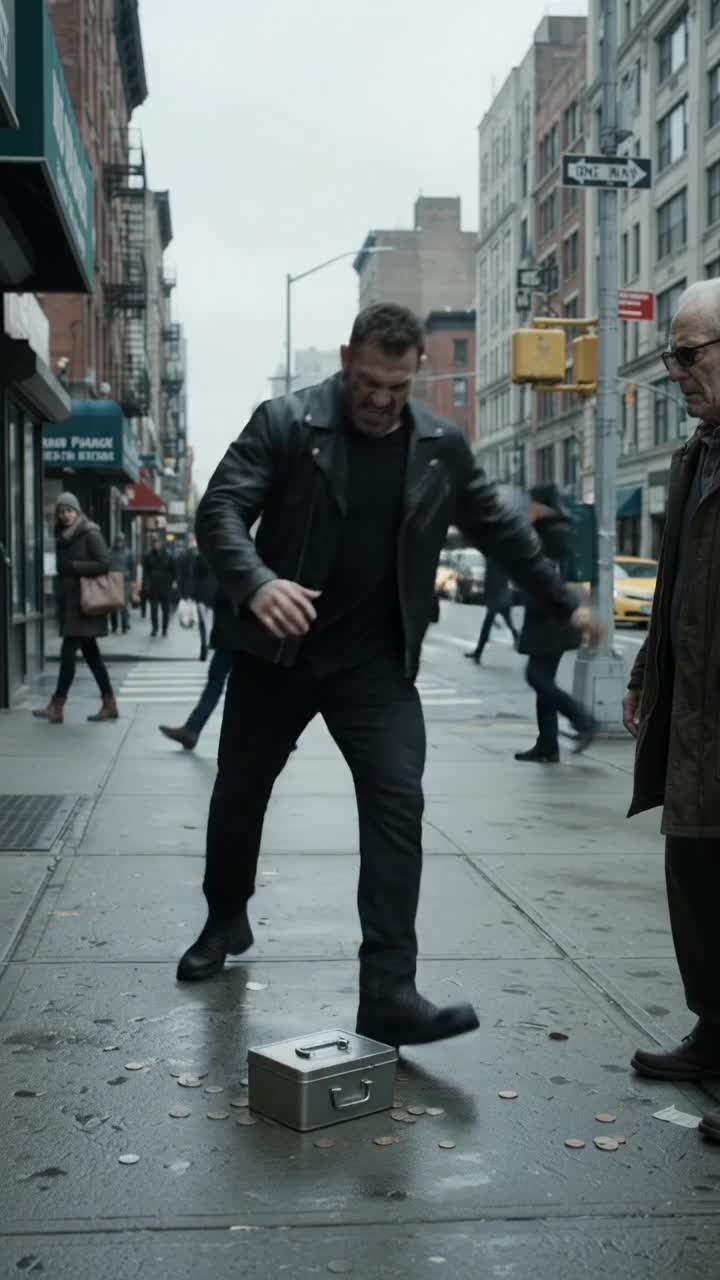
The predator didn't care; he reached down and scooped up the largest wad of bills, his face twisted into a grin of pure, unadulterated cruelty.
I stood up from my table, my heart hammering against my ribs, but my feet felt like they were encased in lead.
I was ashamed of my own fear, ashamed of the way I looked at the glass between us as a shield instead of an obstacle.
Advertisement
Then, the man pulled a folding knife from his pocket, the steel blade clicking into place with a sound that seemed louder than the sirens in the distance.
Back off, old man, or I’ll give you something else to cry about, the thug growled, looming over the trembling Elias.
It was in that moment of peak cowardice from the crowd that the alleyway seemed to spit out a shadow.
Ben, the thin, forgotten homeless man, came charging out of the darkness with a speed that defied his frail appearance.
He wasn't shouting; he was focused, his eyes locked onto the weapon in the thief's hand.
In his grip was a sturdy wooden staff, a piece of discarded oak that he usually used as a walking stick.
The thug didn't even have time to turn before Ben swung the staff with the precision of a seasoned warrior.
The wood connected with the thief's wrist with a sickening crack, and the folding knife went flying into the gutter.
The thief roared in pain, clutching his shattered arm, his bravado evaporating the moment he realized he was no longer the apex predator.
Ben didn't stop there; he stepped into the thief's space, the tip of his staff pressed firmly against the man's throat.
Get out of here before I decide you’ve had enough, Ben said, his voice a low, gravelly rasp that carried the weight of a thousand hard winters.
The thief scrambled backward, tripping over his own feet as he fled into the crowd, leaving a trail of muttered curses behind him.
The street fell into a sudden, eerie silence, as if the city itself had finally decided to hold its breath.
Ben didn't look at the crowd, and he certainly didn't look for applause.
He dropped to his knees in the slush, his hands moving quickly to gather every single coin and bill that had been scattered.
He didn't keep a single cent for himself.
He stood up and walked over to Elias, who was still shaking, his sightless eyes wet with tears of confusion and terror.
Ben took Elias’s hands and placed the tin box firmly back into his lap, closing the old man’s fingers around the cold metal.
It’s all here, every bit of it, Ben whispered, his voice softening into something almost unrecognizable.
Elias reached out, his trembling fingers brushing against the rough fabric of Ben’s sleeve.
Who are you? Elias asked, his voice barely a whisper.
Just someone who remembers what it’s like to be seen, Ben replied.
He turned and walked back toward his alley, his shoulders hunched against the cold, his form slowly dissolving back into the shadows.
I sat back down, my coffee now stone cold, feeling the crushing weight of my own silence.
The crowd began to move again, the river of people resuming its flow as if nothing had happened.
But I saw the way Elias held that box, not as a collection of money, but as a testament that someone in this cold world was still watching.
I realized then that the strongest man on that street wasn't the one with the muscles or the knife.
It was the man who had nothing left to lose except his soul, and he had fought like hell to keep it.
I walked out of the cafe a few minutes later and walked straight to Elias.
I didn't just drop a few coins; I sat down on the cold ground next to him for a moment.
I told him I saw what happened, and I told him he wasn't alone.
He smiled, a fragile, beautiful thing, and told me he already knew.
Because even in the darkest corners of the city, there are ghosts who still have the heart of a lion.
I spent the next hour looking for Ben in the alleyways, wanting to offer him a warm meal or a coat that actually fit.
But he was gone, vanished back into the architecture of the forgotten, leaving behind only the memory of a wooden stick and a moment of justice.
I never saw the thief again, but I saw Elias every day after that.
And every day, I made sure to look him in the eye, even if he couldn't see me doing it.
It was the least I could do to honor the man who had emerged from the shadows to remind us what it means to be human.
The city is still cold, and the people are still busy.
But now, whenever I hear the sound of a cane tapping on the pavement, I look for the shadow in the alley.
Advertisement
I look for the hero that everyone else chooses to ignore.
Because sometimes, the only thing standing between us and the monsters is the person we refuse to see.
I keep a wooden stick in my own hallway now, a reminder of the day I learned that courage doesn't need a uniform.
It only needs a heart that refuses to turn away when the world goes dark.
Elias still sits on his milk crate, and his sign still tells the truth.
God does see what we ignore, but that day, we all saw what a ghost could do.
And I will never forget the sound of that knife hitting the ground.
It was the sound of a city's indifference finally breaking.