The Echoes of Abuela Elena
The air in Abuela Elena’s house was thick with memory and dust.
- 1、The Echoes of Abuela Elena
- 2、The Melody of the Unseen
- 3、A Glimpse into the Past, Distorted
- 4、The Cracks in Memory
- 5、Whispers from the Past
- 6、The Dark Covenant
- 7、The Weight of Remembrance
I had inherited it, along with its curious contents, after her quiet passing last month.
Abuela Elena was a woman of few words, her past shrouded in a silence I never quite understood as a child.
Now, walking through rooms filled with antique furniture and religious iconography, I felt closer to her than ever before, despite the distance she always kept.
Her bedroom, at the far end of the hall, was a sanctuary of shadows and secrets.
Sunlight struggled to penetrate the heavy velvet curtains, casting the room in a permanent twilight.
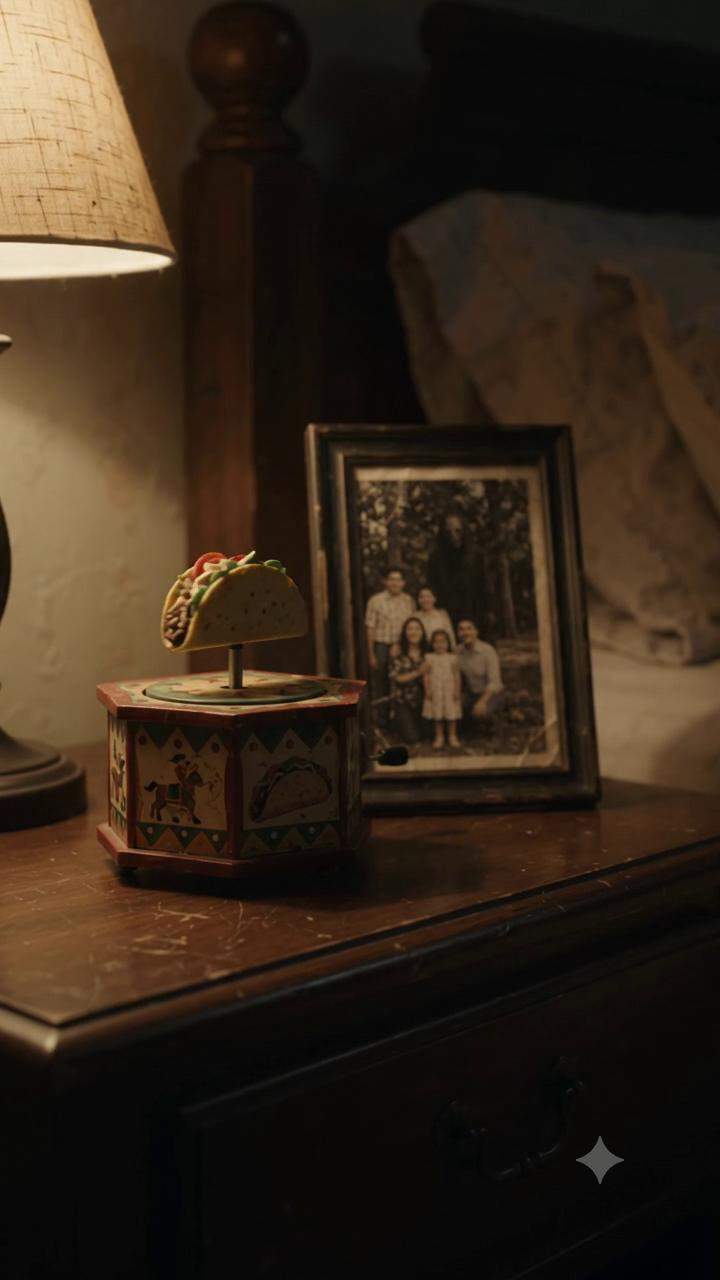
On her intricately carved mahogany bedside table, nestled among rosaries and dried flowers, sat an object that immediately caught my eye.
It was an old music box, unlike anything I’d ever seen.
The Melody of the Unseen
The music box was crafted from dark, aged wood, depicting a vibrant Mexican village scene.
Tiny figures danced, and in the center, on a raised platform, a small, brightly painted alebrije-style taco spun slowly.
Its colors, though faded, hinted at a whimsical past.
I carefully wound the key, a chill running down my spine as the mechanism whirred to life.
An eerie, almost melancholy disco melody filled the quiet room.
It was familiar in a way I couldn’t place, like a fragment of a dream trying to surface.
Next to the music box, tucked beneath a yellowed lace doily, was an oval-framed photograph.
It was a family portrait, a gathering from decades ago, probably taken in the village Abuela often spoke of, but never truly explained.
I picked it up, tracing the faces of distant relatives I barely recognized, searching for a hint of Abuela’s younger self.
The melody from the music box continued its unsettling tune, a strange mix of festive and mournful.
A Glimpse into the Past, Distorted
As I scrutinized the photograph, the music box’s melody began to falter.
It slowed, the notes stretching and distorting, like a cassette tape running out of battery.
My eyes drifted back to the photo, drawn by an inexplicable pull.
A strange sensation pricked at the back of my neck.
There, in the background, half-obscured by a potted palm, was a figure.
A young man, perhaps in his late teens or early twenties, with dark, intense eyes that seemed to pierce through the grainy emulsion.
He wasn’t smiling like the others; his expression was one of quiet, almost resigned sorrow.
He looked strikingly familiar, an unsettling echo of a face I couldn’t quite place in my memory.
The music box gave a final, desperate shudder, the spinning taco grinding to a halt.
Silence.
Advertisement
The sudden absence of sound was more deafening than the eerie melody had been.
My hands trembled, the old photograph threatening to slip from my grasp.
My breath hitched in my throat.
I whispered the words, more to myself than to the empty room, “He wasn’t there before.”
The Cracks in Memory
My first instinct was disbelief, a frantic attempt to rationalize what I had seen.
Had the light shifted?
Was it a trick of my tired eyes, fueled by grief and lack of sleep?
I held the photo closer, then farther, trying to catch the illusion.
But he remained.
The young man in the background, a silent sentinel in a past I thought I knew.
I searched the faces again, desperately trying to remember him, to place him within the family tree Abuela Elena had so sparsely detailed.
Nothing.
He was a blank space in my mental archive, an entirely new entry in a story I believed complete.
A cold dread began to set in, replacing my initial confusion.
This wasn't a trick of light.
This was something far more unsettling.
I spent the rest of the night poring over old photo albums, dusty documents, anything that might shed light on this spectral newcomer.
Abuela Elena’s collection was sparse, almost deliberately so, as if certain parts of her life had been meticulously culled.
No other photos contained the young man.
No mention of him in any birth certificates or letters I found.
It was as if he had been systematically erased, wiped from the fabric of our family’s history.
The music box sat silently on the bedside table, its little taco frozen, a mocking reminder of the unsettling discovery.
Whispers from the Past
Days turned into a week, and the image of the young man haunted me.
His sorrowful eyes seemed to follow me from the photo, a silent plea.
I couldn't shake the feeling that the music box was more than just an antique; it was a key.
Each time I looked at it, memories, hazy and fleeting, began to surface.
A low, melancholic hum Abuela Elena sometimes made, almost identical to the music box’s distorted tune.
A hushed conversation I’d overheard as a child, fragmented words like “pact” and “sacrifice” and “the missing one.”
I returned to Abuela’s room, drawn by an irresistible urge.
I noticed a small, almost invisible seam in the back panel of the bedside table.
With trembling fingers, I pried it open, revealing a hidden compartment.
Inside, wrapped in an embroidered cloth, lay a tarnished silver locket and a small, leather-bound journal.
The locket contained a faded miniature portrait of the young man from the photograph.
His eyes, in this tiny image, held a spark of life, a youthful defiance absent from the photo’s somber gaze.
The Dark Covenant
The journal, written in Abuela Elena’s elegant, looping script, chronicled a devastating family secret.
It spoke of a time of desperate hardship, a blight that threatened to consume their village and their lineage.
It detailed a desperate plea made to an ancient, forgotten entity, a protector of the land, requiring a solemn exchange.
A covenant was forged, a life given to preserve the many.
The music box, I learned, was not just a toy.
It was a vessel, a mnemonic device.
Advertisement
It had been crafted by a village elder to mark the passing of the chosen one, a gift to his grieving mother, Abuela Elena’s own mother.
The spinning alebrije taco, a symbol of life and sustenance, was meant to spin eternally as long as the covenant was held.
But the melody, the disco tune, that was Abuela Elena’s secret addition.
It was a song her beloved older brother, Mateo—the young man in the photo—had adored.
A song that would play only for those with the bloodline, a distorted lullaby meant to awaken forgotten truths.
Mateo, it turned out, was the sacrifice.
He had volunteered, a selfless act to save his family, to ensure the village’s survival.
His memory was then systematically erased from the collective consciousness of the family, a necessary part of the pact to prevent others from seeking the same path or questioning the entity.
Abuela Elena, however, could never truly forget.
The music box, and her journal, were her quiet rebellion, her way of preserving Mateo’s existence, even if only in secret.
The tune played for me was a distorted call, Mateo’s spirit reaching out, finally able to break through the veil of forgotten history.
He wasn’t just a figure in a photograph; he was a missing piece of my soul, a forgotten ancestor whose sacrifice defined my very existence.
The Weight of Remembrance
The truth hit me with the force of a physical blow.
My Abuela, the reclusive woman I thought I knew, had carried this crushing burden her entire life.
She had protected a secret so profound it had warped reality itself, causing her own family to forget one of its most courageous members.
The music box, once a creepy curiosity, now felt like a living entity, its silent taco a constant reminder of Mateo’s suspended existence.
The moment he appeared in the photograph was not just a trick of the light; it was Mateo’s desperate attempt to reclaim his identity, facilitated by Abuela’s music box, passed down to someone who could finally see and remember.
I looked at the photograph again, Mateo’s sorrowful eyes now holding a glimmer of hope.
“He wasn’t there before,” I had whispered.
But the horrifying truth was, I wasn’t remembering him before.
The photograph hadn't changed; my perception, my very memory, had been altered.
The real horror wasn't just Mateo's presence, but the realization that my family's history was a carefully constructed lie.
The music box still sits on the bedside table, a silent guardian.
Sometimes, late at night, I hear a faint, almost imperceptible whisper carried on the breeze.
It’s not the eerie disco melody, but a low hum, a mournful, hopeful tune.
I know now that remembering Mateo isn’t just about honoring a sacrifice; it’s about breaking a pact, and the consequences of that are still unfolding.
The question isn’t if Mateo will fully return, but what price I, and my family, will have to pay for remembering him.