I sat in the cold, glass-walled conference room of Vanguard Logistics and watched the rain streak against the window.
Thirty years of my life were contained in the cardboard box sitting beneath my chair.
I could feel the eyes of the younger associates on me, some filled with pity and others with the predatory hunger of those who had survived the cut.
Marcus Sterling, our thirty-four-year-old CEO who inherited the position from a much better man, stood at the head of the table.
He straightened his thousand-dollar silk tie and checked his reflection in the polished mahogany surface of the desk.
Marcus didn't care about logistics, or the families that relied on our shipping lanes, or the fact that I had helped his father build this company from a single garage.
He cared about profit margins and the sleek, aggressive image he projected on social media.
The air in the room was thick with the scent of expensive cologne and the metallic tang of fear.
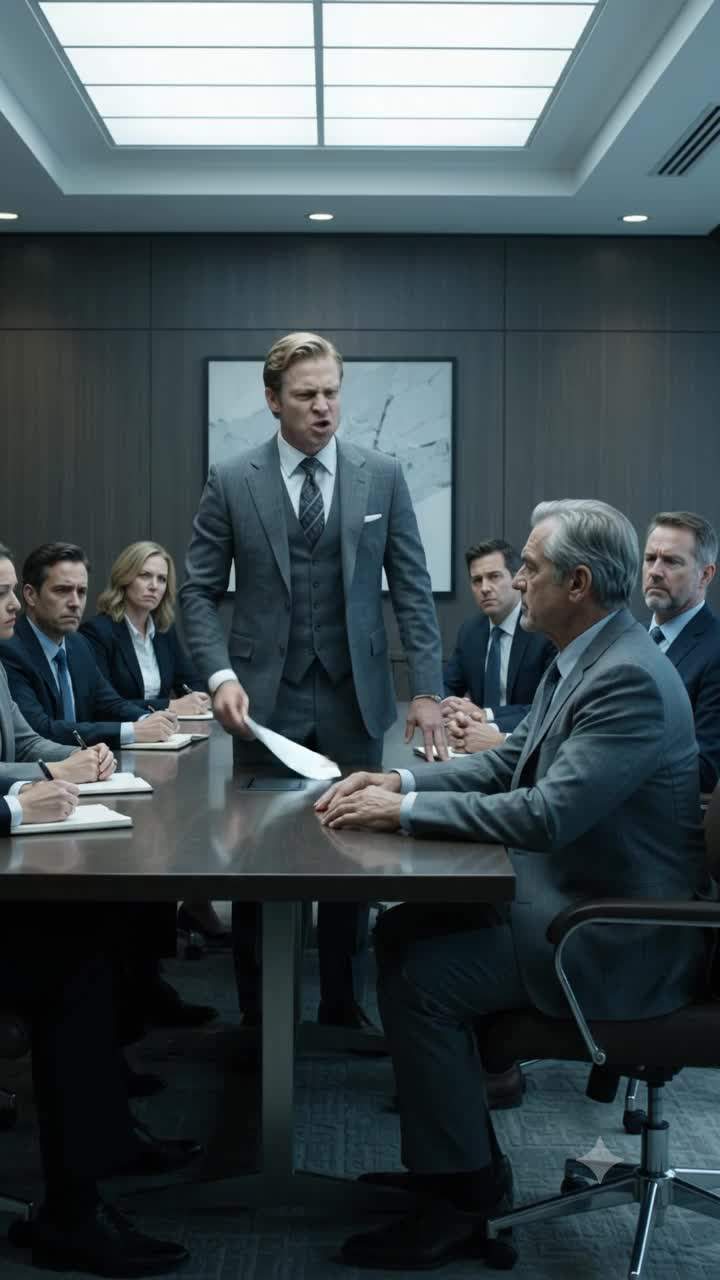
Marcus cleared his throat and a smirk played across his lips as he picked up a single sheet of paper.
He didn't just want to fire us; he wanted to perform for the remaining staff.
He wanted them to see what happened to the "dead weight" that couldn't keep up with his digital revolution.
Arthur, he said, his voice echoing with a forced, condescending warmth that made my skin crawl.
I looked up from my folded hands and met his gaze, refusing to show the tremor that was threatening to take over my knees.
I noticed you still use a physical planner, he continued, holding up the layoff notice like it was a piece of trash he’d found on his shoe.
Is that why you missed the shift in our fourth-quarter projections, or is it just that your brain is as fossilized as your filing system?
A few of the younger managers let out a nervous, sycophant laugh.
Marcus leaned forward, resting his knuckles on the table, closing the distance between us like a predator.
You are a relic of a bygone era, a ghost haunting a machine that has moved on without you.
He tossed the pink slip across the table, and it slid over the polished wood until it brushed against my knuckles.
Don't bother clearing your desk, security will escort you out, and we’ll mail your personal effects in a cardboard box, provided they don't crumble into dust first.
I felt the heat rising in my neck, but it wasn't the heat of shame.
It was the steady, cold burn of a man who had been pushed exactly one inch too far.
I didn't pick up the paper.
Instead, I reached into the inner pocket of my worn tweed jacket and pulled out a heavy, manila envelope.
Marcus rolled his eyes and sighed loudly, looking at his watch as if my very existence was a waste of his precious seconds.
Please, Arthur, no sentimental letters from my father, I’ve heard enough of those to last a lifetime.
I didn't say a word as I stood up slowly, my joints popping in the silence of the room.
I walked to the head of the table, ignoring the security guard who started to step forward from the corner.
I dropped the envelope in front of Marcus, and the sound it made was heavy, like a judge’s gavel.
Advertisement
The flap of the envelope was already open, and a stack of high-resolution glossy photographs spilled out across his pristine workspace.
The first photo showed Marcus sitting in the back of a black SUV in a dimly lit parking garage.
The second photo showed him shaking hands with Julian Vane, the CEO of our primary competitor, Zenith Global.
The third, and most damning, showed Marcus handing over a blue encrypted flash drive—the one containing our proprietary routing algorithms.
The room went so silent I could hear the hum of the air conditioning unit three floors above us.
Marcus reached out a hand to brush the photos away, but his fingers stopped mid-air, trembling violently.
I leaned down, mirroring the same aggressive posture he had used on me only moments before.
I might be a fossil, Marcus, but I wrote the code for the tracking systems you just tried to sell to Julian.
His face transformed from a mask of arrogant triumph to a sickly, pale shade of grey.
I saw the beads of sweat break out on his forehead, glistening under the harsh fluorescent lights.
I also installed a silent back-door in that algorithm twenty years ago that notifies me every time it's accessed from an unauthorized server.
He tried to speak, his mouth opening and closing like a fish gasping for air, but no sound came out.
The brave, revolutionary CEO was suddenly a terrified little boy caught with his hand in the cookie jar.
You didn't just fail to keep up with the projections, Marcus, you actively sabotaged them to drive the stock price down before the merger.
I turned to the rest of the board members, who were now staring at the photos with expressions of pure horror.
That’s called corporate espionage and racketeering, in case your digital revolution forgot to include a law degree.
Marcus collapsed back into his leather chair, his spine turning to jelly as the weight of his own greed finally crushed him.
The photos were undeniable, showing the dates, the times, and the very clear exchange of company secrets.
I reached down and picked up my pink slip from the table, slowly tearing it into tiny, white confetti pieces.
I think there’s been a mistake in the paperwork, I said, my voice calm and steady as I let the paper scraps fall onto his lap.
You won't be mailing my things anywhere, because I’m staying to help the board find a CEO who isn't a criminal.
Marcus let out a ragged, choked sob, his head dropping into his hands as the reality of his situation set in.
He was finished, and everyone in that room knew it.
The security guard, who had been waiting to escort me out, walked over to Marcus and placed a hand on his shoulder.
Sir, I think you need to leave the premises, the guard said, his voice devoid of any of the respect he had shown earlier.
I picked up my cardboard box from under my chair, but I didn't head for the exit.
I walked to the window and looked out at the city I had helped build, feeling the sun finally breaking through the clouds.
The board called an emergency meeting ten minutes later, and the police were waiting for Marcus in the lobby.
I spent the afternoon sitting in my old office, drinking a cup of mediocre coffee that tasted better than any champagne.
People think that being old means being obsolete, but they forget that we are the ones who laid the foundation they stand on.
We know where the cracks are, and we know how to fix them, or how to make the whole building come down.
Marcus thought he was the future, but he was just a footnote in a story I’m still writing.
I didn't need a digital planner to see his downfall coming.
I just needed to wait for him to think he was untouchable.
Because that is always when the arrogant forget to look behind them.
I’m still at Vanguard, but the name on the door at the end of the hall has changed.
And every time a new intern walks past me with a look of pity for the "old guy," I just smile.
They have no idea how much power a fossil can have when it's been under pressure for long enough.