I remember the air in the auction house, thick with anticipation and the scent of old money, on that fateful night.
I was just a junior researcher for an obscure art history blog, but attending the prestigious Thorne Collection auction felt like stepping into a dream.
Every gilded frame, every hushed whisper, spoke of immense value and untold stories.
My heart pounded, not for a bid I could never afford, but for the sheer proximity to art, to history.
The grand finale of the evening was "The Lost Symphony," a masterpiece by the reclusive artist Alistair Davies, believed lost for decades.
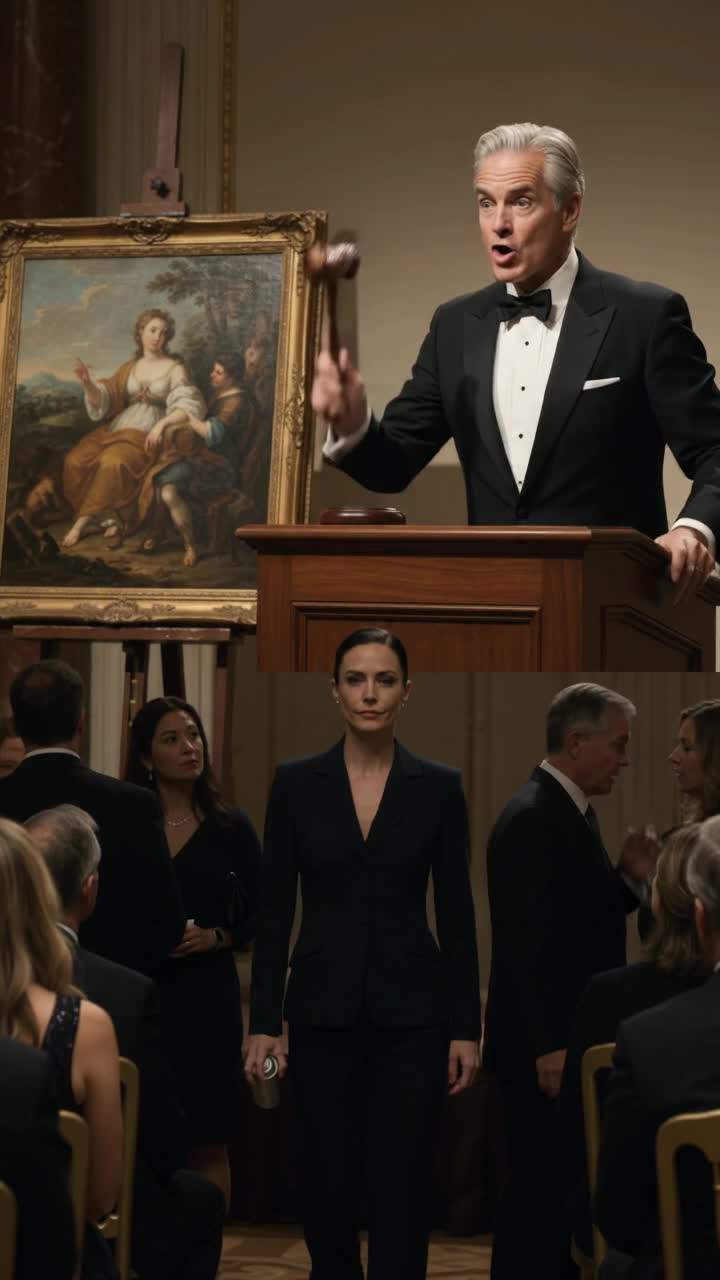
The auctioneer, a sharp-suited man named Mr. Sterling, built the suspense with practiced ease, his voice echoing through the opulent hall.
The bidding soared into the tens of millions, a dizzying dance of paddles and fortunes, far beyond my humble comprehension.
I watched, mesmerized, as the numbers climbed, imagining the history etched into that canvas, the secrets it held.
Then, a ripple of unease, a shift in the otherwise perfectly orchestrated silence, caught my attention.
A woman, slender and composed in a dark navy suit, moved with an unsettling calm through the captivated crowd.
She held something small in her hand, almost imperceptible against her dark clothing.
Before anyone could register her intent, she lunged.
My breath hitched, a strangled gasp escaping my lips as a vivid crimson stream erupted from her hand.
It splattered across the revered canvas of "The Lost Symphony," a violent desecration that felt like a punch to the gut.
Horror seized the room, collective gasps and cries of outrage erupting like a sudden storm.
The crimson paint bled across the delicate brushstrokes, ruining a significant portion of the image.
I felt a surge of incandescent rage, a deep, personal offense at such a senseless act of destruction.
How could anyone defile such beauty, such history?
Security guards, previously inconspicuous, rushed forward, but she stood her ground, unyielding.
She slowly, deliberately, removed her dark sunglasses, her gaze sweeping across the stunned, angry faces.
Her eyes, a piercing shade of grey, held no remorse, only an unnerving certainty.
"This is a fraud!" she declared, her voice cutting through the chaotic murmurs with unexpected power.
"A cheap forgery designed to trick you all!"
The words hung in the air, a different kind of shock, even more profound than the paint itself.
"The true 'Lost Symphony' is not here," she continued, her voice resonating with conviction.
"It never was!"
A stunned silence followed, punctuated only by the frantic whispers of the auction house staff.
The woman was quickly escorted away, but her words, like the indelible red paint, had permanently altered the landscape of that room, and my perception of it.
I left the auction house that night not with a story about a record-breaking sale, but with a burning question: who was she, and what was the truth behind her outrageous claim?
Advertisement
My initial journalistic curiosity soon morphed into an obsession.
I spent the next few days poring over news archives, art journals, and dusty historical records.
The woman, I discovered, was Eleanor Vance, or rather, Eleanor Davies, the estranged granddaughter of Alistair Davies, the very artist whose work she had just "destroyed."
Reports painted her as eccentric, unstable, a recluse haunted by a tragic past.
The family had publicly disavowed her years ago, citing mental health issues following the mysterious disappearance of her father, Alistair's son.
But her eyes at the auction, those clear, resolute grey eyes, were not the eyes of a madwoman.
They were the eyes of someone with a secret, someone driven by an undeniable purpose.
I felt an inexplicable pull to uncover her truth.
It took weeks of persistent inquiry, a few discreet contacts, and perhaps a touch of luck, but I finally managed to secure a meeting with Eleanor.
She was out on bail, living in a modest apartment far removed from the glitz of the art world.
Her demeanor was calm, almost serene, a stark contrast to the frenzied image painted by the tabloids.
She saw my genuine interest, my lack of judgment, and perhaps, a kindred spirit yearning for truth.
"My grandfather never intended 'The Lost Symphony' to be sold," she began, her voice soft but firm, as we sat in her small living room.
"It was a private piece, a declaration of love for my grandmother, painted during their happiest years."
Alistair Davies, she explained, was a man of immense integrity, whose art was his soul.
After his passing, her uncle, Richard Thorne – the very man whose collection was being auctioned – took over the family estate.
Richard was not an artist; he was a businessman, shrewd and ruthless.
He systematically liquidated Alistair's lesser-known works, often at prices Eleanor found suspiciously low.
"He claimed to have sold 'The Lost Symphony' to an anonymous private collector decades ago," Eleanor said, a bitter edge to her voice.
"But something always felt wrong. My father, before he disappeared, was always suspicious."
Eleanor believed her uncle had commissioned a replica, a superb fake, soon after her grandfather's death.
He then 'sold' the replica through a convoluted network of shell companies, establishing its provenance, while secretly keeping the original.
"He wanted the original for himself, to enjoy its beauty in secret, away from critical eyes, or perhaps to sell it when the market peaked, for a price beyond imagination," she theorized.
He let the myth of "The Lost Symphony" grow, cultivating its legendary status.
Then, when the time was right, he orchestrated its "rediscovery" within his own collection, presenting the replica as the long-lost masterpiece.
The auction was the culmination of his grand deception, a final, public validation of his forgery and his ill-gotten wealth.
"Why didn't you just tell people?" I asked, my mind reeling from the intricate web of deceit.
She gave a small, sad smile.
"I tried. For years. No one believed me. My uncle ensured I was dismissed as an unstable, grieving relative, obsessed with a family legend."
"I needed to make a statement no one could ignore," she explained, gesturing towards an old, faded photograph of her grandfather in his studio.
"The paint was not an act of destruction; it was an act of revelation."
She revealed to me a small, cryptic inscription her grandfather had etched into the back of an old, discarded palette.
It was a riddle, a private joke only Alistair and her father had shared, a clue to where he would hide something truly precious.
"My uncle tore apart the main house after my father disappeared, looking for something," Eleanor whispered, her eyes distant.
"He never found this clue, or perhaps he dismissed it as meaningless."
The clue pointed to a forgotten, sealed-off study in the old Davies family estate, a place Richard Thorne had deemed too dilapidated to be worth anything.
It was a small, unassuming room, obscured by years of neglect and overgrown ivy.
Driven by a shared sense of justice, and a thrill I hadn't known I possessed, I helped Eleanor gather what evidence we could.
We presented our findings to a few trusted, discreet investigators who had also harbored suspicions about Richard Thorne's dealings.
Armed with Eleanor's intricate knowledge and my corroborating research, a search warrant was eventually issued for the old Davies estate.
Advertisement
The day they finally breached the hidden study felt like the climax of a suspense novel.
Dust motes danced in the shafts of light cutting through grimy windows.
And there, in a makeshift, climate-controlled vault concealed behind a crumbling bookshelf, was "The Lost Symphony."
The real one.
It was undeniably different from the fake, more vibrant, with a subtle luminescence that the replica simply could not capture.
It bore the very faint, almost invisible, inscription that perfectly matched Alistair Davies's private signature – the one Eleanor had described.
The fraud was exposed, Richard Thorne arrested, and the art world reeled.
My blog post, detailing the entire saga from my initial horror to the uncovering of the true masterpiece, went viral overnight.
My name, once an obscure footnote, became synonymous with investigative art journalism.
Eleanor Vance, no longer viewed as a madwoman, was hailed as a courageous guardian of her family's legacy and artistic integrity.
She decided to donate the true "Lost Symphony" to a public museum, ensuring its beauty and history would be accessible to all, just as her grandfather, in his heart, would have wished.
The painting now hangs in a place of honor, its story a testament to enduring love and the power of truth.
I often visit it, standing before its luminous canvas, remembering the night the art world was shattered, and how a single act of defiance, seemingly destructive, ultimately brought something beautiful and true to light.