The smell of diesel and stale coffee usually defines my mornings, but today it was fear, sharp and acrid, that filled my lungs.
My name is Mark, and I run a small, independent warehousing and distribution business, the kind that survives on tight margins and even tighter schedules.
Our one and only loading dock, crucial for every shipment, has become a battleground with the oblivious, entitled drivers who think "no parking" signs are merely suggestions.
I’d tried everything: polite notes, stern warnings, even calling towing companies which, to my unending frustration, often took longer to arrive than the delivery trucks I was waiting for.
Each blocked spot wasn't just an inconvenience; it was money bleeding from my pocket, late fees, and the risk of losing clients I’d worked years to secure.
This particular Tuesday was already a nightmare, a massive shipment of perishable goods due in an hour, and I was already behind.
I was fuming, pacing by the loading bay door, when I saw it—a sleek, gleaming black luxury SUV, parked directly across the yellow lines of my loading zone.
My stomach clenched.
I walked over, my heart already pounding with a familiar dread, and saw a woman, Sarah, about thirty, impeccably dressed, casually chatting on her phone, leaning against the side of her vehicle.
I recognized her; she was a new tenant in the upscale apartment complex next door, and I'd had a few polite-turned-tense exchanges with her about this very spot before.
"Excuse me," I said, trying to keep my voice even, though my blood was boiling.
She ended her call with a dramatic sigh and turned to me, a faint smirk playing on her lips.
"Yes?" she asked, her tone dripping with annoyance, as if I were interrupting her royal procession.
"This is a loading zone, ma'am. My truck is due any minute. You need to move your car, now."
She glanced at the sign, then back at me, as if weighing my importance, which I clearly failed to meet in her eyes.
"I'll be five minutes," she declared, pulling out her phone again.
"Just chill."
My hands clenched at my sides.
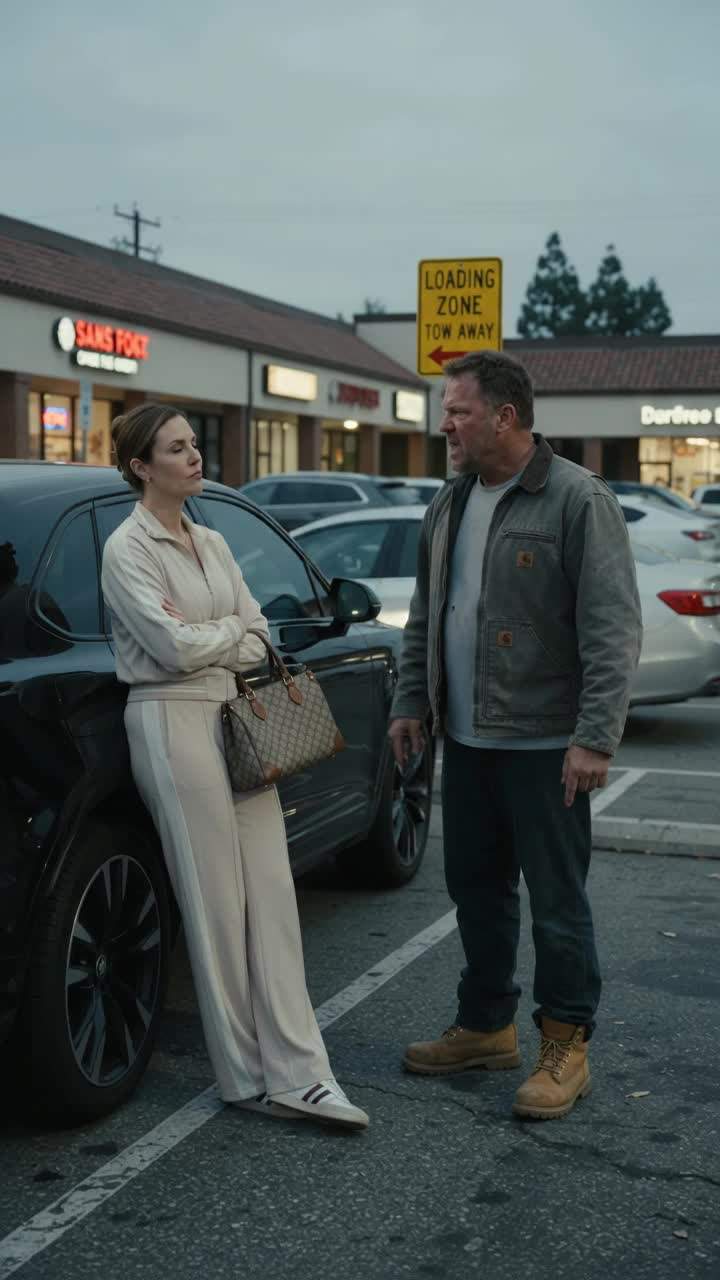
Five minutes was an eternity when a thousand dollars worth of goods was on the line, and she clearly had no intention of moving.
I imagined my forklift, usually reserved for lifting pallets, now lifting something much more satisfying.
The thought, once a fleeting fantasy, solidified into a concrete plan.
This wasn't just about a parking spot anymore; it was about respect, about my livelihood, about the constant disregard for small businesses.
I stalked towards my trusty yellow beast, the forklift, parked just inside the warehouse door.
Each step was deliberate, fueled by years of pent-up frustration.
Sarah, still engrossed in her phone, didn't even notice me pulling on my work gloves.
I climbed into the driver's seat, the engine sputtering to life with a guttural roar that made the ground tremble slightly.
She finally looked up, her expression a mix of mild irritation and confusion, as I expertly maneuvered the heavy machinery.
The metallic clang of the forks extending made her phone clatter to the ground.
Her eyes widened in horror, tracking the steel prongs as they glided under her expensive SUV.
Advertisement
The hydraulic system whirred, a sound that, to me, was the sweet symphony of justice.
Her car, with its arrogant gleam, rose slowly, majestically, a foot off the ground.
Her jaw dropped, her smug veneer cracking, revealing pure, unadulterated shock.
"Hey! What are you doing?!" she shrieked, her voice echoing through the quiet afternoon, no longer composed or dismissive.
I paused the lift, her car hovering precariously.
I leaned out of the forklift, a grim satisfaction spreading across my face.
"Moving your car," I stated calmly, "just like I asked."
She fumbled for her phone, undoubtedly to call the police, her face a mask of outrage.
A few moments later, a tow truck arrived for my actual delivery, completely blocking the street.
The tow truck driver, a grizzled old timer named Gus, just shook his head and chuckled when he saw Sarah’s car suspended in the air.
He knew all about our parking issues here.
When the police arrived, Sarah was still red-faced, ranting about property damage and assault.
I, on the other hand, was calm, pointing to the clear "Loading Zone – Tow Away" signs, showing them our business permits, and explaining how many times I had tried to reason with her and others.
I even had security footage from earlier that day showing her ignoring my requests.
The officers, after a thorough but brief investigation, sided with me, albeit with a stern lecture about using "conventional methods" for parking enforcement.
They gave Sarah a hefty ticket for illegal parking and obstructing a commercial zone.
She had to arrange for another tow truck to get her car down from my forklift and out of the way, a process that took another two agonizing hours.
Watching her stand there, humiliated and helpless, as her luxury vehicle was finally lowered onto a flatbed, was a bittersweet victory.
My perishable shipment arrived, just barely on time, saving me from a financial disaster.
The incident went viral, of course, thanks to a bystander's video, and I received both angry condemnations and a surprising wave of support from other small business owners online.
The loading zone, for a while at least, remained clear.
But the real victory wasn't just the clear parking spot or the averted crisis; it was the quiet sense of empowerment that settled over me.
It was the feeling of finally standing my ground, of drawing a line in the sand, and proving that sometimes, unconventional problems demand unconventional solutions.
It also made me realize how much small businesses are constantly battling for their survival, against indifference, against bureaucracy, against people like Sarah who simply don't care.
I still drive past that spot every day, and sometimes, I see a car hovering, not on my forklift, but in my memory, a powerful reminder of that day.