The heavy silence in my late father’s study felt suffocating, thicker than the expensive velvet drapes that always shielded us from the outside world.
It had been two weeks since his funeral, and today was the day we would finally hear his last will and testament.
My heart ached with a familiar blend of grief and apprehension.
Grief for the kind, if sometimes too trusting, man who was my father, and apprehension for what this gathering would inevitably unleash among the remaining members of our fractured family.
I sat at the large mahogany table, directly across from my cousin, Victoria.
She was impeccable as always, dressed in a sleek, dark designer dress that whispered money and status.
Her perfectly styled blonde hair framed a face that usually held an air of sophisticated superiority, but today, there was something else – a forced calm, almost a predatory stillness, that made my skin prickle.
Victoria had always considered herself the rightful heir to the lion’s share of our family’s considerable wealth, a belief that stemmed from her mother’s side of the family having contributed significantly to the initial fortune generations ago.
She saw us, my father’s other children and me, as secondary, almost as trespassers on what she perceived as her birthright.
Over the years, her subtle manipulations and overt demands had been a constant source of tension.
Father, in his gentle way, always tried to maintain peace, often giving in to her whims to avoid confrontation.
But recently, about a year before he passed, he had grown increasingly weary of her relentless greed.
He had confided in me, during one of our quiet afternoon teas, that he felt a strong need to ensure fairness, to protect the legacy he had built from being devoured by avarice.
He had mentioned consulting Mr. Davies, our long-time family attorney, about updating his will to reflect his true wishes for equitable distribution among all his children and grandchildren, not just Victoria’s branch.
This conversation lingered in my mind, a quiet warning bell.
Mr. Davies, a man with kind eyes framed by wire-rimmed glasses, cleared his throat from the head of the table.
He was a familiar, comforting presence in our family, a quiet observer of all our dramas and triumphs.
He began to speak, his voice calm and professional, outlining the procedures, the legalities.
My gaze, however, kept drifting back to Victoria.
She sat unusually still, her hands resting demurely on her lap, almost hidden from view by the table’s edge.
It was too still, too perfect.
A flicker of movement, almost imperceptible, caught my eye.
Her right hand, adorned with a large diamond ring, subtly shifted.
It wasn't a natural movement.
It was deliberate, a slow, almost snake-like slide.
My breath hitched in my throat.
My eyes narrowed, focusing intently, trying to discern what she was doing beneath the table.
I saw it then, a faint edge of paper emerging from her lap, being carefully nudged towards a stack of documents already on the table, placed there by Mr. Davies.
The very documents we were here to discuss.
Advertisement
A cold dread spread through me, quickly replaced by a surge of pure adrenaline.
She was replacing something.
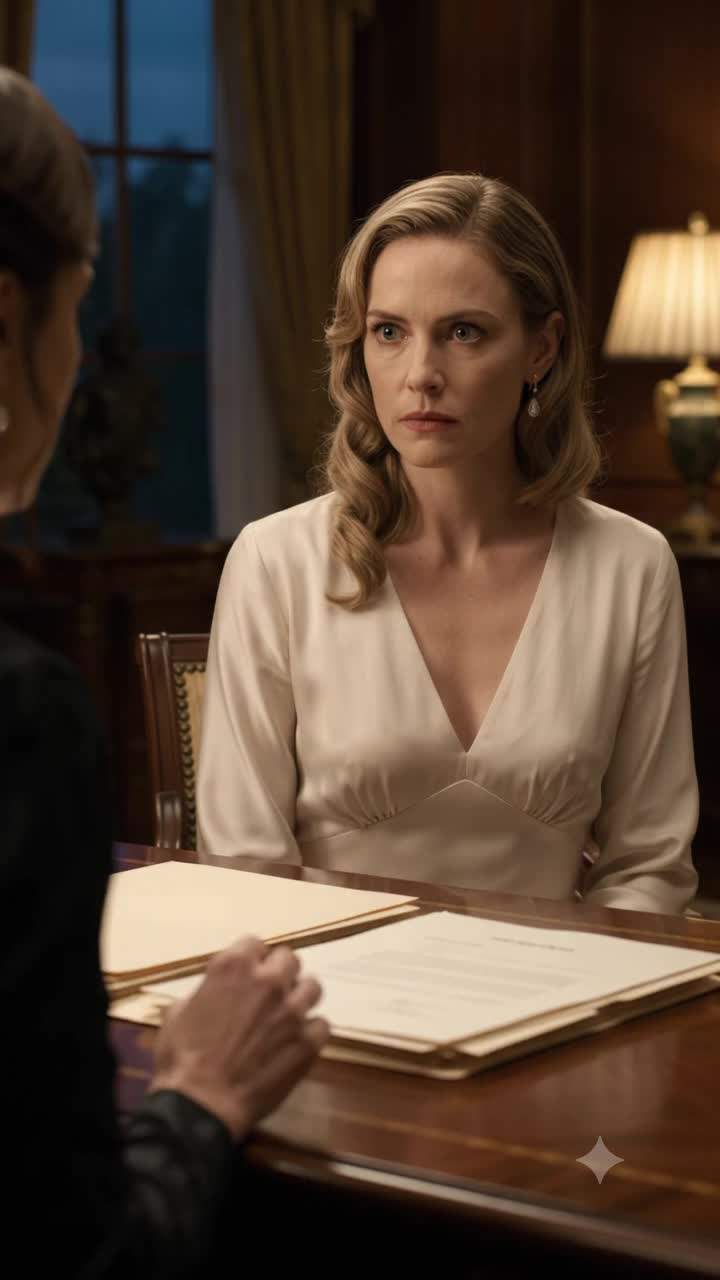
She was attempting to swap a document right here, right now, in front of all of us.
My heart hammered against my ribs, a frantic drumbeat of disbelief and fury.
How dare she?
How could she be so brazen, so contemptuous of our father's memory, of us?
Mr. Davies was still speaking, his voice a low hum in the background, but his words faded into an indistinguishable drone.
All my senses were acutely focused on Victoria.
Her eyes flickered towards me for a split second, and for that brief moment, I saw a flash of panic, quickly masked by a strained, saccharine smile.
It was a smile that didn't reach her eyes, a smile that screamed guilt.
That was all the confirmation I needed.
Without conscious thought, I pushed my chair back slightly, leaning forward across the polished surface of the table.
My hand shot out, not hesitating, not wavering.
My palm landed firmly on her wrist, trapping her hand just as she was trying to blend the fraudulent document with the genuine stack.
The faint but distinct thud of my hand on hers seemed to echo in the sudden, sharp silence that descended upon the room.
Every head snapped towards us.
Victoria’s carefully constructed composure shattered instantly.
Her face drained of all color, turning a ghastly white, and her eyes, wide with shock and fear, darted around the room like a trapped animal.
Her lips parted, trembling, but no sound escaped.
"What are you doing, Victoria?" I asked, my voice low, a raw whisper of pure, controlled fury that I barely recognized as my own.
My grip on her wrist was firm, unyielding.
She tried to pull away, a desperate, frantic tug, but I held fast.
"Nothing, dear, just... organizing," she stammered, her voice thin and reedy, a pathetic attempt at normalcy.
It was an insult to everyone's intelligence.
"Organizing?" I scoffed, the word dripping with contempt.
With a swift, decisive movement, I wrenched her hand open, dislodging the papers.
The two documents, the original will and what was clearly her forgery, fluttered to the table, landing side-by-side with a soft rustle.
The contrast was glaring, undeniable.
One was the familiar, slightly aged parchment with my father's distinctive signature and Mr. Davies's official seal.
The other, much newer, had a different font, a subtly altered layout, and a crude, almost cartoonish attempt at my father’s signature.
Robert, my elder brother, who had been sitting next to me, let out a choked gasp.
He leaned forward, his eyes widening in disbelief and then darkening with rage as he saw the two wills.
He reached out, his hand trembling, to point at the obvious forgery.
"What is this?!" he boomed, his voice cracking with a mixture of shock and profound betrayal.
"A forgery?!" His eyes, usually so steady, were now blazing with an inferno of anger directed squarely at Victoria.
Victoria recoiled as if struck.
The last vestiges of her carefully crafted facade crumbled.
Her elegant posture dissolved, her shoulders slumped, and her face crumpled into a mask of pure terror and shame.
Tears welled in her eyes, not tears of remorse, I knew, but of self-pity and the bitter realization of being caught.
Her jaw worked soundlessly, her entire body shaking uncontrollably.
Advertisement
The silence in the room was deafening, punctuated only by her ragged breathing.
Mr. Davies, after a moment of stunned silence, adjusted his glasses, his professional demeanor returning with an iron will.
He carefully picked up both documents, his gaze sweeping between them, then at Victoria, his expression stern and gravely disappointed.
"This," he said, his voice quiet but resonating with authority, holding up the newer document, "is clearly not Mr. Henderson's authentic last will and testament."
He paused, letting the weight of his words sink in.
"The signatures are entirely different. The paper stock, the notarization—this is a crude imitation."
I met Victoria’s gaze across the table, my own eyes cold, devoid of any pity.
I picked up the genuine will, then the forged one, and gently, deliberately, tossed the fake one back onto the table in front of her.
"This is your true legacy, Victoria," I stated, my voice cutting through the silence like a shard of ice.
"Deceit."
The aftermath was a blur of accusations, denials, and raw emotion.
Victoria, cornered, eventually broke down into hysterical sobs, attempting to paint herself as a victim, misunderstood, desperate.
No one bought it.
The evidence lay starkly on the table, an undeniable testament to her greed and audacity.
Mr. Davies immediately declared the forged document null and void and proceeded with the reading of my father's true will, which, as he had promised me, outlined a fair and equitable distribution among all his descendants.
Victoria was not only disinherited from the substantial portion she had hoped for but was also stripped of any minor bequest father had initially intended for her, a decision Mr. Davies assured us was within his legal power given her blatant attempt at fraud.
The police were involved, though my father’s will stipulated a strong preference for keeping family matters private unless absolutely necessary, so formal charges were avoided, but Victoria’s reputation within the family, and indeed within wider society, was irrevocably ruined.
She left that day, not with the inheritance she craved, but with the heavy burden of shame and the utter contempt of everyone present.
Our family, already fragile, fractured further.
The trust was gone, replaced by a bitter understanding of the depths to which one of us would sink for money.
For me, there was a profound sense of exhaustion, but also a quiet, firm peace.
I had honored my father's wishes, protected his legacy from being corrupted by greed.
It wasn't just about the money; it was about the principle, about justice, about standing up for what was right.
The study, once a place of comfort and memory, now held a darker echo, a reminder of the day our family’s true colors were brutally exposed.
But at least, the truth had prevailed.