I remember the summer evening so vividly, the air thick with the sweet scent of Eleanor Vance’s hydrangeas and the low hum of neighborly chatter.
It was our annual block party, a tradition as old as the oak tree in Eleanor’s meticulously kept front yard.
Eleanor was my dearest friend, a woman of impeccable taste and a green thumb that was the envy of everyone on Willow Creek Lane.
Her garden wasn’t just a hobby; it was her masterpiece, a vibrant tapestry of color and life that brought her immense joy and, admittedly, a fair bit of local fame.
This year, her hydrangeas were particularly breathtaking, huge, sapphire-blue blooms cascading from ancient shrubs, each flower head perfect, almost luminous in the fading light.
They were the star of the show, sitting proudly on a wrought-iron display stand, already the unspoken winner of the neighborhood’s annual garden competition, with the official announcement due the next day.
I was standing beside Eleanor, clinking glasses as she accepted compliments from a stream of admiring neighbors, her face radiant with pride.
She truly deserved every accolade; she poured her heart and soul into those flowers.
That’s when I saw Brenda Jenkins on the edge of the crowd.
Brenda had always been a complicated presence in our tight-knit community.
She lived just two houses down, a quiet woman who ran a small online pottery shop from her garage.
Her demeanor was often reserved, a little brittle, and beneath the surface, I always sensed a simmering resentment, especially when it came to Eleanor.
Their rivalry wasn’t overt, no shouting matches or dramatic confrontations, but a subtle undercurrent of one-upmanship that had defined their relationship for decades.
Brenda, despite her efforts, could never quite achieve the effortless grace or widespread admiration that Eleanor commanded, whether it was for her gardens, her perfectly curated home, or her social ease.
I’d often tried to bridge the gap, inviting Brenda to coffee with Eleanor and me, but the conversation always felt strained, Brenda’s eyes darting around the room, rarely meeting Eleanor’s gaze.
A few months prior, the tension had thickened considerably.
“Suburban Living” magazine, a regional publication much coveted by local businesses for exposure, had featured Eleanor’s garden on its cover.
It wasn't just a small blurb; it was a lavish, multi-page spread celebrating her unique hydrangeas and her "passion for cultivating beauty."
The article led to a short segment on a local morning news show, further cementing Eleanor’s status as our neighborhood's darling.
What Eleanor didn’t know, or perhaps chose not to notice, was that Brenda had been actively pursuing that exact feature for her pottery business for nearly two years.
She had submitted proposals, sent countless emails, and even tried to schmooze the editor at a local craft fair.
The magazine had a strict "one local talent feature per issue" policy, and Eleanor’s garden had inadvertently taken the spot Brenda desperately sought for her fledgling business.
Brenda believed that feature would have been a game-changer for her, a recognition that would elevate her from a garage hobbyist to a serious artisan.
Instead, Eleanor, who certainly didn't need the publicity for her "hobby," had effortlessly walked away with it.
I saw Brenda’s despair when the magazine came out, a hollow look in her eyes that made me worry.
She stopped attending our regular coffee meet-ups, her calls went unanswered, and when I saw her at the grocery store, she’d give a curt nod and quickly move away.
Eleanor, wrapped up in the glow of her success and preparing for the garden competition, seemed oblivious to the depth of Brenda’s hurt.
She'd casually mention the magazine article, not out of malice, but just as a topic of conversation, completely missing the flicker of pain in Brenda’s eyes.
I tried to warn Eleanor, gently suggesting that Brenda might be feeling sensitive, but Eleanor just waved it off, saying, “Oh, Brenda’s always a little dramatic, isn’t she, Sarah? She’ll get over it.”
Advertisement
As the evening wore on at Eleanor's party, the atmosphere was joyous, the air filled with laughter and the clinking of glasses.
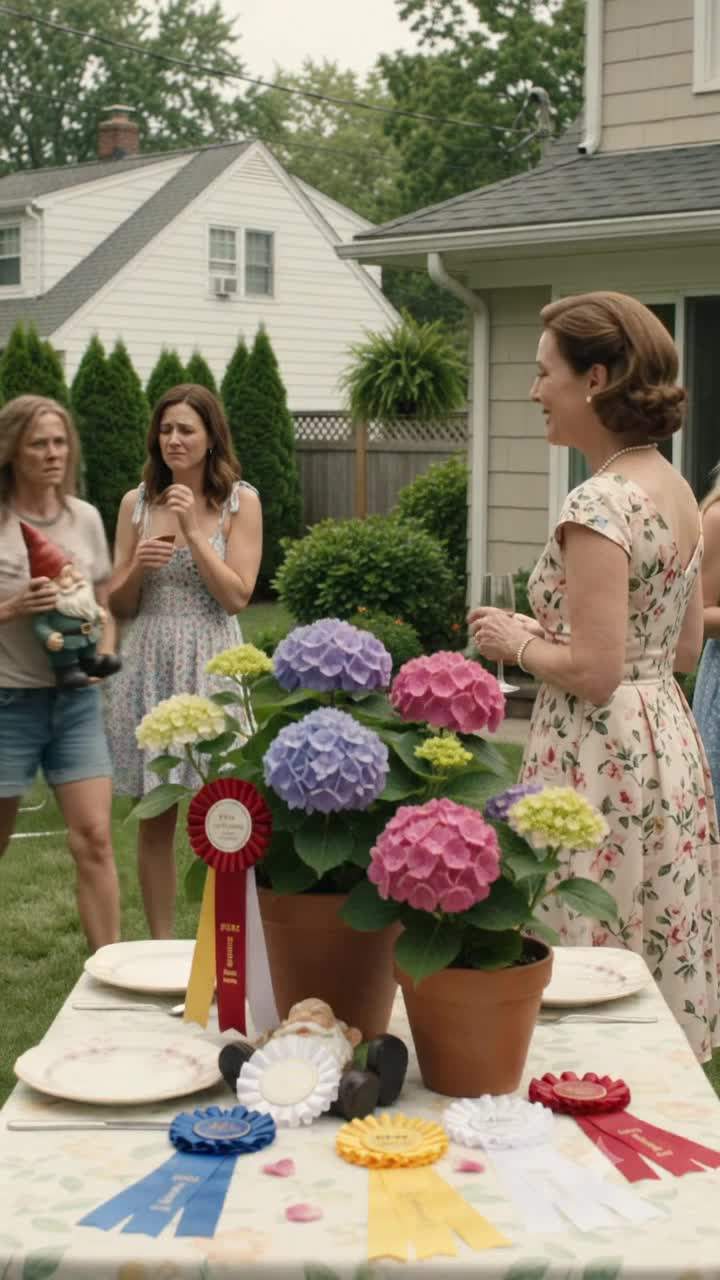
Eleanor's hydrangeas, adorned with the competition's "finalist" ribbon, were truly the centerpiece, bathed in the soft glow of fairy lights.
Brenda, however, remained a solitary figure, nursing a drink, her eyes fixed on the flower display with an intensity that made me shiver.
I had a bad feeling, a gnawing discomfort in my stomach, but I dismissed it as overthinking.
Suddenly, a strange hush fell over the crowd.
The music seemed to fade, conversations died down.
Everyone’s gaze, including mine, drifted towards Brenda.
She had moved, slowly and deliberately, towards the display stand.
Her face was pale, drawn, but there was a fierce, almost unhinged determination in her eyes that I had never seen before.
She reached for a heavy ceramic gnome that was part of the garden's whimsical decor.
It was one of Eleanor’s favorites, a gift from her late husband.
Brenda’s hands trembled slightly as she gripped it, but her resolve was chillingly clear.
Eleanor was still chatting animatedly with a group of friends, her back to Brenda, completely unaware.
Brenda took a deep, shuddering breath, a sound that seemed to echo in the sudden silence.
Then, with a guttural cry that was more pain than anger, she swung the gnome high.
It came down with a sickening thud, smashing directly into the heart of Eleanor’s prize-winning hydrangeas.
The sound was shockingly loud – the crunch of ceramic, the tearing of delicate petals, the snapping of stems.
My breath hitched in my throat.
The blue blooms, moments ago vibrant and proud, crumpled into a pathetic heap of broken beauty.
Eleanor whirled around, her eyes wide with confusion, then horror.
Her face, which had been so full of joy, contorted into an expression of utter disbelief and raw anguish.
Her mouth fell open, but no sound came out, only a choked, gasping "Oh my God... no..."
She stretched out a trembling hand as if to somehow gather the scattered remnants of her dream, then let it drop, defeated.
Brenda, still clutching the broken gnome, stared directly at Eleanor.
Her chest heaved, but her voice, when it came, was eerily calm, though laced with an venomous edge that cut through the stunned silence.
“You had it coming, Eleanor,” Brenda said, her voice thin but unwavering.
“You always do.”
The words hung in the air, a declaration of war, a confession of years of bitterness finally unleashed.
The festive atmosphere had evaporated completely, replaced by a suffocating silence punctuated only by Eleanor’s quiet sobs.
I rushed to Eleanor’s side, putting an arm around her shaking shoulders, trying to offer comfort, though I felt utterly helpless.
Other neighbors stood frozen, a mix of shock, outrage, and awkward discomfort on their faces.
Brenda didn’t attempt to flee or apologize.
She remained standing there, defiant, her eyes blazing, and then, the dam burst.
She began to speak, her voice trembling at first, then gaining strength as years of suppressed resentment poured out.
She spoke of the magazine feature, how it had stolen her opportunity, how Eleanor always managed to outshine her effortlessly, making Brenda feel invisible, worthless, a constant second-best.
She recounted countless small slights, real and imagined, moments where Eleanor's casual brilliance had, in Brenda's mind, deliberately diminished her.
“You just don’t see it, do you, Eleanor?” Brenda cried, her voice cracking with a mix of fury and despair.
“You just take, and take, and never even realize what you’re trampling underfoot!”
Eleanor, through her tears, listened, her initial shock slowly giving way to a dawning, terrible understanding.
I saw the recognition in her eyes, the dawning realization that her "harmless hobby" had inflicted real, deep pain on someone else.
Advertisement
The party dissolved then, the neighbors quickly making their excuses, leaving Eleanor weeping amongst the shattered ceramic and broken blooms, and Brenda standing rigidly, an exhausted, twisted satisfaction on her face.
In the days that followed, Willow Creek Lane buzzed with hushed conversations and divided loyalties.
Some neighbors condemned Brenda’s act as an unforgivable breach of decorum, an act of sheer madness.
Others, however, whispered about Brenda’s struggles, the years of feeling overshadowed, finding a strange, albeit destructive, empathy for her actions.
Eleanor was heartbroken over her destroyed flowers, but the deeper wound was the realization of Brenda’s profound unhappiness and the part she, however unwittingly, had played in it.
She withdrew for a time, her usual vibrant energy subdued.
The garden competition was canceled that year, the symbol of rivalry tainted.
What surprised me most was Eleanor’s eventual response.
Instead of seeking retribution, instead of pressing charges or further ostracizing Brenda, she sought understanding.
A few weeks later, I watched as Eleanor, looking smaller, humbler than I’d ever seen her, walked across her lawn and knocked on Brenda’s door.
I don't know the exact words exchanged in that difficult conversation, but I know it wasn't a quick reconciliation.
Brenda, I learned later, expressed regret for the destruction but confessed the deep-seated pain that had driven her.
Eleanor, in turn, acknowledged her own insensitivity, her unintentional blindness to Brenda’s struggles, and genuinely expressed sorrow for causing her such anguish.
There was no magical, movie-like happy ending where they became best friends.
The broken hydrangeas couldn't be instantly repaired, nor could years of resentment be erased overnight.
But something shifted.
Eleanor still gardened, but with less emphasis on winning, more on the simple joy of cultivation and sharing.
She even subtly, through community channels, helped Brenda connect with a local artisan collective, giving her pottery the visibility she craved.
Brenda, though still quiet, slowly began to re-engage with the neighborhood, her eyes holding less bitterness, more a weary introspection.
The incident was a harsh lesson for all of us on Willow Creek Lane.
It showed us that beneath the perfectly manicured lawns and polite smiles, there could be unseen battles, decades of quiet desperation, and that even the most beautiful achievements could cast long, painful shadows.
Our quiet, idyllic neighborhood was never quite the same after that summer night, but perhaps, in its own fractured way, it became a little more empathetic, a little more aware of the delicate balance of human emotions that truly rooted us together.