Our street was always the picture of suburban peace.
Neatly manicured lawns stretched out on either side, meeting in the middle at a small, shared green space that served as a communal backyard for our little cul-de-sac.
It was where kids learned to ride bikes and where we held our annual summer barbecue, a quiet haven of shared responsibility.
Then Gary moved in.
At first, he seemed like any other new neighbor, a bit boisterous perhaps, but nothing overtly concerning.
He’d wave from his porch, sometimes offer a strained smile, but mostly kept to himself.
The trouble started subtly, almost imperceptibly, like a slow-growing vine.
Gary began by placing a few potted plants just beyond his property line, creeping onto the edge of the shared green.
No one said anything, thinking it was harmless, perhaps even an oversight.
Then came a small, decorative picket fence, just a few feet long, enclosing what he claimed was his “extended flowerbed.”
It was still small enough that most of us just sighed and exchanged knowing glances, preferring peace over confrontation.
I remember thinking then that someone should say something, but I hesitated, not wanting to be the one to start a neighborhood war.
My husband, bless his peace-loving heart, always urged me to just “let it go, Eleanor, it’s not worth the trouble.”
But Gary didn’t let it go.
He interpreted our silence as permission, an invitation to take more.
The picket fence grew longer, then it became a solid wooden barrier, snaking further and further into the easement.
He started storing his lawn equipment, then old patio furniture, on what was clearly common property, treating it as his own private storage yard.
The final straw came when he decided to build a permanent, rather ugly, tool shed right in the middle of where our children used to play badminton.
It wasn't just encroaching anymore; it was an outright annexation, a blatant disregard for everyone else and the established rules of our community.
I tried the polite route, as did several other neighbors.
I knocked on his door, a casserole in hand, and gently brought up the issue, suggesting there might be a misunderstanding about the property lines.
Gary just chuckled, a dismissive sound, and told me, “Eleanor, honey, nobody uses that patch of dirt anyway. I’m just tidying it up.”
He refused to even look at the plat maps I had printed from the county website, slamming the door with a finality that stung.
We went to the HOA, submitting formal complaints, attaching photographs, and even getting a petition signed by almost everyone on the street.
The HOA sent Gary official letters, citing violations, issuing warnings, and imposing fines.
Gary ignored them all, or simply paid the fines and continued building, as if the rules were merely suggestions for lesser mortals.
He even put up “No Trespassing” signs on the land he’d stolen from us all.
My frustration festered, a hot, bitter knot in my stomach.
I saw the disappointed looks on the faces of the other parents when their kids couldn’t use the green space anymore, the quiet resentment building in everyone.
Advertisement
But no one wanted to be the one to escalate it further, to risk open warfare with the notoriously stubborn Gary.
I lay awake for nights, replaying conversations, imagining arguments, feeling the weight of injustice pressing down on me.
It wasn't just about the land; it was about respect, about community, about the principle of standing up for what was right when someone thought they could just take what wasn't theirs.
One morning, after watching Gary nail another plank onto his ever-expanding fence, I snapped.
It was a quiet snap, not a shout, but a firm, cold resolve that settled deep in my bones.
I spent the next few days making phone calls, not to lawyers, not to the HOA, but to local landscaping and demolition companies.
I needed someone who understood the precise legal boundaries of our easement and who wasn’t afraid of a little confrontation.
I found a contractor named Mike, a gruff but kind man who listened to my story, looked at the maps, and nodded slowly.
“He’s definitely over the line, ma’am,” he confirmed, his voice calm.
“What do you want me to do?”
“I want you to take it down,” I told him, my voice surprisingly steady.
“Every last bit of it.”
The morning arrived bright and clear, almost mockingly peaceful.
My heart was a drum in my chest, a frantic beat against my ribs, but my hands were steady as I held the coffee mug.
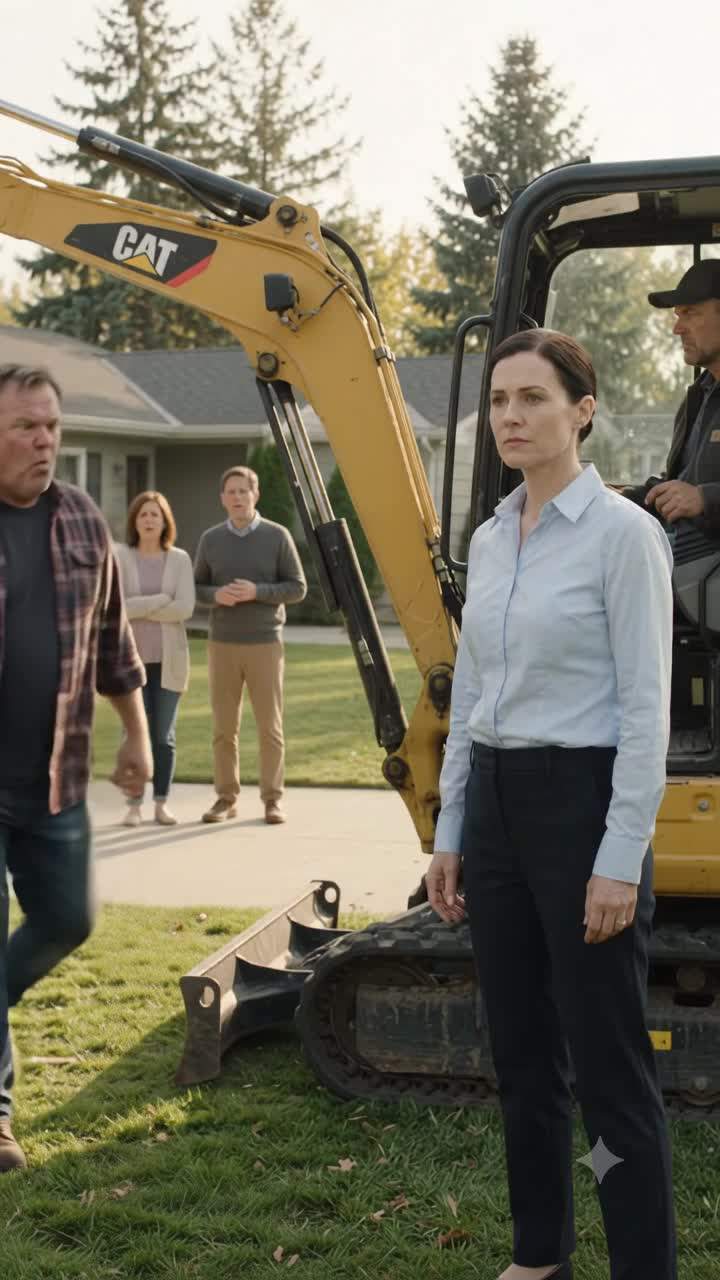
I watched from my window as Mike’s crew arrived, a flatbed truck carrying a small but powerful mini-excavator rumbling down our quiet street.
It looked enormous, intimidating, a symbol of finality.
I walked out to meet them, taking a deep breath, and stood beside the excavator as it parked on the edge of the disputed land.
It felt surreal, like I was watching a movie of my own life.
Within moments, Gary stormed out of his house, his face already contorted in a mask of fury.
He was wearing his usual plaid shirt and jeans, his hair disheveled, clearly having just woken up.
“What the hell do you think you’re doing, Eleanor?!” he bellowed, his voice raw with outrage, striding directly towards me, his finger jabbing in the air.
His eyes were wide, incredulous, as if I had personally invaded his home.
I met his gaze, my own eyes probably reflecting the years of frustration I’d harbored.
“Gary,” I said, my voice calm, belying the storm inside me.
“This is community property. You were warned. Repeatedly.”
He sputtered, searching for words, his face reddening.
“You can’t just… you can’t just bring a machine onto my property!” he roared, gesturing wildly at the shed and fence.
I took a deliberate step back, nodding once to Mike, who was already settled into the excavator’s seat.
“It’s not your property, Gary,” I stated, my voice clear and firm, the finality of it hanging in the morning air.
“You had your chance.”
The engine of the excavator roared to life, a deep, throaty growl that vibrated through the ground.
Mike expertly maneuvered the arm, its metal bucket arcing through the air.
Gary’s jaw dropped, his protests dying in his throat as the heavy machinery swung towards his illegal fence.
There was a deafening CRUNCH as the bucket made contact, splintering wood, tearing through the flimsy structure with shocking ease.
Gary recoiled, a look of pure shock and disbelief plastered across his face.
He shouted something unintelligible, a mixture of rage and panic, but the machine continued its work, tearing down the shed next, piece by piece, reducing his defiant structure to a pile of rubble.
Our other neighbors, drawn by the noise, emerged from their houses, coffee mugs in hand, their expressions ranging from stunned surprise to thinly veiled satisfaction.
No one said a word, but their silent presence felt like a collective sigh of relief, a shared vindication.
The demolition was swift and brutal, a cathartic symphony of destruction.
When Mike finally cut the engine, leaving behind a cleared patch of land strewn with debris, the silence that followed was profound.
Advertisement
Gary stood there, defeated, his face pale, his earlier bluster evaporated.
He just stared at the wreckage, then at me, then back at the empty space where his encroachment had once stood.
He mumbled something about lawyers, about suing me, but his voice lacked conviction, the fire gone from his eyes.
I simply stood there, my shoulders finally slumping from the tension I hadn't realized I was carrying for so long.
Mike’s crew began clearing the debris, and the shared green space slowly re-emerged, battered but free.
Gary never did sue.
My lawyer, whom I consulted beforehand, assured me I was well within my rights, having given ample notice and proof of his violation of community easements.
He retreated into his house, and for a few days, a tense silence hung over our cul-de-sac.
Slowly, the other neighbors started to approach me, first with cautious questions, then with quiet words of thanks and even a few grateful hugs.
The kids started playing on the green again, tentative at first, then with joyful abandon.
Gary still lives on our street, but he keeps to himself even more now, and strangely, he respects the property lines.
The shared green space is once again a place of peace, a testament to what happens when someone finally decides that enough is truly enough.
Sometimes, to reclaim peace, you have to bring in the heavy machinery.