I remember the call as if it were yesterday, though it feels like a lifetime ago now.
My sister Sarah’s voice was barely a whisper, a strained, broken sound that ripped through me like a physical blow.
She didn't have to say much; the news had already plastered her face across every local channel, a blurry still frame taken from a bystander's shaky phone video.
“I did it, Mia,” she confessed, her voice thick with something I couldn’t quite identify—regret, defiance, exhaustion.
I wasn’t there, not physically, but I lived through every agonizing second of it with her.
For years, I’d watched Sarah struggle, her life a relentless uphill battle against circumstances that seemed stacked against her.
She was a single mother, working two jobs just to keep a roof over her head and food on the table for her two boys.
Her ex-husband, Mark, was a phantom, his child support payments as sporadic as rain in a desert.
Every late bill, every broken appliance, every school field trip request felt like a personal affront, a heavy stone added to the already unbearable load she carried.
She used to be full of life, a vibrant, quick-witted woman with a laugh that could light up a room.
But slowly, incrementally, the joy had been leached out of her, replaced by a quiet, simmering resentment that she rarely voiced but that I could see in the permanent crease between her brows.
She was always tired, always stressed, always just one unexpected expense away from a total meltdown.
The week before the infamous parking lot incident had been particularly brutal.
Her youngest son, Leo, had come down with a nasty flu, forcing Sarah to miss three days of her morning shift at the diner.
That meant lost wages, and the electric bill was already past due.
Then, her old sedan, a faithful but increasingly unreliable companion, started making a terrifying grinding noise, signaling yet another impending repair.
She’d spent her last few dollars on groceries, hoping to stretch them until her next paycheck, which felt like an eternity away.
The supermarket parking lot on that sunny afternoon was just another crucible in her daily grind.
She’d circled for what felt like an eternity, patiently waiting for a spot to open up.
Finally, she saw it—a perfect space near the entrance, just wide enough for her tired old car.
She put on her blinker, signaling her intent, watching as the car currently occupying it started to back out.
It was almost hers, a small victory in a day full of defeats.
But then, out of nowhere, a sleek, gleaming black luxury SUV, a Mercedes G-Wagen, swooped in, cutting her off.
It slid effortlessly into the spot, the driver clearly having ignored her blinker, her patience, her very existence.
I could almost feel Sarah’s breath hitch, the blood rushing to her head.
It wasn't just a parking spot; it was a symbol, a blatant disregard for her struggle, her basic right to courtesy.
The driver, a man in his early forties, with a perfectly coiffed haircut and an air of casual entitlement, stepped out of the Mercedes.
He was wearing an expensive designer polo shirt and crisply pressed chinos, his sunglasses pushed up onto his head, revealing a smug smirk.
His eyes swept over Sarah’s beat-up sedan, then flickered to her, a dismissive glance that spoke volumes.
Advertisement
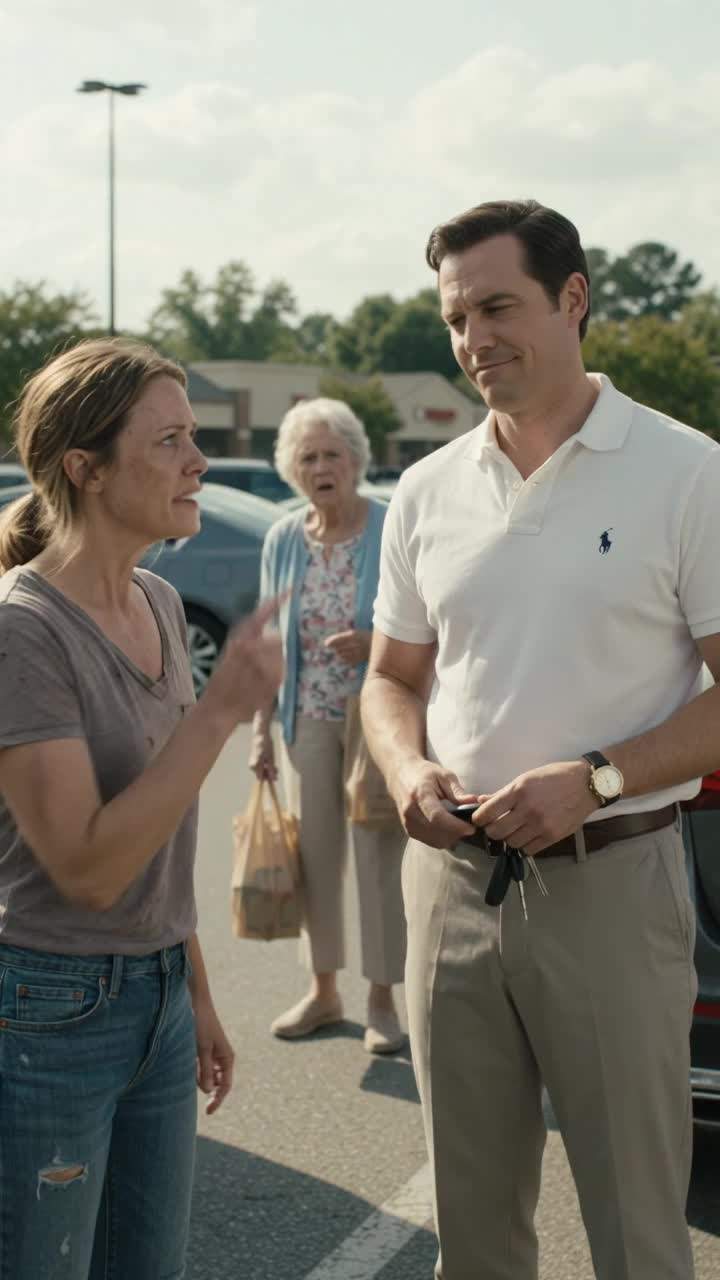
“Excuse me!” Sarah called out, her voice trembling with a mixture of disbelief and building fury.
“I was waiting for that spot! My blinker was on!”
The man, Richard, as we later learned, barely acknowledged her.
He just leaned against the hood of his pristine vehicle, adjusting his watch, as if her words were mere background noise.
“Finders keepers, darling,” he finally drawled, a condescending smirk playing on his lips.
“Or maybe… losers weepers?”
That was it.
That casual cruelty, that arrogant dismissal, was the precise match that lit the fuse of Sarah’s accumulated rage.
It wasn’t about the parking spot anymore.
It was about every injustice, every indignity, every moment she had been made to feel invisible and insignificant.
It was about the constant struggle, the lack of respect, the feeling of being trodden on by people who had it all.
A wave of something cold and utterly resolute washed over her.
She looked down at the car keys clutched in her hand, the sharp edge of her house key suddenly feeling heavy and purposeful.
Then, her gaze lifted to the impossibly shiny, untouched surface of Richard's luxury SUV.
In that moment, she didn’t see a car; she saw everything he represented.
And she saw herself, pushed to the absolute edge.
With a sudden, deliberate movement, so swift and shocking that it seemed to stun Richard into momentary silence, she raised her hand.
The key glinted in the sunlight.
She dragged it, slowly and with immense satisfaction, right across the center of the engine hood, carving a deep, jagged scar into the gleaming black paint.
The sound was a sickening screech, metal against metal, raw and primal, cutting through the mundane sounds of the parking lot.
It was the sound of a breaking point, a woman finally snapping under the weight of too much.
Richard’s face contorted in a grotesque mask of disbelief and rage.
“What the hell did you just do?!” he shrieked, his voice cracking, all pretense of cool superiority gone.
Sarah stepped back, her chest heaving, but her eyes were clear, a grim satisfaction settling over her features.
“Now it’s our spot,” she stated, her voice calm, chillingly devoid of emotion.
A crowd had gathered, drawn by the commotion and the horrifying sound of destruction.
Mobile phones were already out, recording the aftermath.
An elderly woman, clutching a shopping bag, gasped, her hand flying to her mouth.
The police arrived swiftly, sirens wailing, their flashing lights casting an surreal glow over the scene.
Richard was beside himself, pointing frantically at the deep scratch, then at Sarah, demanding her arrest.
Sarah, surprisingly, remained calm.
She didn't resist when the officers gently cuffed her, her eyes meeting mine through the grainy news footage later, a mixture of fear and a strange, defiant peace.
The incident exploded online, a viral sensation.
Sarah was branded a "parking lot psycho," a "rage monster," another example of society's decay.
Richard, the "victim," lamented his ruined property and the "unhinged violence" he had endured.
But beneath the sensational headlines and the furious comments, a different narrative began to emerge.
Someone recognized Sarah, shared her story—the single mother, the struggles, the relentless pressure.
Suddenly, her act wasn’t just mindless aggression; it was a desperate cry, a breakdown forged in the fires of systemic inequality and personal hardship.
A crowdfunding page was set up for her legal fees.
Initially, it was slow, but then, as more details of her life came out, donations poured in.
Advertisement
People identified with her, with the feeling of being overlooked, disrespected, pushed to the brink by the everyday arrogance of privilege.
The legal battle was long and emotionally draining.
Richard pressed charges for vandalism and emotional distress.
Sarah, represented by a public defender who saw her humanity beyond the single, destructive act, pleaded guilty to property damage but argued for leniency, explaining the years of pressure that had culminated in that moment.
She was given probation, ordered to pay restitution for the damage, and attend anger management classes.
The restitution was a heavy burden, but the community support, the unexpected kindness from strangers who understood, helped lighten the load.
Richard, for his part, received a new hood for his Mercedes, but the public sympathy he initially garnered quickly waned.
His perceived arrogance in the parking lot, amplified by the viral video, turned many against him.
He became a symbol of the entitlement Sarah had lashed out against.
Sarah lost her job at the diner, the management unable to overlook the negative publicity.
But through the support of the community, she found a new, better-paying job at a local community center, working with families in similar situations to her own.
She attended every anger management session, not because she had to, but because she genuinely wanted to understand what had driven her to such an extreme.
She learned coping mechanisms, found a therapist who helped her unpack years of suppressed frustration.
She taught her boys about patience, about choosing battles, but also about standing up for themselves with dignity, not with destructive rage.
That day in the parking lot changed Sarah’s life irrevocably.
It was a public meltdown, a moment of utter humiliation and raw, uncontrollable fury.
But it was also a turning point.
It forced her, and many others, to confront the invisible burdens people carry, the thin line between resilience and despair.
And in a strange, unexpected way, it became the catalyst for her to finally reclaim her voice, to find a strength she didn't know she had, not just to survive, but to truly begin to live again.