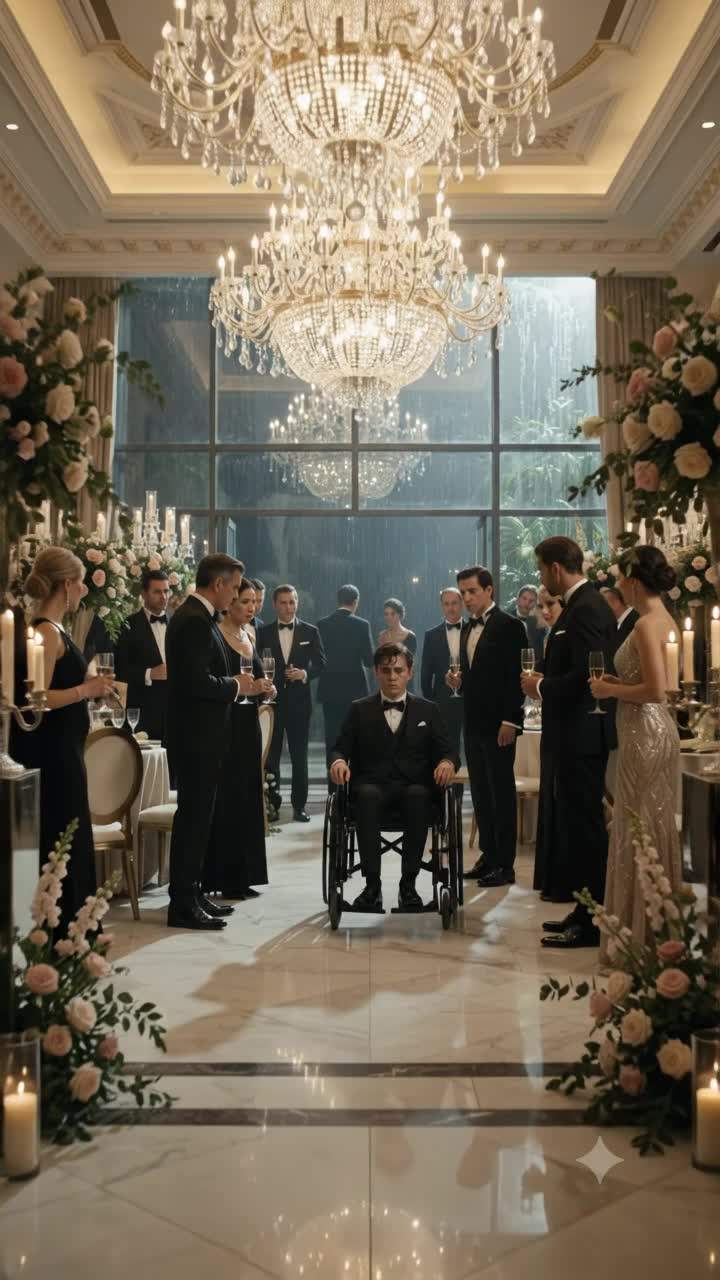
The Beaumont Grand Ballroom hummed with the superficial elegance of a carefully constructed lie.
Crystal chandeliers, dripping like frozen tears, cast a blinding sheen over marble floors that had witnessed generations of discreet betrayals.
Tonight, however, was meant for celebration: the union of Isabella Beaumont, the family’s golden child, to Marcus Thorne, a tech magnate whose influence promised to further entrench the Beaumont dynasty.
But beneath the profuse floral displays and the hushed orchestral melody, an undercurrent of tension pulsed, thick and undeniable.
At the very heart of this gilded cage sat Eleanor Beaumont, Isabella’s younger sister.
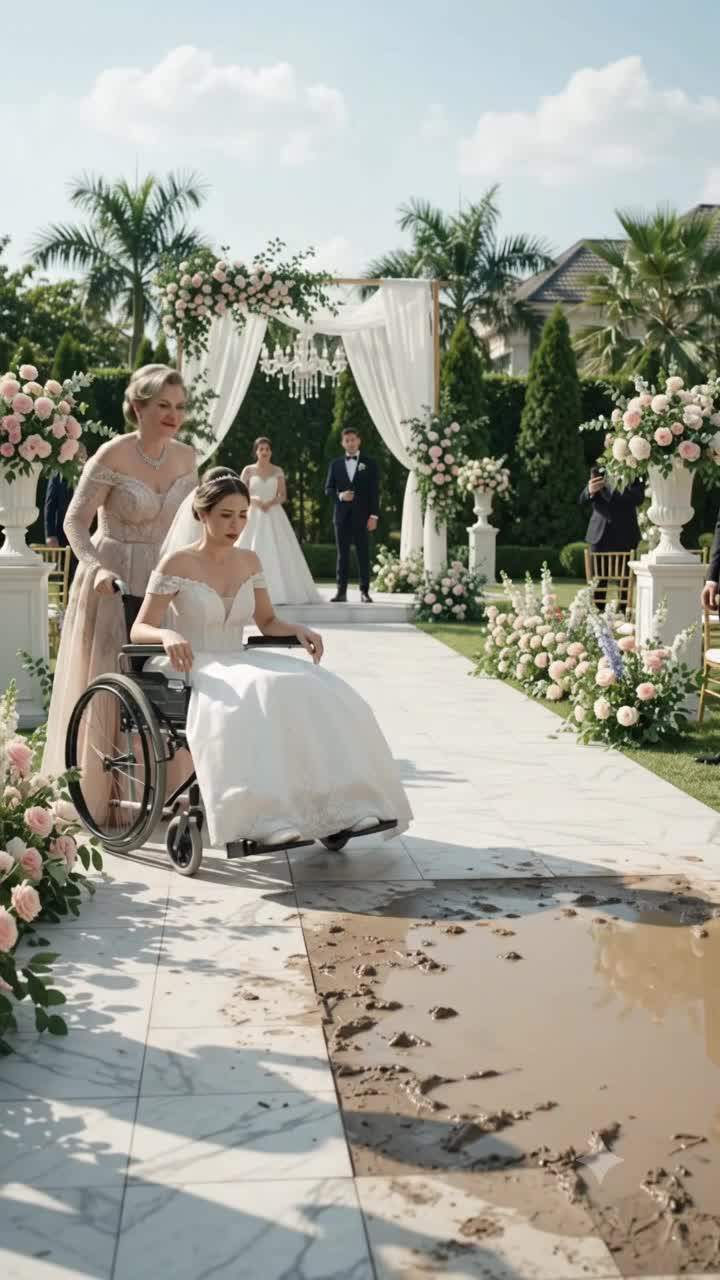
She occupied a custom-designed wheelchair, its polished chrome a stark contrast to her pale, almost translucent skin.
For ten years, Eleanor had been confined, a tragic consequence of a horse-riding accident that had left her lower body completely immobile.
Her expression was a masterpiece of controlled despair, a flicker of resentment in her otherwise vacant eyes.
VIPs in haute couture suits and diamond-encrusted gowns offered polite, distant smiles, their gazes carefully skirting her wheelchair as if disability were contagious.
The atmosphere was opulent yet suffocating, a silent testament to the family’s unwavering control and their deep-seated secrets.
Suddenly, the grand, mahogany doors at the far end of the ballroom, usually attended by stern-faced security, swung inward with an unceremonious creak.
Every head turned, champagne glasses paused mid-air.
A young boy, no older than fifteen, stood silhouetted against the stormy night outside.
He was a jarring anomaly in this tableau of perfection.
His clothes were ragged, matted with rain and street dust, his hair plastered to his forehead.
His eyes, however, held a fierce, unwavering intensity that defied his humble appearance.
A nervous whisper snaked through the crowd, quickly escalating to murmurs of shock and disgust.
The boy, oblivious to or perhaps indifferent to the scrutiny, began to walk slowly, deliberately, towards the raised dais where the wedding party was seated.
A handheld camera, seemingly operated by an invisible presence, moved through the crowd, capturing the genuine revulsion on a socialite's face, the frozen champagne bubbles reflecting the flickering candlelight.
The band, momentarily faltering, picked up a tentative, hushed tune, but the spell was broken.
The boy finally stopped before Eleanor’s wheelchair.
He met her gaze, and for a fleeting instant, a silent understanding passed between them, a spark of defiance in Eleanor’s desperate eyes.
The silence that followed was absolute, the kind that makes one acutely aware of their own breathing.
Only one person spoke, his voice carrying with an unnerving clarity.
“She can walk.”
The boy’s words were not a question, but a flat, undeniable statement.
Gasps rippled through the room, quickly suppressed by tight, nervous smiles.
The patriarch, old Mr. Beaumont, rose, his face a mask of furious indignation.
“Security! Remove this vagrant at once!” he thundered, his voice cracking with thinly veiled panic.
Advertisement
But before anyone could move, the boy did something unthinkable.
He knelt gracefully beside Eleanor’s wheelchair, utterly ignoring the billionaire’s command.
He reached out, his dusty hand gently coming to rest on Eleanor’s immobilized leg.
A faint, warm golden light emanated from his palm, not dazzling, but a soft, internal glow that seemed to seep into Eleanor’s very being.
It briefly illuminated the reflections of surrounding faces, crystal glasses, the polished marble floor, and the jewels adorning stunned guests.
A close-up view, from that unseen camera, captured the horrifying transformation on Eleanor's face.
Her expression slowly shifted from despair to utter confusion, then to raw, unadulterated shock.
Her fingers, delicate and trembling, gripped the armrests of her wheelchair with astonishing force, knuckles turning white.
Then, impossibly, her legs began to tremble.
Not the involuntary spasms of nerve damage, but a natural, almost primal tremor of awakening.
For the first time in years, those legs were reacting.
Nearby guests leaned forward, their disbelief palpable, their champagne glasses still frozen mid-air.
Doctors, renowned for their pessimistic diagnoses of Eleanor’s condition, stared, their professional composure shattering.
Wealthy socialites, the bride Isabella, even the stern Mr. Beaumont, were all overwhelmed, frozen in a tableau of shared astonishment.
The music had stopped completely.
The grand ballroom was enveloped in a silence so profound it felt like a physical weight pressing down.
Then—
With a guttural cry that was half-gasp, half-sob, Eleanor Beaumont slowly, excruciatingly, began to rise from her wheelchair.
Her body swayed precariously under the enormous crystal chandelier, her every muscle straining.
Her legs, weak and unused, trembled violently as she struggled to maintain balance, a terrifying, beautiful display of raw human will.
Several guests instinctively stepped back, their faces aghast, their minds struggling to process the impossible.
Champagne glasses seemed to literally freeze in mid-air, forgotten.
The band members, utterly stunned, remained silent, instruments held motionless.
A collective gasp of shock, followed by a torrent of astonished murmurs, erupted from the crowd.
Eleanor stood, wobbly, disoriented, but undeniably upright.
Her eyes, now filled with a ferocious, defiant light, swept across her family.
The golden glow from the boy’s hand had faded, but its effect was undeniable, and far more profound than a simple miracle.
This wasn't healing; it was an unveiling.
It was the moment a decade-old lie began to crumble.
Mr. Beaumont, his face now purple with a mixture of rage and terror, pointed a trembling finger at Eleanor.
“What is the meaning of this charade?!” he roared, his voice betraying the panic of a man whose carefully constructed world was collapsing.
Eleanor, still trembling, managed a wobbly step forward, her gaze fixed on her father.
“The meaning, Father,” she whispered, her voice hoarse from disuse, yet carrying through the stunned silence, “is that I was never truly paralyzed.”
The crowd erupted in a cacophony of whispers and gasps.
“My accident,” Eleanor continued, her voice gaining strength with each word, “was no accident at all. It was engineered.”
Her eyes darted to Isabella, who stood frozen, her perfect bridal smile shattered.
“Designed to remove me from the line of succession, to ensure Isabella’s path was clear.”
The boy, Caleb, still kneeling, watched the unfolding drama with a chilling satisfaction.
He was no random street urchin.
He was Caleb Beaumont, Eleanor’s half-brother, illegitimate and exiled years ago when he dared to question the circumstances of Eleanor’s so-called tragedy.
Advertisement
Eleanor, aware of the manipulation, had secretly maintained contact with Caleb through coded messages and clandestine meetings, plotting this very moment.
Her "disability" had been a desperate act of self-preservation, a shield against a ruthless family that saw her as a threat.
The forced marriage of Isabella tonight was the final straw, a symbol of their complete control.
Caleb’s arrival, his dramatic “healing,” was their meticulously planned signal.
The golden light? A small, theatrical device Eleanor had hidden, activated by a subtle pressure from Caleb’s hand.
It was designed to be a visual trigger, a dramatic flourish for her grand reveal.
She had endured years of feigned helplessness, years of desperate hope, waiting for this perfect, explosive moment.
“They wanted me silenced, broken, forgotten,” Eleanor declared, her voice now ringing with newfound authority, “but they underestimated my will, and my allies.”
She looked at Caleb, a silent acknowledgment passing between them.
The Beaumont family’s immaculate facade had been ripped apart, not by a miraculous healing, but by a carefully orchestrated act of rebellion.
The wedding of the year had become the scandal of the century.
As Eleanor took another faltering step, a new, fierce light in her eyes, the true battle for the Beaumont legacy had just begun.
The question now wasn’t just how she stood, but what she would do next.