My shift at The Obsidian Table always felt like walking a tightrope. Every gleaming fork, every whispered request, every demanding glance from our clientele was a potential misstep. I was Emily, just a waitress, barely scraping by in a city that gleamed with unattainable wealth, serving people who barely registered my existence beyond the uniform I wore.
I remember the day I first met Margaret Sterling, or rather, the day I was first introduced to her legend. She wasn't just wealthy; she was old money wealthy, with a reputation that preceded her like a chilly draft through the grand dining room. She was one of our most frequent, and notoriously difficult, patrons. Her husband, Richard Sterling, was a quiet, almost ghostly presence beside her, a stark contrast to Margaret's flamboyant, often cruel, demeanor.
My connection to the Sterlings, however, ran much deeper than just serving their caviar and champagne. It was a secret, a heavy burden I carried, folded neatly inside my apron pocket for months, a piece of paper that held the key to my entire future, and potentially, to their downfall. It was a promissory note, signed by Richard Sterling himself, for a sum that might have seemed negligible to them but was everything to me.
My late father, God rest his soul, had been a diligent, trustworthy foreman at one of Sterling Industries' older factories for decades. He wasn’t a rich man, but he was shrewd and saved every penny, especially for my college fund and, later, for my grandmother's specialized medical care. Richard Sterling, a few years back, had approached my father in desperation. His own family was facing a quiet, devastating financial crisis, a secret gambling debt that threatened to expose him and bankrupt certain family trusts. He needed a significant sum, quickly and discreetly, to prevent a complete catastrophe. My father, with a compassionate but cautious heart, had loaned him a substantial portion of his life savings, securing it with a rigorously drawn promissory note, due with interest within two years.
My father died before he saw a penny of it back. And then my grandmother’s health deteriorated rapidly, demanding costly treatments that I simply couldn't afford on a waitress's salary. I inherited that note, that last desperate hope, a silent testament to my father’s trust and Richard Sterling’s shame. I had tried to contact Mr. Sterling subtly, discreetly, as my father had intended, but he always deferred, promising to "make arrangements soon," always "soon."
Meanwhile, Margaret's daily humiliation of me and other staff grew unbearable. She reveled in making us feel small, less than human, often singling me out. "Emily, dear," she would purr, her voice dripping with mock sweetness, "Are you sure you're cut out for this? You seem so… overwhelmed by simple tasks." Or, "Your uniform, darling, it looks a bit… lived-in. Perhaps you should consider a career where appearances matter less." Each barbed comment chipped away at my resolve, but I swallowed it down, thinking of my grandmother, thinking of the note, thinking of the life my father had wanted for me. I needed this job, and I needed that money.
Today, she was worse than ever. The restaurant was bustling, a symphony of hushed conversations and clinking cutlery, but Margaret's voice seemed to cut through it all, aimed directly at me. She had complained about the temperature of her soup, the crispness of her salad, the very air she breathed. I had replaced her soup twice, adjusted the AC, even managed a polite smile as she dissected my every movement.
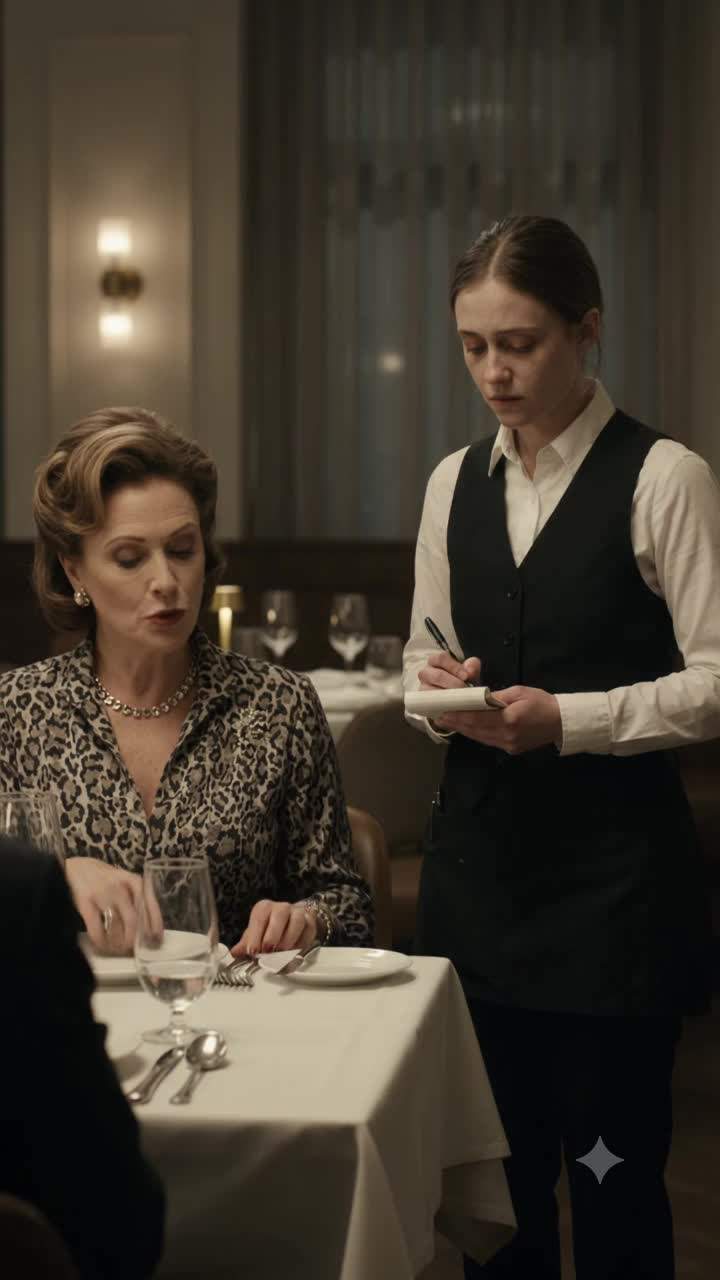
Then she started on my character. "Honestly, Emily," she sighed, pushing away a perfectly good amuse-bouche, "It's not just the food today. It's the whole… atmosphere you bring. A certain drabness. One expects a level of sophistication here, a spark, a touch of class. Some people are just destined for mediocrity, I suppose, no matter how hard they try to climb." Her eyes, cold and dismissive, raked over me, making me feel every thread of my uniform, every bead of sweat on my brow.
Something inside me snapped. It wasn't just the words; it was the cumulative weight of months of her petty cruelty, juxtaposed with the immense, unspoken debt her husband owed my family. It was the irony of her lecturing me on "class" while her husband harbored a secret that could shatter their carefully constructed world. My hands began to tremble, but this time it wasn't fear. It was a tremor of righteous fury. My vision narrowed, focusing only on her sneering face.
I took a deep breath, the kind that feels like it might tear your chest open. My usual meekness evaporated, replaced by a steel resolve I hadn't known I possessed. I set down my notepad on the nearest small table with a quiet, deliberate thud, the sound echoing strangely loud in my ears. I reached into my apron pocket, my fingers brushing against the crisp, folded paper I had carried like a talisman for so long.
"Perhaps I don't belong here, ma'am," I said, my voice surprisingly steady, though I could feel the tremor deep within my chest. I looked directly into her shocked, then irritated, eyes. "But neither, it seems, does your husband."
I pulled out the promissory note, unfolding it slowly, deliberately, giving her ample time to recognize the signature, the official-looking script. The rustle of the paper seemed deafening. I held it up, not dramatically, but simply so she could see it clearly. Her condescending smirk had melted away, replaced first by confusion, then a dawning horror that spread across her features like a stain. Her eyes, usually so sharp and critical, widened in disbelief. She knew. She recognized her husband’s distinctive, elegant signature.
"What... what is that?" she whispered, her voice barely audible, a stark contrast to her earlier booming declarations. Her perfect composure shattered, her hand flying to her mouth.
I met her gaze, no longer subservient, no longer afraid. "It's a debt," I stated, my voice now laced with a bitter resolve. "Signed by Mr. Sterling himself. A rather substantial sum, I might add. With interest." The words hung in the air, heavy with unspoken implications.
The silence that followed was deafening, broken only by the distant clatter of the kitchen and the sudden, stunned hush from the tables around us. A few heads turned, sensing the shift in dynamics. Margaret, usually so imperious, looked utterly destroyed, her face drained of color, her eyes darting frantically between the note and my unwavering stare. Her arrogance had been a shield, and I had just found the crack in its armor.
Suddenly, our manager, Mr. Davies, was at our table, his face a mask of concern. "Is everything alright, ladies?" he asked, trying to project an air of calm that he clearly didn't feel. Margaret just gaped, speechless, pointing a trembling finger at the note. Mr. Davies, seeing the official-looking document, cleared his throat, sensing a deeper issue.
"Perhaps we should discuss this privately," he suggested, his gaze flicking to the curious onlookers. But the secret was already out. Margaret's carefully curated image of untouchable wealth and perfect marital bliss had just been irrevocably tarnished.
Richard Sterling was called. He arrived within minutes, looking disheveled and pale, having been informed of "an urgent family matter" at the restaurant. When he saw me, standing defiantly with the note in my hand, and his wife, white-faced and trembling, he knew immediately. The color drained from his face, and he visibly sagged.
He confessed everything right there in a semi-private alcove, away from the immediate gaze of the main dining room, but still within earshot of several staff members. The hidden gambling addiction, the desperate loans, the promissory note to my father, the repeated promises to pay it back. Margaret listened, her face contorting through disbelief, rage, and finally, a profound, humiliating shame. Her husband had not only jeopardized their fortune but had done so with a secret from a mere employee's family.
"I will have the money transferred by the end of the day, Emily," Richard said, his voice thick with a mixture of embarrassment and relief that the truth was finally out. "And the interest, of course. My deepest apologies for the delay and for… everything."
Margaret, for once, was silent. Her empire of condescension had crumbled around her. My personal revenge was sweet, but the real victory was seeing the fear and the truth etched onto their faces. I finally had my money for my grandmother’s treatment, and a profound sense of justice.
I walked out of The Obsidian Table that day, not with a notice of dismissal, but with a quiet, victorious resignation. I had endured the insults, swallowed my pride, and worked tirelessly, all for that moment. I no longer needed to serve them; I had served myself a dish of justice. My grandmother's medical bills were paid, and she had the best care available in her final months. As for Margaret Sterling, I heard she became a much quieter, less frequent diner, her haughty demeanor replaced by a haunted, subdued politeness. Some battles are won with a shout, others with a quietly held piece of paper. Mine was the latter, and it changed everything.