My hands still tremble slightly when I think about that afternoon, even now, months later.
It started like any other Tuesday at “The Daily Grind,” a small, vintage-themed coffee shop tucked away on a quiet side street.
The scent of roasting beans and warm pastry usually filled the air, a comforting blanket over the constant hum of city life.
But that day, a different kind of tension hung heavy, acrid like burnt sugar.
My name is Sophia, and for the past two years, this cafe had been my sanctuary and my livelihood.
It wasn't a glamorous job, but it paid the bills, and the regular customers often brought a smile to my face.
Then there was Mr. Richard Sterling.
Richard, as he preferred to be called, was a fixture in our city's elite circles, a renowned philanthropist whose name graced countless charity galas and foundation boards.
He was particularly famous for his “Sterling Endangered Species Protection Fund,” an organization he championed with fervent public speeches and grand gestures.
In person, however, Richard was a different man altogether.
He was a man who measured worth by brand names and price tags, his suits always impeccable, his watch glinting under the cafe's soft lighting.
He was also notoriously demanding, often sending back perfectly good lattes if the foam wasn't precisely to his liking, or complaining about the background music being too loud.
I had always tried to remain professional, to let his snobbery roll off me, but there were days it was harder than others.
Days when my own struggles felt overwhelming, and his casual disdain for anyone he deemed beneath him felt like a personal insult.
I worked hard, sometimes picking up extra shifts, trying to save enough to get my old car fixed, or to send a little extra to my younger brother for his college textbooks.
My passion, however, was for the very cause Richard publicly championed: animal welfare.
I volunteered at a local animal shelter on my days off, and every spare dollar I could muster went towards charities dedicated to protecting endangered species.
Ironically, the Sterling Endangered Species Protection Fund was one I had always admired, despite my reservations about its founder.
It seemed to do genuinely good work, funding conservation efforts globally.
A few months prior, a small collective of us, fellow volunteers and animal lovers, had pooled our meager resources and managed to raise a significant sum.
It was enough to make a real difference, enough to purchase equipment for a wildlife tracking project we believed in.
We decided to donate it to Richard’s fund, hoping our contribution would be maximized by his organization's reach.
We requested anonymity, wanting the focus to be on the cause, not our names.
I was the one who personally delivered the check, receiving a formal, albeit rather impersonal, receipt in return.
The amount was substantial, more than I had ever seen in one lump sum in my life, certainly more than what most people in my position earned in a year.
I tucked the receipt away, a quiet testament to our collective effort, never imagining it would become a weapon in a very different kind of battle.
That Tuesday, Richard walked in, already radiating an air of self-importance and thinly veiled irritation.
He ordered his usual elaborate custom coffee, making a show of checking his designer watch as if every second I spent preparing it was costing him a fortune.
The cafe was moderately busy, the usual lunchtime rush tapering off.
Advertisement
I was carrying his meticulously crafted drink, navigating between tables, when a child, giddy with sugar and excitement, darted unexpectedly from behind a potted palm.
It happened so fast.
I swerved, trying to avoid a collision, but my elbow knocked the ceramic mug.
Warm, dark coffee splashed across the front of Richard's pristine, charcoal-gray suit jacket.
A gasp rippled through the cafe.
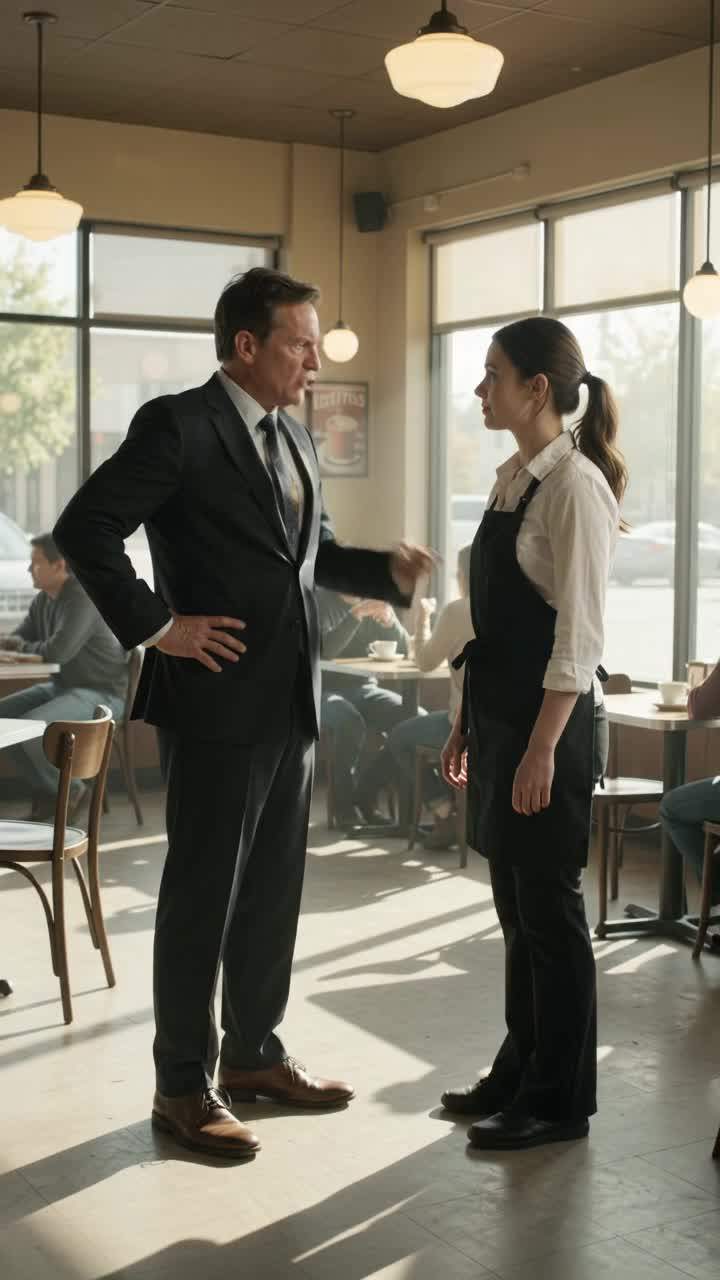
For a moment, silence hung in the air, thick with anticipation.
Then, Richard's face contorted, his carefully composed facade cracking into a mask of pure fury.
"Look at this!" he bellowed, his voice cutting through the soft murmur of conversations.
He pointed dramatically at the dark stain blooming on his chest, then at me, his finger trembling with outrage.
"My designer suit, ruined! Do you have any idea how much this cost?"
His words were laced with venom, dripping with condescension.
He spoke as if the suit's value transcended my very existence, as if my clumsiness was an unforgivable sin against luxury itself.
My cheeks flushed, not from shame, but from a surge of indignation.
I had spilled coffee, yes, an accident, but his reaction was disproportionate, cruel.
He stood there, chest puffed out, waiting for my apology, for my cowering submission.
But something inside me snapped.
All the quiet resentment, all the frustration at his hypocrisy, boiled to the surface.
I met his gaze, my own eyes cool and steady.
"I understand your concern, sir," I said, my voice surprisingly calm, belying the storm within.
He expected more, an apology, a promise to pay, but I offered neither.
Instead, I reached into the front pocket of my apron, my fingers closing around the folded piece of paper I had kept there for months.
I pulled it out, deliberately slowly, smoothing out the creases.
The cafe was completely silent now, all eyes on us.
Customers had paused mid-bite, conversations had died, their gazes fixed on the unfolding drama.
Richard watched me, a flicker of confusion replacing some of his anger.
What was I doing? Was I pulling out my wallet? My insurance card?
I held out the receipt, offering it to him.
"Perhaps this will put things into perspective," I said, my voice barely a whisper, yet it carried clearly in the stillness.
He snatched the paper from my hand, his brow furrowed in annoyance, clearly expecting some pathetic excuse or a bill for the coffee.
He unfolded it, his eyes scanning the printed text.
As he read, the color drained from his face.
His jaw went slack, his eyes widening in disbelief, then something akin to horror.
He looked up from the receipt, his gaze meeting mine again, but this time, all the arrogance had vanished, replaced by genuine shock and a dawning, terrible understanding.
"This... this is a donation receipt..." he stammered, his voice barely audible, completely devoid of its earlier booming authority.
"To my fund? And the amount..."
He trailed off, his eyes darting back to the paper, as if unable to process the numbers.
The amount was indeed staggering, dwarfing the cost of his precious suit many times over.
It was the receipt for the anonymous donation I, and my friends, had made to the Sterling Endangered Species Protection Fund.
His own fund.
He looked at me, a mere waitress, standing calmly before him, not apologizing for a coffee spill, but holding the proof of a generosity that shamed his petty outrage.
Advertisement
The silence in the cafe deepened, but now it was a different kind of silence, laced with revelation.
Other customers, who had been listening intently, exchanged glances.
Some leaned forward, trying to discern what was written on the paper.
The realization hit him like a physical blow.
He, the great philanthropist, was publicly berating someone who had contributed more to his beloved cause than his expensive suit was worth, someone who had done so anonymously and without seeking recognition.
He tried to speak again, but no words came out.
His face, once red with anger, was now pale, his lips slightly parted.
He crumpled the receipt slightly in his hand, then straightened it as if unsure what to do with it.
He looked around the cafe, sensing the shift in the atmosphere, the sudden scrutiny of the other patrons.
The whispers began, soft at first, then growing louder, carrying fragments of his earlier outburst and the word "donation."
Without another word, without even a glance at the coffee stain that suddenly seemed insignificant, Richard Sterling turned on his heel.
He almost stumbled as he made his way out of the cafe, moving with uncharacteristic haste, leaving behind the hushed conversations and the undeniable weight of his own hypocrisy.
I watched him go, a quiet sense of triumph unfurling within me.
I hadn't planned it, not really.
The receipt had been in my pocket for weeks, a reminder of what truly mattered.
But in that moment of his outrage, it felt like the only appropriate response.
My manager, Mr. Henderson, a kind man who usually avoided conflict, approached me cautiously.
He didn't scold me for the spill, or for confronting a prominent customer.
Instead, he just looked at me, then at the door Richard had exited through, a knowing look in his eyes.
"Sophia," he said, a small, approving smile playing on his lips, "you always have a way of handling things."
The incident became the talk of the cafe for days.
The story, whispered and embellished, soon spread beyond our walls.
Richard Sterling's meticulously crafted public image began to fray at the edges.
His next charity gala was noticeably less attended, his speeches met with a colder reception.
People started questioning his motives, his sincerity.
As for me, I kept my job, and found a quiet respect among my colleagues and regulars.
Some even tipped a little extra, giving me knowing smiles.
The stain on Richard's suit was long gone, probably dry-cleaned out of existence, but the stain on his reputation lingered.
And the receipt, that crumpled piece of paper that had once felt so insignificant, had done its job.
It wasn't about the coffee, or the suit, or even the money.
It was about values, about integrity, and about the quiet power of someone standing up for what they believe in, even in the face of arrogance and assumed superiority.
That day, the spilled coffee didn't just ruin a suit; it exposed the true cost of hypocrisy, and for me, that was priceless.