The fluorescent hum of the supermarket was usually a comforting drone to me, a soundtrack to the mundane rhythm of weekly errands.
It was a bright, almost aggressively cheerful Tuesday afternoon, the kind of day that mocked any lingering cynicism.
I had just grabbed a cart, the wonky wheel instantly reminding me of life's minor frustrations, and headed for the produce section.
My own list was short, but the queues, as always, were long, each snaking line a testament to our collective need for fresh avocados and frozen dinners.
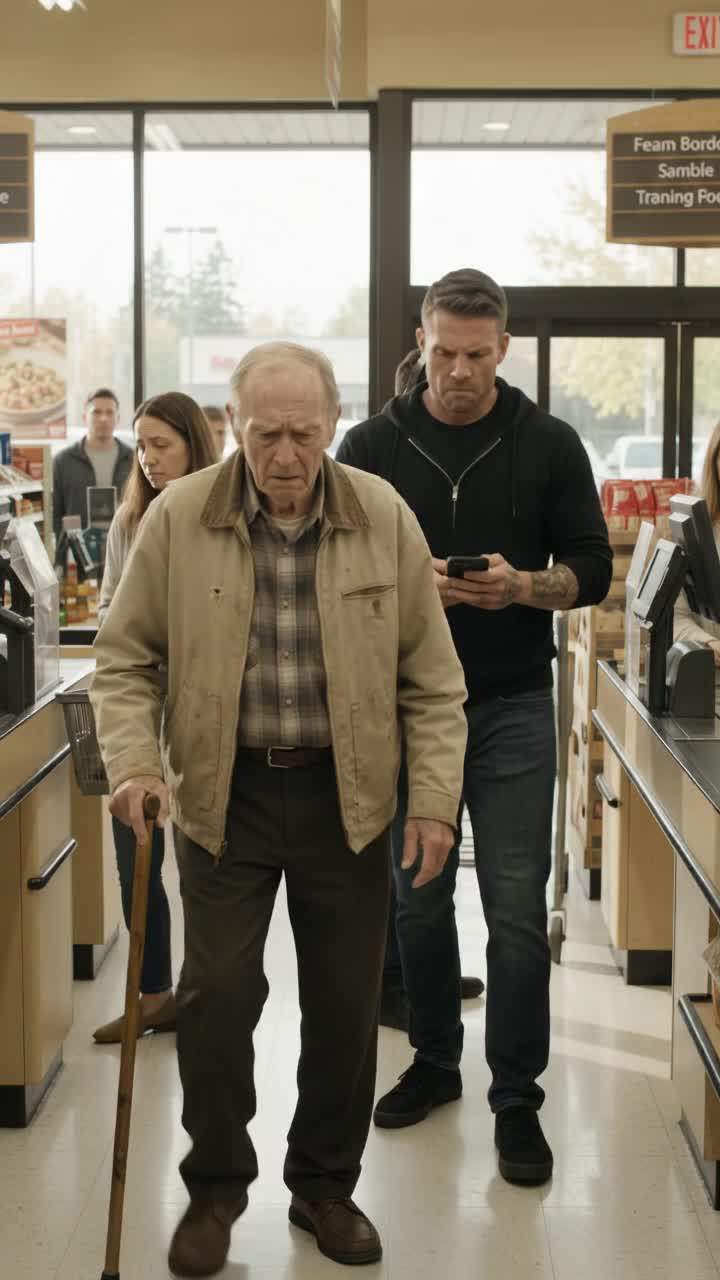
It was then I noticed him, several rows ahead, inching forward with a deliberation that felt almost ceremonial.
Arthur, his name I would soon learn, was an elderly man, probably in his early eighties, his frame brittle beneath a worn beige jacket.
He gripped a polished wooden cane, each step a careful negotiation with the tile floor, his shoulders slightly hunched, as if carrying the weight of years.
His movements were slow, yes, but they were not hesitant; they were simply the pace of a body that had seen many seasons.
Behind him, however, stood the antithesis of patience.
Chad, a young man radiating an almost palpable impatience, was a coiled spring of frustrated energy.
His black hoodie seemed to shrink his neck, making his jaw look perpetually clenched, and he kept checking his phone, then glaring up, then sighing dramatically.
I watched him from my distant vantage point, feeling that familiar twinge of discomfort that comes from witnessing rudeness before it fully blossoms.
The queue barely moved.
Arthur was gently placing his groceries, one by one, onto the conveyor belt, his fingers stiff, taking what felt like an eternity for a single can of soup.
Chad’s exasperation escalated from sighs to muttered curses, though I couldn't quite make out the words.
I could see other shoppers in the line, some casting sympathetic glances at Arthur, others avoiding eye contact, perhaps too busy or too uncomfortable to intervene.
My own heart was starting to pound a little, a familiar battle between my desire to avoid conflict and my growing sense of injustice.
I had seen my own grandmother struggle with similar tasks, and the thought of anyone treating her with such disregard made my blood simmer.
Then it happened, the moment that would forever be seared into my memory.
Arthur, having finally cleared his last item, was slowly trying to move forward, his hand reaching for his cart.
Chad, with a sudden, aggressive forward lurch, pushed his own cart into Arthur's back, a clear and deliberate bump.
Arthur stumbled, his frail body swaying precariously, his grip on his cane momentarily faltering.
A small gasp escaped my lips, but it was lost in the general supermarket din.
Chad didn't even flinch; he just lowered his head and let out a dismissive scoff, as if Arthur's near-fall was an inconvenience to his personal timeline.
My hands tightened on my own cart, a silent fury beginning to bubble inside me.
Arthur, with a quiet dignity that belied his physical fragility, slowly turned, his eyes wide and tinged with hurt.
"I'm trying... just a little more time," he whispered, his voice barely audible, a plea that seemed to hang in the stale air.
His gaze met Chad's, a stark contrast between vulnerability and callous disregard.
Chad’s response was immediate and chilling.
Advertisement
A smirk twisted his lips, a look of pure disdain.
Without a moment's hesitation, he swung his right foot out, a swift, deliberate motion, and kicked Arthur’s wooden cane, which was resting innocently by his leg.
The dull thud of wood against floor echoed surprisingly loud in the momentary silence that fell over our section of the queue.
The cane skittered across the polished floor, stopping several feet away, a helpless symbol of Arthur's lost stability.
Arthur let out a small cry, his body lurching violently as he lost his vital support.
He flailed, his arms grasping at empty air, before managing to catch the edge of the conveyor belt, his knuckles white, preventing a full, painful fall.
Chad stood there, his smirk widening into a sneer, a triumphant glint in his eyes.
"Oops. Butterfingers," he drawled, his voice laced with mocking humor, loud enough for everyone to hear.
A collective murmur rippled through the onlookers, a mix of shock and quiet disapproval, but still, no one stepped forward.
My heart ached, a sharp, physical pain of empathy and indignation.
I couldn’t stand it anymore.
My feet moved before my brain had fully registered the decision.
I strode forward, past the silent, uncomfortable faces, towards the fallen cane and the struggling old man.
I knelt, ignoring the stares, and retrieved Arthur's cane, handing it back to him with a gentle touch.
"Are you alright, sir?" I asked, my voice steady despite the tremor in my hands.
Arthur’s eyes, filled with a mixture of surprise and gratitude, met mine.
"Thank you, dear," he croaked, his voice still shaky, as he slowly regained his balance.
It was at that moment, as I helped Arthur steady himself, that a new voice cut through the tension, a voice of authority that made everyone, including Chad, stiffen.
"Chad Miller! What on earth do you think you are doing?!"
We all turned to see Ms. Brenda Thompson, the store manager, a formidable woman in her late fifties, marching towards us, her face a thundercloud.
She had obviously witnessed the tail end of the incident, her eyes now blazing with an anger that dwarfed Chad's earlier bravado.
Chad’s sneer vanished, replaced by a look of sheer terror.
"Ms. Thompson, I... he was just so slow..." he stammered, his bravado evaporating like morning mist.
Ms. Thompson ignored him, her gaze softening as she turned to Arthur.
"Mr. Henderson, are you hurt? I am so terribly sorry for this."
She gently took Arthur’s arm, her concern genuine.
"Mr. Henderson," she continued, her voice now stern as she turned her full attention back to Chad, "is not just any customer, Chad. He's been coming to this store since it opened, long before you were even a thought."
"He's a decorated veteran, a former school principal, and he's taught half the people in this town, including me, the meaning of respect and dignity."
The words hung heavy in the air, a sudden, public unveiling of Arthur’s true standing in the community.
Chad's face turned ashen, the color draining from his cheeks as the weight of his actions crashed down on him.
He wasn't just being rude to an old man; he was publicly shaming a local hero, a man revered by many, and doing it in front of his boss.
"Get your things, Chad," Ms. Thompson said, her voice low but firm, leaving no room for argument.
"You're not working here anymore."
A wave of relief and satisfaction washed over me, a feeling that resonated through the now-attentive queue.
Chad, utterly defeated, mumbled something unintelligible, abandoning his full cart, and slunk away, his head down, the swagger completely gone.
Ms. Thompson apologized profusely to Arthur again, and then to the rest of the queue for the disturbance.
Arthur, though shaken, managed a small, grateful smile.
"It's alright, Brenda," he said, his voice gaining a little strength.
"Sometimes, lessons need to be taught."
I finished my shopping with a lighter heart, feeling a quiet pride in my small act of intervention and witnessing the swift, satisfying justice.
Advertisement
As I left the supermarket, the bright sun still shining, I realized that moments of cruelty can indeed shine a light on the quiet strength of decency.
It was a stark reminder that even in the most mundane settings, our actions have consequences, and that kindness, though sometimes slow to appear, always has the power to prevail.