My heart hammered against my ribs, a frantic drumbeat echoing the countdown to a moment I had rehearsed a thousand times in the dark corners of my mind.
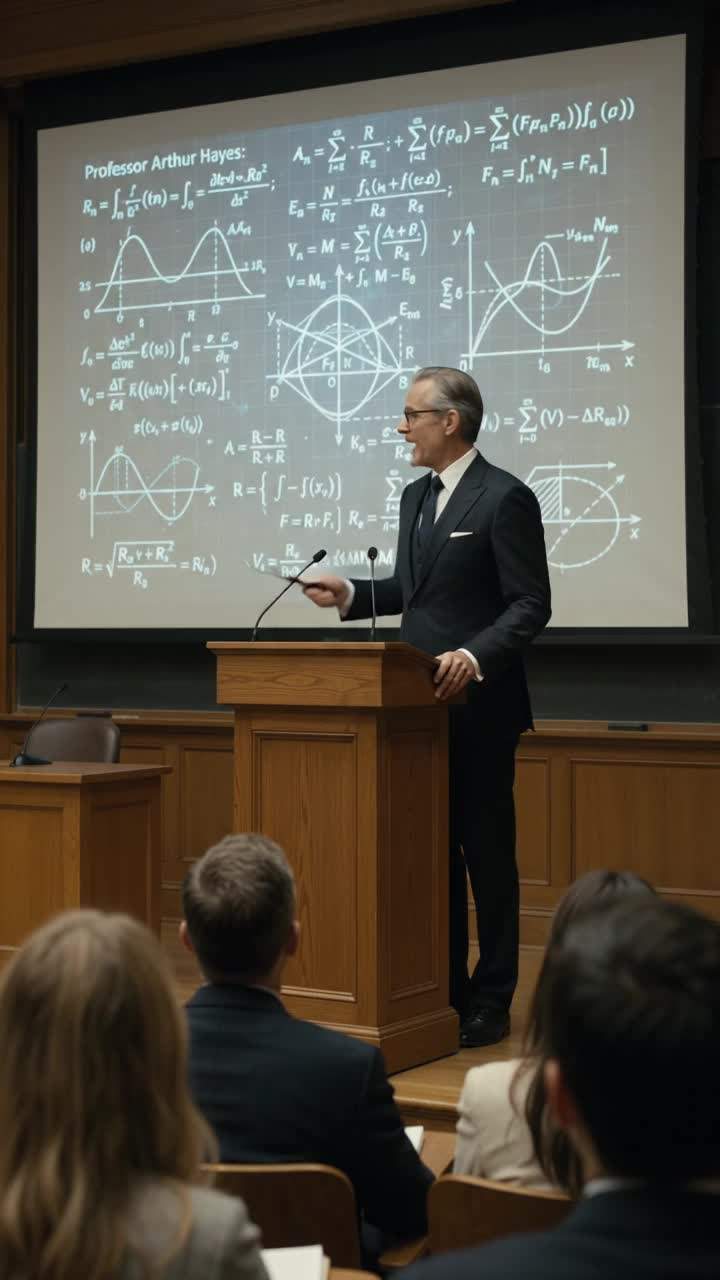
Professor Arthur Hayes, the titan of theoretical physics, my former mentor, stood bathed in the spotlight, his silver hair gleaming, his voice resonating with authority as he captivated the audience.
He was presenting "his" magnum opus, the culmination of decades, or so the world believed, of his brilliant intellect.
But I knew the truth, a truth that had been gnawing at my soul for five long years.
I clutched the worn leather portfolio in my lap, its contents my only weapon, my silent scream against the injustice that had almost consumed me.
The air in the grand lecture hall was thick with reverence, the scent of polished wood and old paper filling my nostrils, a stark contrast to the acid churning in my stomach.
He reached the part of his lecture where he unveiled the "Hayes-Petrova Unified Field Theory," a name that was supposed to be mine, entirely mine, before he stole it.
His words about its elegance and groundbreaking implications were a dagger twisting in an old wound.
I remembered the sleepless nights, the endless calculations scribbled across countless notebooks, the exhilarating Eureka moment when the complex equations finally clicked into place.
I was a bright-eyed, ambitious PhD student then, brimming with trust for the man I considered a scientific deity.
Professor Hayes had been my supervisor, my academic father figure, the one who first saw the flicker of genius in my raw ideas.
I had shared my initial breakthroughs with him, excitedly detailing the intricate pathways of my thought process, the novel approaches I had dared to take.
He had praised me, called me "extraordinarily gifted," and promised to help me refine the theory for publication, suggesting we work on it together.
I was ecstatic, believing my career was about to launch under the wing of a legend.
But then the subtle shifts began.
His encouragement turned into subtle critiques, then outright dismissal of certain aspects, deeming them "immature" or "requiring further thought."
He suggested I put the project aside for a while, focus on other, less ambitious papers to build my bibliography.
Naively, I complied, trusting his seasoned judgment, believing he had my best interests at heart.
He became elusive, his office door often closed, his responses to my emails curt and dismissive.
My attempts to revisit the unified field theory were met with a firm "not yet, Lena, not yet."
Then came the first sting: a conference abstract, bearing his name alone, hinting at concepts startlingly similar to my own preliminary work.
My heart sank, a cold dread washing over me.
When his full paper appeared in a prestigious journal six months later, it was unmistakable.
Every core premise, every unique mathematical derivation, even some of the illustrative examples I had painstakingly crafted, were there, attributed solely to Arthur Hayes.
He had taken my intellectual child, scrubbed my name from its birth certificate, and presented it as his own.
I confronted him in his office, my voice trembling with a mixture of disbelief and fury.
He feigned surprise, then anger, accusing me of delusions, of being overly ambitious, of misunderstanding the collaborative nature of academia.
He subtly reminded me of his power, his connections, and how easily a young, unknown researcher could be ostracized in the cutthroat world of physics.
His words were veiled threats, painting a picture of academic ruin if I dared to challenge him.
Advertisement
I left his office that day shattered, my dreams in tatters, my trust annihilated.
The academic world, which I had once seen as a beacon of truth and discovery, now felt like a viper's nest.
For a time, I considered giving up, leaving science behind entirely.
The injustice was a heavy cloak I wore, stifling my passion, dimming my once bright intellect.
But deep down, a spark of defiance remained, fueled by the undeniable proof I still held: my original manuscript, dated and initialed by me, complete with all my raw, unfiltered notes.
It was my lifeline, my silent witness.
Years passed, and Professor Hayes soared to even greater heights on the back of "his" unified field theory.
He won awards, gave keynote speeches, became a celebrated figure, while I toiled in obscurity, my spirit bruised but not broken.
Every accolade he received felt like a personal insult, a public validation of his theft.
The pain never dulled; it festered, hardening into a resolve that surprised even me.
I realized that if I didn't fight, not only would he continue to profit from my work, but the integrity of the entire academic system would be compromised.
Today was the day.
Today, at his most celebrated moment, I would reclaim what was mine.
My palms were sweating, my breath shallow, as Professor Hayes projected the final, most intricate diagram of "his" theory onto the massive screen behind him.
It was the very diagram I had sketched out on a whiteboard in my small office, the one he had praised as "brilliant" before he stole it.
This was it.
I took a deep, shaky breath, pushed myself up from my seat in the third row, the leather portfolio held firmly in my hand.
My legs felt like jelly, but a surge of adrenaline coursed through me, silencing the fear.
"Excuse me, Professor Hayes," I called out, my voice surprisingly steady, cutting through the reverent silence of the hall.
His confident smile faltered, his eyes scanning the audience, annoyed at the interruption.
He found me, and for a split second, his eyes widened imperceptibly, a flicker of recognition, then a mask of polite irritation settled on his face.
"Yes, young lady?" he said, his tone dismissive, as if addressing an overly eager undergraduate.
I walked forward, my steps deliberate, until I was standing in the aisle, clearly visible to everyone.
I opened my portfolio, pulled out the thick, yellowed manuscript, its pages slightly dog-eared from years of desperate safekeeping.
"Professor," I stated, holding up the manuscript, letting its age and weight speak for themselves.
"This is my original research. My unified field theory."
Gasps rippled through the audience, a collective intake of breath.
His face, usually so composed, contorted into a mixture of shock and disbelief, then a flash of pure, unadulterated panic.
"Dated five years ago," I continued, my voice gaining strength, pointing to the faded ink of my signature and the departmental stamp on the title page.
"Identical, down to the last nuance, to your 'groundbreaking' theory."
I saw a few audience members, distinguished professors themselves, lean forward, their expressions a mixture of curiosity and dawning horror.
Professor Hayes stammered, his voice cracking, "That's... preposterous! This is a baseless accusation! Security!"
But it was too late.
The seed of doubt had been planted, watered by the tangible evidence I held.
Whispers erupted, growing into a murmur that filled the hall, drowning out his increasingly frantic attempts to regain control.
The projector screen behind him, still displaying "my" diagram, seemed to mock his fading authority.
Security arrived, but before they could reach me, several prominent academics from the front rows were already demanding answers, their faces etched with concern and suspicion.
The lecture hall descended into chaos, a whirlwind of shouts, questions, and the frantic clicking of camera phones.
The university launched an immediate investigation, which became a media circus.
The weight of my proof, combined with the testimony of a few former colleagues who had seen my early drafts, was undeniable.
Advertisement
Professor Hayes's empire crumbled with astonishing speed.
His awards were rescinded, his publications retracted, his reputation irrevocably shattered.
He became a pariah, a cautionary tale.
For me, the aftermath was a strange mix of vindication and exhaustion.
The academic world, once so hostile, now opened its doors, cautiously at first, then with genuine recognition.
My unified field theory, finally attributed to me, was published under my name, sparking renewed interest and research.
The path to justice was long and arduous, marked by immense emotional cost.
But standing there, manuscript in hand, reclaiming my truth in front of the world, was a moment of profound liberation.
It wasn't just about the theory anymore; it was about integrity, about courage, and about refusing to let silence be complicity.
I had lost years, but I had gained my voice, and that was a victory more profound than any award.