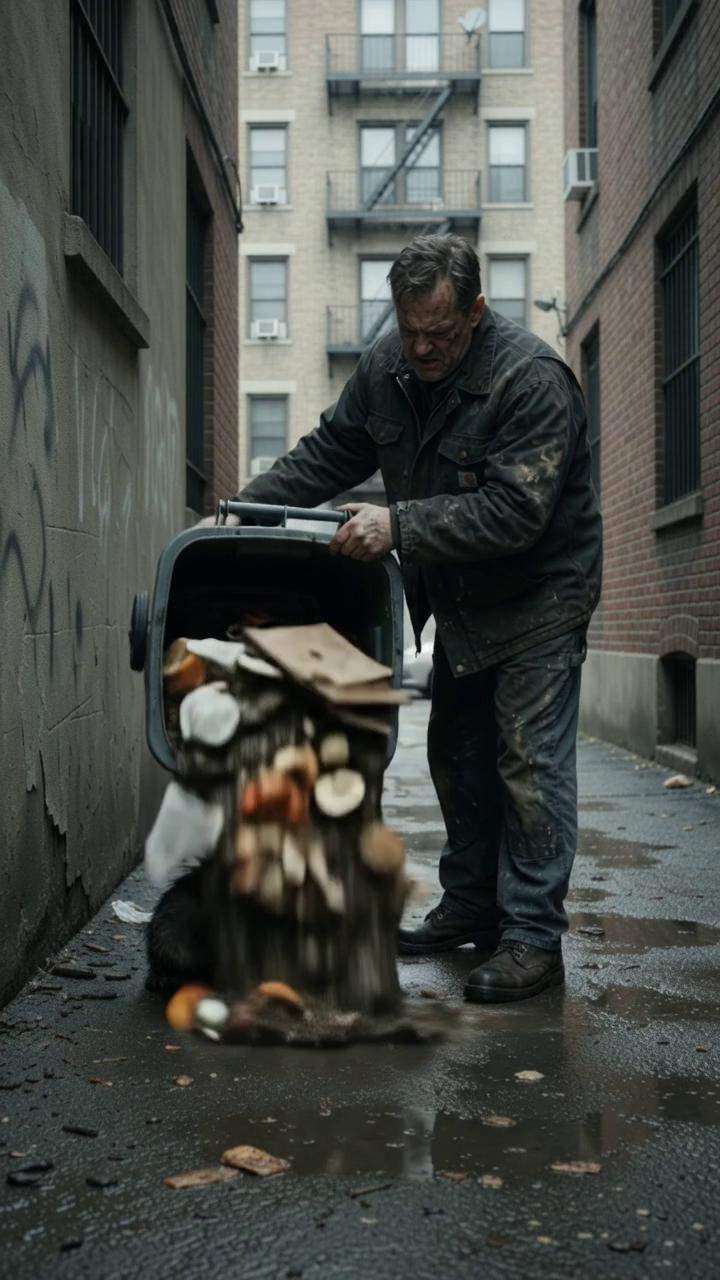
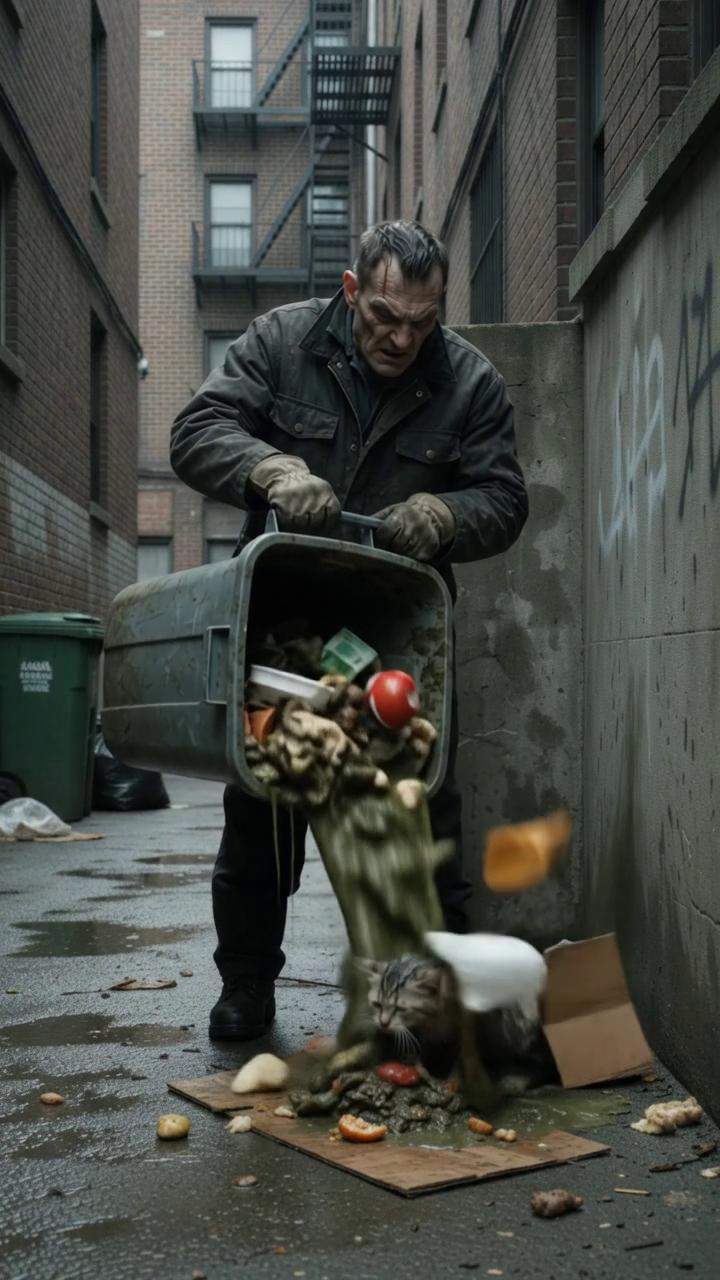
My name is Arthur, and I was once a man of blueprints and bold visions.
I crafted towering structures that kissed the sky, meticulously designed to withstand the tests of time and nature.
My hands, now calloused and stained with street grime, once held the future of cityscapes within their grasp.
I was an architect, respected, well-off, with a loving wife and a small, vibrant home.
Then came the storm, disguised as opportunity, in the form of a man named Maxwell Thorne.
He was a real estate mogul, a titan of industry, with a smile that promised partnership and eyes that spoke only of conquest.
I had poured five years of my life into a revolutionary urban development project, a sustainable city within a city, my magnum opus.
Thorne praised it, invested in it, then, with a flick of his wrist and a team of ruthless lawyers, he stripped me bare.
He claimed my designs were derivative, that I had violated contracts, fabricating evidence that painted me as a charlatan and a thief.
The legal battles were a farce, a rigged game against infinite resources.
I lost everything: my reputation, my savings, my home.
My wife, bless her heart, couldn't bear the shame and the endless fight; she left, taking with her the last vestiges of my hope.
Over the years, the descent was gradual, then swift, like a building collapsing floor by floor.
From a respected professional to a shadow on the streets, the pavement became my bed, the sky my roof.
I saw Maxwell Thorne’s empire grow, his name emblazoned on buildings that should have been a testament to my dreams.
And then there was Richard, his son.
Richard Thorne.
He was a younger, more arrogant version of his father, the same entitled smirk, the same cold, dismissive eyes.
He would often speed past my usual spot near the old market, his sleek black luxury sedan a cruel, gleaming taunt.
Sometimes, he would glance over, a fleeting sneer on his perfectly sculpted face, as if my very existence was an affront to his privileged world.
I had stopped begging years ago; pride, or what was left of it, prevented me.
Instead, I sat, silently observing the ceaseless churn of life, a forgotten sentinel of the city's underbelly.
That particular afternoon, the sun beat down with an almost oppressive intensity, baking the asphalt and making the air shimmer.
I had been fortunate earlier; a kind woman, a regular at the nearby bakery, had given me a small portion of leftover stew in my dented, trusty metal bowl.
It wasn't much, but it was warm, nourishing, and a rare comfort in my daily struggle.
I sat hunched against the rough brick wall, carefully spooning the stew, trying to make each mouthful last, savoring the simple warmth.
The rumble started subtly, growing quickly into a roar that momentarily eclipsed the city's usual cacophony.
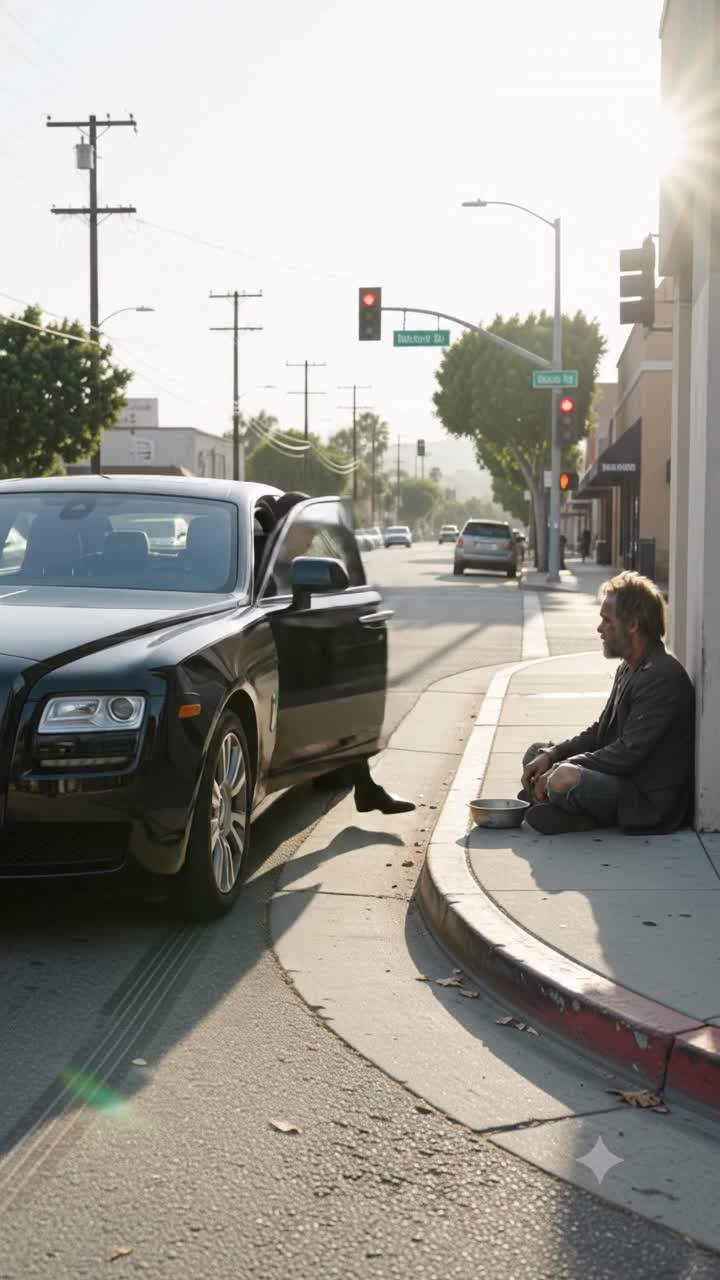
A black luxury car, a model I knew was obscenely expensive, screeched to an abrupt halt just a few feet from me.
The tires shrieked in protest, a violent sound that cut through the afternoon haze.
Advertisement
My head snapped up, my tired eyes blinking against the sudden intrusion.
It was him.
Richard Thorne.
He emerged from the driver’s side, his expensive suit immaculate, his face a mask of disdain.
He didn't just walk; he stalked, radiating an aura of superiority that made the very air around him feel thick with contempt.
He stopped directly in front of me, his shadow falling over my meagre meal, his presence a dark, suffocating weight.
My heart, usually a dull, rhythmic thud, picked up a frantic pace.
He stared down at me, his eyes narrowing with a look of pure disgust.
"Look at this filth," he drawled, his voice laced with an arrogant sneer.
It wasn't just an insult; it was a pronouncement, a judgment on my entire existence.
I merely met his gaze, my own eyes, though weary, holding a depth of experience he could never comprehend.
A slow, cruel smile spread across his lips, a mirror of his father’s predatory grin.
He raised his foot, not to kick me, but to deliver a more precise, calculated blow.
With a swift, contemptuous movement, he swung his leg, and his polished shoe connected with my metal bowl.
The clang was deafening, amplified by the sudden silence that seemed to fall around us.
The bowl skittered across the pavement, spinning wildly before clattering to a halt near the curb.
My precious stew, my last comfort, splattered across the dirty sidewalk, a tragic, greasy stain.
A few droplets even spattered my already grimy trousers, but I barely registered it.
I felt a tremor run through me, not of fear, but of an old, familiar emptiness.
He stood there, triumphant, his chest puffed out, clearly relishing my humiliation.
"You don't deserve even this," he spat, his voice dripping with condescension.
It was then, in that moment of ultimate degradation, that something inside me, long dormant, solidified into a block of ice.
I looked at him, truly looked at the entitled arrogance in his eyes, and a profound, chilling indifference settled over me.
He finally turned, a satisfied smirk still playing on his lips, and walked towards his car.
He pulled open the door, his movements fluid and confident.
I saw his hand instinctively reach for his phone on the dashboard, a familiar habit of constant distraction.
He must have been still looking back at me, or at something on his phone, because the moment he settled into the driver's seat, the car lurched.
A violent, unexpected acceleration.
The engine roared, a sound of unleashed, untamed power.
His tires spun, screaming against the asphalt, sending up a cloud of smoke.
Then, with a terrifying, uncontrolled surge, the car veered sharply to the right.
Richard's triumphant expression vanished, replaced by a look of pure, unadulterated terror.
His eyes widened, his mouth opened in a silent scream.
He wrestled with the wheel, but it was too late.
The black sedan, once a symbol of his unchallenged power, became a missile.
It slammed into the solid concrete base of a utility pole with an sickening crunch of metal and shattering glass.
The impact was tremendous, echoing through the street like a thunderclap.
Thick, dark smoke immediately billowed from beneath the mangled hood, a grim plume against the bright sky.
The luxurious front was crumpled, unrecognizable, its sleek lines twisted into a grotesque parody of its former glory.
Silence descended once more, heavy and absolute, broken only by the hiss of steam and the faint smell of burning oil.
Advertisement
I slowly pushed myself up from the ground, my joints stiff, my movements deliberate.
I walked to the edge of the curb, my eyes fixed on the wreckage.
Richard was slumped against the steering wheel, unmoving, blood staining his white shirt.
His face was barely visible through the shattered windshield, contorted in a final, agonizing expression of shock and pain.
I watched, not with joy, not with pity, but with a detached, clinical observation.
There was no triumph, no elation within me.
Just a profound, quiet stillness.
The universe had simply balanced its scales, not on my behalf, but through its own indifferent, brutal logic.
A distant wail of sirens began to grow louder, approaching fast.
People started to emerge from shops, pointing, gasping, their faces etched with horror.
But no one looked at me.
I was, as always, invisible.
I took a deep, shuddering breath, the smell of burning plastic and gasoline filling my nostrils.
I knelt and slowly, carefully, picked up the scattered pieces of my broken metal bowl.
It was beyond repair, its edges sharp and jagged.
Holding the fragments, I turned my back on the chaos, on the flashing lights that were now drawing near.
I walked away, my footsteps silent against the bustling city noise that was now returning, carrying the weight of my past, and the lightness of a burden finally, if tragically, released.
I was still Arthur, still homeless, still forgotten.
But as I walked, an imperceptible shift had occurred within me, a final acceptance that some justice, however harsh, finds its own way, whether I asked for it or not.
And in that moment, I felt nothing but a strange, unsettling peace.