My name is Sophia Sterling, and I grew up in a gilded cage.
Our family mansion, a behemoth of Victorian architecture, loomed over the city, a testament to my father Richard Sterling’s immense wealth and influence.
My father was, to me, a benevolent giant, a man who built an empire from nothing, showering us with every luxury imaginable.
My elder brother, Arthur, was different; intense, often brooding, he always seemed to see shadows where the rest of us saw only light.
My younger brother, Liam, was the carefree spirit, oblivious to any underlying tension, enjoying the fruits of our father’s labor without question.
Then there was Eleanor, our stepmother, who glided into our lives with an unsettling grace after my mother’s untimely death, her presence bringing a quiet, almost sterile order to the grand, but once warm, Sterling household.
Father’s health had been declining for months, a slow, insidious fade that stole his vigor and, it seemed, his peace of mind.
His sudden death, attributed to heart failure, left us all reeling, but Arthur… Arthur seemed to carry a heavier burden, a knowing look in his eyes that I couldn’t quite decipher.
He became obsessed, digging through old company ledgers, poring over archived documents, and asking uncomfortable questions about Eleanor’s sudden rise to prominence within our father’s affairs and the nature of his “late-night meetings.”
We, Liam and I, dismissed it as grief-fueled paranoia, a symptom of his struggle with loss, especially since Arthur had always been the most fiercely protective of our father’s legacy.
I, in particular, wanted nothing more than peace, to remember Dad as the benevolent patriarch, the loving figure who always had a comforting word.
Arthur’s relentless pursuit of answers often led to heated arguments with Eleanor, who skillfully deflected his inquiries with feigned concern for his mental well-being.
I found myself caught in the middle, torn between my desire for family harmony and the nagging suspicion that Arthur might be onto something.
The anticipation of the will reading had hung over us like a shroud, a formal declaration of a new era for the Sterling family, or so I hoped.
I envisioned a quiet affair, a dignified ceremony that would bring closure and a sense of continuity.
I had hoped for a simple division of assets, perhaps a trust for Liam and me, a confirmation of Arthur’s role in the family business.
The day arrived, stark and formal.
Mr. Davies, our family lawyer for decades, a man whose face held the creases of a thousand Sterling secrets, sat at the head of the polished mahogany table in my father’s opulent study.
Afternoon sunlight, thick with dust motes, streamed through the heavy velvet curtains, illuminating the tension in the room.
Eleanor, composed and elegant in a sleek black dress, sat opposite me, her perfectly coiffed hair catching the light, a faint, almost imperceptible smirk playing on her lips as she surveyed us.
Arthur was there too, but his presence was a storm waiting to break; he sat rigidly, his body coiled, his intense blue eyes fixed not on Mr. Davies, but on Eleanor.
I tried to catch his eye, to offer a silent plea for calm, but he just stared straight ahead, his jaw tight, a muscle twitching visibly in his cheek.
Mr. Davies began to read, his voice dry and monotonous, listing properties, investments, and trusts, the familiar legal jargon washing over us.
Then he reached the clauses pertaining to the main beneficiaries.
My inheritance was substantial, Liam’s equally so, confirming my initial hopes for our financial security.
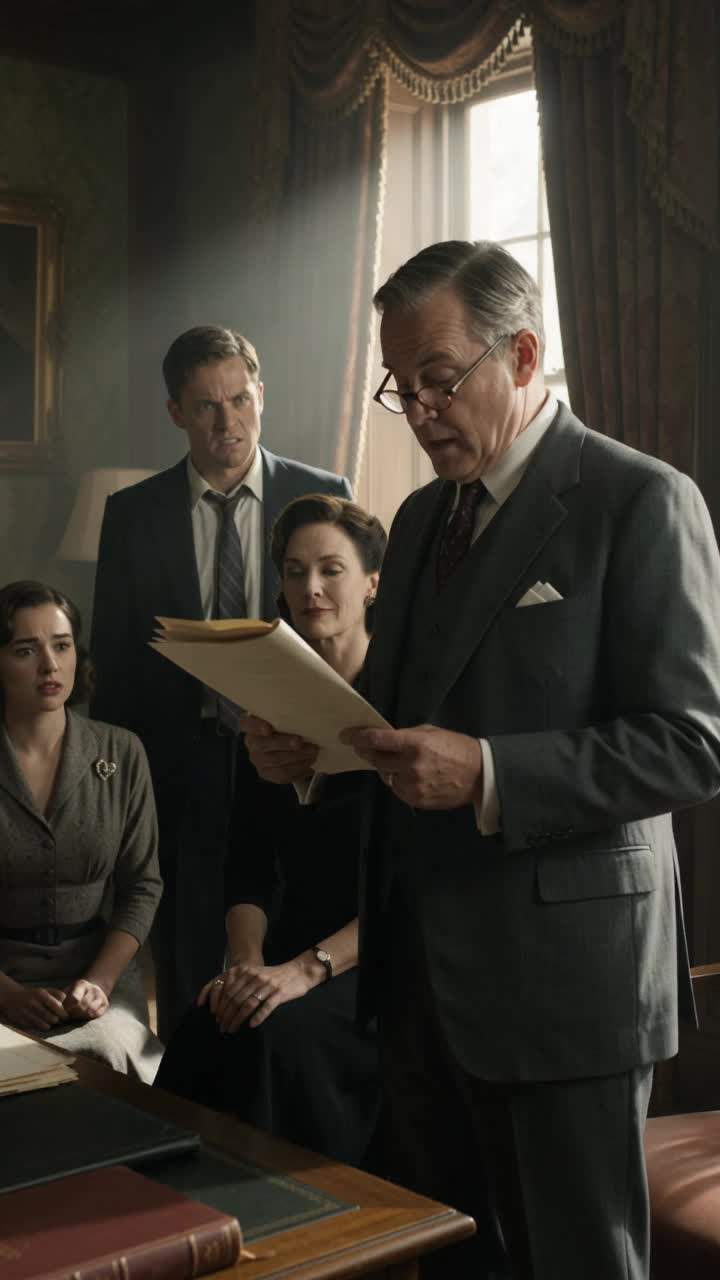
But then came the portion for Arthur – a pittance, a mere fraction, barely enough to be called a gesture, a clear and deliberate disinheritance from the bulk of the Sterling empire.
My heart sank, not for the money, but for the profound insult it represented to my brother, the eldest son, who had dedicated years to the family business.
Before Mr. Davies could even finish the humiliating clause, Arthur moved.
It was a blur of motion, sudden and violent, a stark contrast to the lawyer’s staid drone.
Advertisement
He snatched the leather-bound document from Mr. Davies’s trembling hands, the old lawyer gasping in surprise.
Then, with a forceful, deliberate motion, Arthur tore the will in half, the sound of ripping paper sharp and loud in the stunned silence of the room.
“This is worthless!” Arthur’s voice cut through the air, cold and clear, laced with an anger that shook me to my core.
“A pathetic lie! This is a farce! A forgery!”
My own gasp was swallowed by the sudden chaos.
Eleanor’s smugness vanished, replaced by a horrified pallor, her eyes wide with a fear I had never seen before.
Arthur threw the torn pieces onto the polished mahogany table, the fragments scattering like fallen leaves, then, with a thunderous slam, he laid down a thick, aged manila envelope beside them.
His eyes swept across the room, lingering on Eleanor, who recoiled as if struck, her hands fluttering instinctively to her mouth.
Liam, wide-eyed, could only stare.
Arthur’s final declaration, delivered with a grim, unwavering resolve, reverberated through the opulent study: “The real inheritance... is the truth!”
My world tilted, spun on its axis, as the reality of his words crashed over me.
The document in the envelope wasn’t just old papers; it looked official, stamped, sealed, ancient, and foreboding.
My mind raced, struggling to comprehend: what truth could be so devastating that it would make Arthur risk everything, tear apart our family in such a public, scandalous way?
Eleanor looked like she’d seen a ghost, her face devoid of all color, her elegant composure utterly shattered.
Arthur, his voice now a low, chilling drone, began to read excerpts from the document, and the truth, raw and ugly, began to unravel.
The papers detailed a massive, decades-old financial fraud, a meticulously planned scheme that allowed our father, in his early years, to acquire much of his initial wealth.
It wasn't just illicit business dealings; it was a ruthless campaign that involved the deliberate ruin of countless smaller businesses, the systematic destruction of innocent lives and livelihoods, all engineered to eliminate competition and consolidate power.
The document implicated a shadowy network, and with a sickening lurch, I realized Eleanor’s family, who had always been distant but influential, had been deeply involved in helping him cover it up, profiting immensely from the silence and complicity.
Her marriage to my father, it suddenly became clear, wasn’t merely a love match, or even one of convenience; it was a pact of silence, a consolidation of dirty money, a sealing of a shared, dark secret.
The "will" Mr. Davies had been reading, the one that so cruelly disinherited Arthur, was designed to protect this very secret, to silence anyone who dared to question the Sterling foundation.
Arthur, it turned out, had stumbled too close to the truth during his father’s final, lucid moments, and had inadvertently threatened to expose it all.
My father, weakened by illness and, I now understood, wracked with a profound guilt in his last days, had been manipulated by Eleanor and her family.
In his clouded state, he had signed a will that protected their shared criminal past, ensuring Arthur, the only one who truly sought justice, would be left with nothing.
I wanted to deny it, to scream that it was all a lie, a cruel fabrication to destroy our family.
My father, a criminal? Our entire legacy built on fraud and ruin?
But Arthur’s meticulous research, his unwavering conviction, the agonizing truth in his eyes, and Eleanor’s terrified, exposed face… it all clicked into place.
The whispers I’d overheard, the tense late-night arguments that had once been dismissed as business disputes, my father’s increasing reclusiveness and visible torment in his final months – it suddenly made a terrible kind of sense.
He had tried to confess to Arthur, who then started his own frantic investigation, piecing together the fragmented clues his dying father had provided.
Liam, my younger brother, was first bewildered, then furious, accusing Arthur of destroying our family name and squandering our inheritance.
But I saw the agony in Arthur’s eyes; this wasn’t about revenge, or spite, or even just the money.
This was about exposing a festering wound, about bringing light to decades of darkness.
I felt a profound, gut-wrenching sense of betrayal, not from Arthur, but from the very foundation of my life, from the man I had revered.
In that moment, I knew I had to choose, not between brothers, but between a comfortable lie and a painful truth.
The legal battle that followed was brutal, a media circus that descended upon our family with predatory glee.
The Sterling name, once synonymous with prosperity and impeccable reputation, became a byword for scandal and deceit.
Our assets were frozen, subjected to painstaking investigations, and eventually seized to compensate the countless victims whose lives our father’s schemes had shattered.
Eleanor was exposed as a calculating co-conspirator, her family’s past dealings coming to light, painting a picture of systemic corruption and greed.
My father’s carefully constructed image shattered, but from the wreckage, a different, more honest kind of truth emerged.
Arthur and I, and even Liam eventually, found ourselves stripped of our inherited wealth and the grandeur of our past.
Yet, in that profound loss, we gained something far more valuable: our integrity, our peace of mind.
Advertisement
We worked tirelessly to help the victims, to rebuild what we could, not of an empire, but of our own lives, finding meaning in restitution rather than accumulation.
I started a small foundation for victims of corporate fraud, using my unique and painful experience to advocate for others.
Arthur, finally free from the crushing burden of his secret, found a new purpose, directing his fierce intelligence towards ethical endeavors.
The mansion, once a symbol of our shadowed prosperity, was sold, its opulence replaced by a quiet, honest simplicity.
My world was indeed torn apart that day, but it was rebuilt, brick by painful brick, on a foundation of honesty and justice.
It was a devastating experience, a public humiliation, but it was finally real, and for the first time in my life, I felt truly free.