I still remember the oppressive heat of the graduation gown, clinging to my skin as if trying to absorb my shame.
It was supposed to be the proudest day of my life, the culmination of years of hard work, but for me, it felt like a public execution.
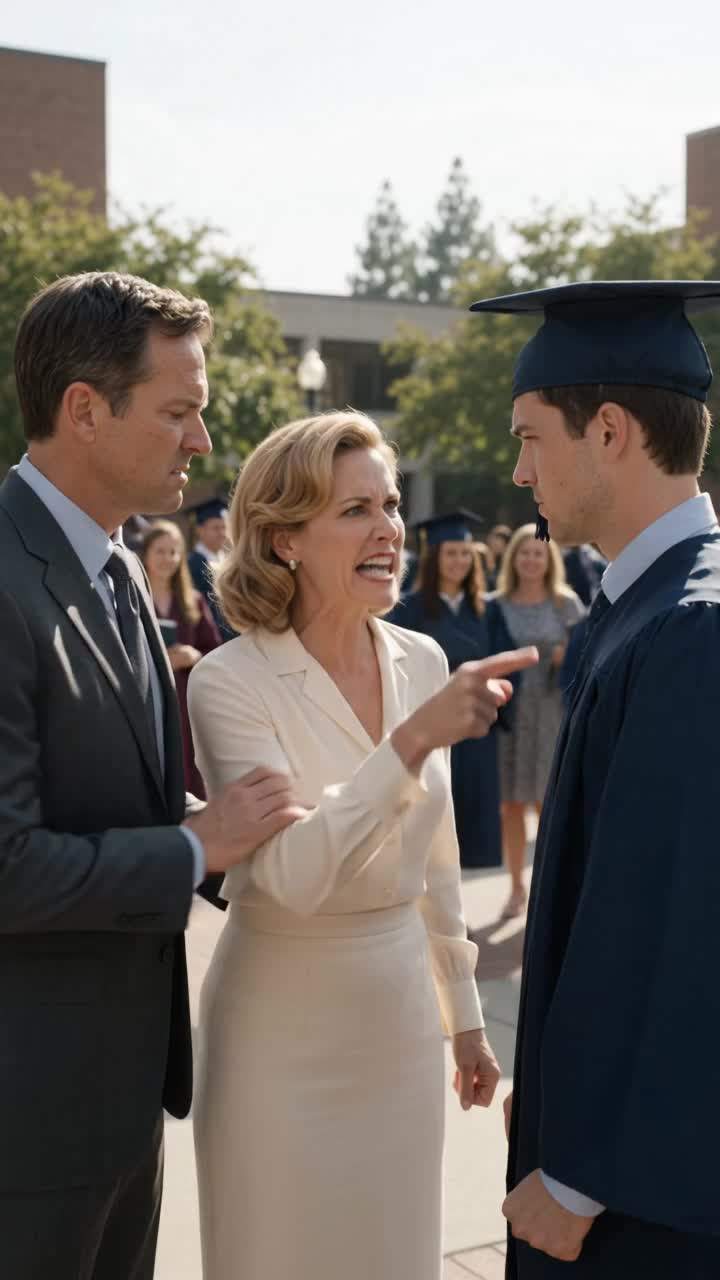
My parents, Sarah and David, stood a few yards away, their voices a venomous whisper, yet each word felt amplified by the grand, indifferent space of the university quad.
They were arguing, not with each other, but about me, their “disgraceful” son, on what should have been a day of celebration.
My stomach churned with a familiar mix of anger and despair as I overheard snippets of their bitter exchange.
“Expelled, David! Expelled!” my mother hissed, her voice edged with a desperation that always curdled into accusation.
My father, usually the more composed of the two, had a vein throbbing in his temple, his jaw tight.
“After everything we sacrificed for him, Sarah,” he muttered, his gaze piercing through me, a silent judgment that spoke volumes.
I squeezed my hands into fists inside the voluminous sleeves of my gown, my knuckles turning white.
“Expelled.”
That word had haunted me for months, a scarlet letter branded onto my reputation, even though it wasn't the full truth.
The truth was far more complex, a narrative my parents had refused to hear, blinded by their rigid expectations and the fear of public embarrassment.
I wasn’t expelled, not in the way they imagined, but I had withdrawn from State University under a cloud, a disciplinary action hanging over my head for an independent research project that had pushed the boundaries a little too far, challenging established protocols.
They saw it as insubordination, a direct attack on the respectable, predictable future they had meticulously planned for me.
I saw it as innovation, a necessary step beyond the confines of a curriculum that felt stifling, repetitive, and ultimately, beneath my true potential.
My parents, staunch believers in traditional success—Ivy League degrees, stable careers, a well-manicured life—had been devastated.
They envisioned a perfect graduation photo, a path laid out with minimal deviation.
My deviation, however, was significant, a chasm between their dreams and my reality, and they had spent every waking moment since the incident reminding me of my failure.
They called me reckless, ungrateful, a disappointment.
I called myself an outlier, an explorer, someone who simply refused to fit neatly into their predetermined box.
The argument reached a crescendo as my mother’s voice rose, cutting through the festive chatter of other families.
“How can we even show our faces here, David? Our son, a dropout, a failure, on graduation day!”
Her words felt like physical blows, each one chipping away at the fragile composure I had managed to maintain throughout the morning.
My face burned with humiliation, not just for myself, but for the spectacle my parents were creating.
People were starting to glance over, their smiles fading into curious frowns.
A wave of nausea washed over me, a familiar companion during these public shaming sessions.
I wished I could just disappear, melt into the bustling crowd, but I was rooted to the spot, a silent target.
Then, something inside me snapped.
Months of biting my tongue, enduring their scorn, and living under the shadow of their disappointment suddenly coalesced into a fierce, unwavering resolve.
Advertisement
I was tired of being their convenient scapegoat.
I was tired of being defined by their narrow perception of success.
With a surge of adrenaline, I lifted my head, my eyes locking onto theirs, my gaze burning with a newfound intensity.
My mother flinched slightly, momentarily silenced by the unexpected defiance in my eyes.
My father’s expression tightened, ready for another confrontation, another argument he assumed he would win.
But I wasn't about to argue.
I was about to deliver a truth that would shatter their carefully constructed narrative of my failure.
My hand, which had been clutching the edge of my gown, moved purposefully to an inner pocket.
I felt the crisp, official paper, folded neatly, a tangible symbol of my secret triumph.
I pulled it out, deliberately, slowly, letting the suspense hang heavy in the air between us.
It was an admission letter, not just any letter, but one from a place they respected, perhaps even revered.
My parents watched, their anger giving way to confusion, then to a flicker of something akin to curiosity.
They didn't recognize the official seal on the envelope immediately, but the formality of it, the pristine quality of the paper, seemed to momentarily disarm them.
I unfolded the letter, my fingers steady despite the tremor in my chest.
I held it up, high enough for them to clearly see the elegant, unmistakable crest of Harvard University.
The sun caught the embossed lettering, making it gleam like a beacon of my liberation.
My mother gasped, a sharp, choked sound, her eyes wide with disbelief.
My father’s jaw dropped, his face paling as he stared at the letter, then at me, then back at the letter as if trying to reconcile the impossible.
The noise of the graduation ceremony, the joyful shouts and laughter, seemed to fade into a distant hum.
All I heard was the pounding of my own heart, and the sudden, profound silence that enveloped my parents.
I took a deep breath, the air filling my lungs with a clarity I hadn't felt in months.
My voice, though not loud, carried an undeniable force, cutting through the silence, carrying the weight of all my unspoken frustrations and secret labors.
“I’m not expelled,” I stated, each word a stone dropped into the quiet pond of their shock.
Then, with a directness that left no room for doubt, I delivered the punchline, the truth that would irrevocably alter their perception of me.
“I got into Harvard.”
The words hung in the air, a declaration, a vindication, a seismic shift in our family dynamic.
My parents stared, their faces a canvas of warring emotions: disbelief, confusion, a dawning realization that verged on horror, and perhaps, just perhaps, a glimmer of pride.
The horror was for their own misjudgment, for the months they had spent berating me, for the public shame they had inflicted upon me, and upon themselves, based on an incomplete and distorted truth.
A few nearby families, who had been discreetly watching the unfolding drama, now openly turned, their whispers growing louder.
I didn’t care.
The weight of their judgment had lifted, replaced by a surge of triumph, cool and satisfying.
My mother’s hand flew to her mouth, her eyes welling up with tears that seemed to be a mix of regret and astonishment.
My father, typically stoic, finally broke his silence, his voice raspy, “Harvard? How… what is this?”
I lowered the letter, my gaze unwavering as I met their stunned stares.
“It’s a special admission,” I explained, my voice calmer now, the initial rush of defiance settling into a quiet confidence.
“For my astrophysics project. The one I was ‘expelled’ for.”
I watched as the pieces slowly clicked into place for them, the full irony of the situation dawning in their eyes.
My “failure” was, in fact, my key to an even greater success, a path I had forged entirely on my own, outside their rigid parameters.
They had dismissed my passion, condemned my unconventional approach, and yet, it was precisely that which had opened the door to an opportunity far beyond what they had ever envisioned for me at State University.
The path to that Harvard letter had been a lonely one, filled with late nights in my makeshift lab, countless rejections from traditional programs, and the constant, nagging doubt fueled by my parents’ criticisms.
Advertisement
But I had persevered, driven by an unyielding belief in my own vision and a desperate need to prove myself, not just to them, but to myself.
The Harvard admissions committee, it turned out, was looking for exactly the kind of unconventional thinking my former university had found problematic.
They had recognized the brilliance in my “disruptive” research, seeing potential where others saw only trouble.
My parents stood there, utterly speechless, the festive sounds of the graduation ceremony slowly returning to my ears, no longer mocking, but now a celebratory chorus.
The victory was mine, hard-won and deeply personal.
But in that moment, as I looked at their bewildered faces, I realized the deeper truth: this wasn't just about proving them wrong.
It was about finally being seen, truly seen, for who I was and what I was capable of.
The journey to mend the fractured relationship with my parents would be long, I knew.
An admission letter, even from Harvard, couldn't erase years of misunderstanding and emotional distance overnight.
But it was a start.
It was a bridge, built from my defiance and my dedication, spanning the chasm between their expectations and my destiny.
As I walked away from them, towards the cheering crowd and the promise of a future I had carved out for myself, I felt a lightness I hadn't known in years.
I wasn’t just graduating from a university that day; I was graduating from their shadow, stepping into my own light, finally free.