Six months had passed since the accident that stole my parents from us, a void that still echoed in every quiet corner of our lives.
The air in the cemetery was thick with unspoken grief and a tension that had been brewing between my older brother, Ethan, and me for weeks.
It was the first anniversary of their passing, a day I dreaded but knew I had to face, hoping for a moment of peace, perhaps even a shared memory with Ethan.
Instead, I found him already there, standing over their shared headstone, a familiar, intricately carved wooden box clutched in his hands.
That box, a seemingly innocuous object, had become the epicenter of our fracturing world.
Dad always kept it on his study desk, occasionally tracing its patterns with a thoughtful finger, calling it his “most cherished possession,” but he never let us open it.
After their death, with no clear will specifying personal effects, the box morphed into a symbol of everything we felt we’d lost, everything we felt we were owed.
Ethan, the elder, always burdened by Dad’s high expectations, saw it as his rightful inheritance, a tangible validation of his place as the family’s inheritor, the one who would carry on the legacy.
I, Liam, always feeling a step behind, yearned for a different kind of legacy from it, a personal message from Mom, a hidden testament to her love that I often felt overshadowed by Ethan’s more outward successes.
We hadn't spoken properly since the funeral, each phone call degenerating into terse accusations about who deserved what, especially concerning that damn box.
Seeing him at the grave, holding it, felt like a deliberate act of provocation, a final insult to our already shattered bond.
My chest tightened with a rage so potent it surprised me, a raw, primal anger born of grief and resentment.
“What are you doing, Ethan?” I demanded, my voice raw, breaking the somber silence of the graveyard.
He flinched, his head snapping up, his face gaunt and drawn, mirroring my own unspoken torment.
“I’m doing what Dad would have wanted,” he spat back, his grip tightening on the box.
“And how would you know that?” I countered, stepping closer, the gap between us filled with years of unspoken competition and fresh sorrow.
“Because I was always the one he trusted, the one he relied on,” Ethan sneered, a flicker of old insecurity in his eyes, now twisted into aggressive defense.
“Trusted to steal from your own brother?” I accused, my voice rising, the sacredness of the place momentarily forgotten.
He didn’t reply with words, but with a fierce pull on the box, as if to shield it from my gaze, from my very existence.
That was it, the final spark that ignited the powder keg of our shared, unacknowledged pain.
Without thinking, driven by an impulse both desperate and reckless, I lunged for the box.
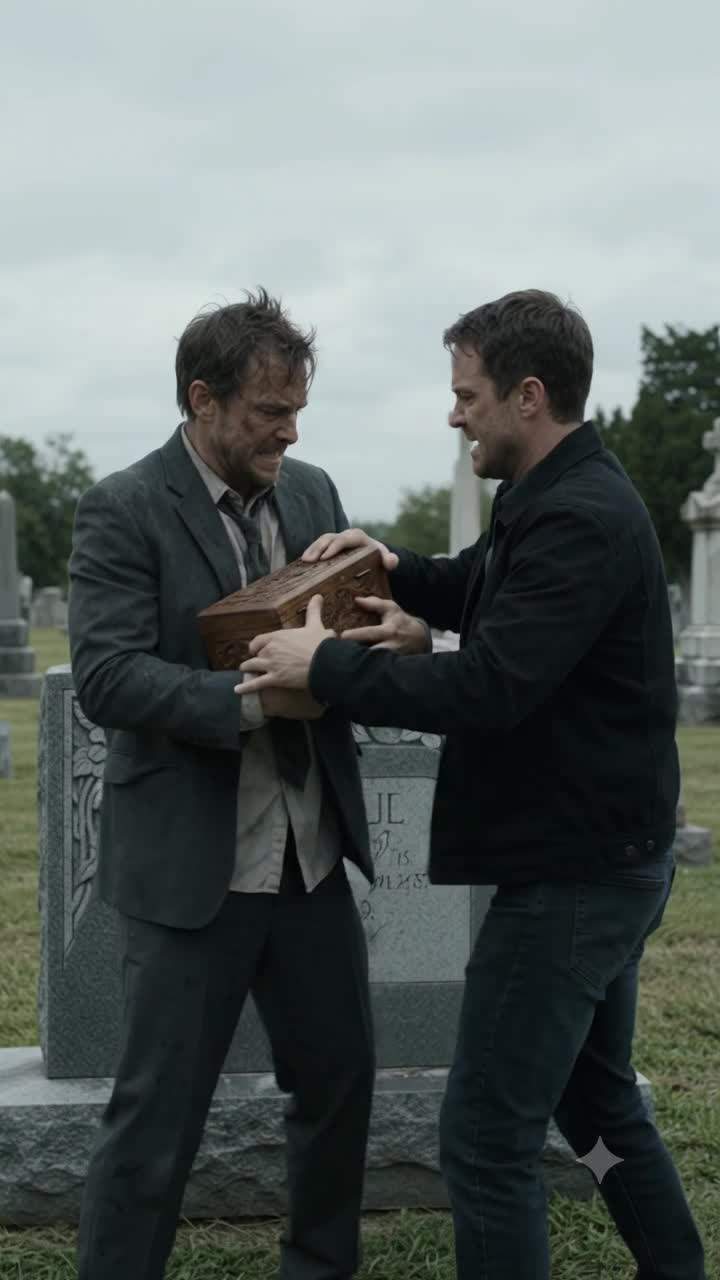
“It’s not just yours!” I yelled, my hands closing around his forearm, trying to pry his fingers open.
Ethan roared back, his face contorted with a mask of fury I barely recognized, and he resisted with surprising strength.
We wrestled there, amidst the solemn markers of countless lives, our parents’ tombstone looming over us, silent witnesses to our undignified descent.
The polished granite felt cold beneath my scrambling feet, the air growing heavy with our desperate grunts and the rustle of our clothes.
My vision blurred with tears and rage, focusing only on the wooden box, a prize that felt like our last tangible link to a past now utterly lost.
In the heat of the struggle, as Ethan twisted violently to break my hold, my elbow struck something hard and brittle on the edge of the headstone.
A sickening crash echoed through the quiet cemetery as the beautiful blue ceramic vase, filled with the fresh lilies I had just placed for Mom, fell.
It shattered against the stone base, pieces scattering like shards of our broken family, the vibrant white petals of the lilies strewn across the damp earth.
Advertisement
We both froze, our bodies still locked in a desperate embrace, but our eyes snapped simultaneously to the destruction.
A collective gasp escaped my lips, a sound of pure horror and disbelief.
“Look what you’ve done!” I choked out, my voice trembling, pointing a shaky finger at the fragmented pottery, my gaze then darting to our parents’ names etched above.
My accusation hung heavy in the air, a physical weight pressing down on us both.
Ethan’s face, moments ago a picture of pure aggression, now contorted into something akin to shock, then quickly hardened into a defiant mask.
He stared at the broken vase, then at the scattered flowers, a strange mixture of shame and anger warring in his eyes.
“Our parents are watching us!” I whispered, the words a desperate plea, a desperate shame washing over me.
His eyes, full of a pain I rarely saw, met mine for a fleeting second, but then darted away, fixed on the inscription on the tombstone, then back to the wooden box.
He clutched the box tighter to his chest, as if it were a shield against my words, against the crushing reality of our actions.
“They would understand!” he yelled, his voice cracking, thick with a desperation that was both familiar and alien.
He took a step back, separating us physically, but the emotional chasm between us only widened.
“You never did!” he added, his voice raspy, a low growl of accusation that sliced through me more effectively than any punch could have.
The words hung in the air, poisoning the sacred ground, the wind suddenly whistling through the ancient trees, a mournful lament.
I stood there, panting, surrounded by the remnants of our fragile peace, my brother a stranger holding a meaningless wooden box.
The fight had stopped, but the damage was done, the silence even more deafening than the crash.
A few other mourners, drawn by the commotion, were now staring, their expressions a mixture of shock and pity.
The shame was unbearable, a searing heat that spread through my entire body.
Ethan, still clutching the box, turned and stumbled away, disappearing quickly between the rows of headstones, leaving me alone with the shattered vase and the ruins of our brotherhood.
I knelt, not caring about the mud or the cold, and picked up a shard of the blue ceramic, its sharp edge a stark reminder of what we had just broken.
The lilies, once pristine, were now crushed and stained, their beauty ruined, just like the image of our family.
My parents, who had always preached unity and love, would have been devastated to see us, their only sons, tear each other apart over a mere object at their final resting place.
Weeks later, the box was finally opened, not by us, but by a family lawyer trying to mediate the absurd situation.
Inside, there was no secret fortune, no hidden will, no specific instructions for either of us.
There was only a single, faded, childish drawing of a stick-figure family, holding hands, with "Our Family" scrawled in my mother’s youthful handwriting.
Tucked into a tiny, almost invisible compartment, was a single, microscopic dried forget-me-not flower.
The revelation hit me like a physical blow, a sudden, brutal clarity that shamed me to my core.
The fight, the arguments, the years of unspoken resentment, the shattered vase at their grave – it had all been for a symbol of pure, unconditional family love.
It wasn't about inheritance or favoritism; it was about our own inability to process grief, our deep-seated insecurities manifesting as a desperate grab for a tangible piece of our parents.
The silence between Ethan and me persisted, colder and deeper than before.
We both received a copy of the drawing, framed it, and placed it somewhere private, a constant, painful reminder of our folly.
The box, once so powerful, now sat on a shelf in my home, a mere container for a simple truth we had violently overlooked.
I often visit their grave now, sometimes leaving a single lily, always making sure to bring a new, unbroken vase.
But the real breakage, the one in our family, remained.
The physical scar of the broken vase could be cleaned, the ground repaired, but the wound in our brotherhood felt permanent, a testament to the day our grief consumed us, leaving behind only fragments and regret.