A Gentleman's Demise
The insistent downpour had turned the cobblestones of Mayfair into a slick, mirroring canvas.
E.g. :The bridal march stopped dead when the chapel ceiling collapsed, exposing my groom's secret family.
- 1、A Gentleman's Demise
- 2、The Immaculate Crime Scene
- 3、A Stain on the Velvet
- 4、The Logic of Impossibility
- 5、Whispers of a Hidden Hand
- 6、The Sky Above, The Earth Below
- 7、A Signature in Mud
- 8、The Unseen Architect
- 9、Beneath the Facade
- 10、A Debt Unpaid
Detective Edmund Vale pulled his wool coat tighter against the biting wind, the gas lamps casting an ethereal glow on his grim ascent up the steps of Lord Ashworth’s opulent townhouse.
Sir Alistair Finch, a man whose face seemed perpetually etched with worry lines, greeted him at the door, his usual bluster replaced by a pale, quivering silence.
“It’s... it’s Lord Ashworth, Detective,” Finch stammered, leading Vale through dimly lit corridors redolent with the scent of old money and fresh grief.
The news had spread like wildfire through London’s upper crust: the esteemed industrialist, the man who built half the city’s railway lines, found dead in his study.
An apparent suicide.
Edmund, a man whose mind operated like a finely tuned clockwork mechanism, felt an immediate disquiet.
He had known Lord Ashworth, albeit briefly, and the notion of the fiercely pragmatic man taking his own life seemed… implausible.
Ashworth was a titan of industry, ruthless in business yet impeccably private, a man who meticulously orchestrated every aspect of his life.
Suicide felt too messy, too uncontrolled for his temperament.
As they approached the study door, the whispers from the downstairs staff grew louder, punctuated by the rhythmic tick of an unseen grandfather clock.
Finch paused, his hand hovering over the ornate brass knob, his eyes wide with a mixture of fear and something unreadable.
The Immaculate Crime Scene
The study was a shrine to wealth and intellect.
Leather-bound volumes lined floor-to-ceiling shelves, a grand mahogany desk stood center stage, cluttered with neatly stacked papers and a half-empty decanter of brandy.
The heavy velvet curtains were drawn, plunging the room into a gaslight-filtered twilight that accentuated the somber mood.
And there, beside the desk, slumped in his armchair, was Lord Ashworth.
A crystal vial, its contents a bitter-smelling residue, lay loosely in his hand.
The scene screamed suicide.
But Edmund’s gaze, sharp and unblinking, immediately swept past the obvious.
He noticed the heavy oak door, locked from the inside, the key still in the lock.
The tall, mullioned windows were latched, their sashes sealed tight, not a pane broken, not a speck of dust disturbed.
No visible signs of forced entry.
This was a sealed chamber, a perfect, self-contained tragedy.
Finch cleared his throat, “He locked himself in, Detective. No one could get to him. A terrible, private despair.”
Edmund simply nodded, his eyes now fixed on a detail that made his breath catch.
A Stain on the Velvet
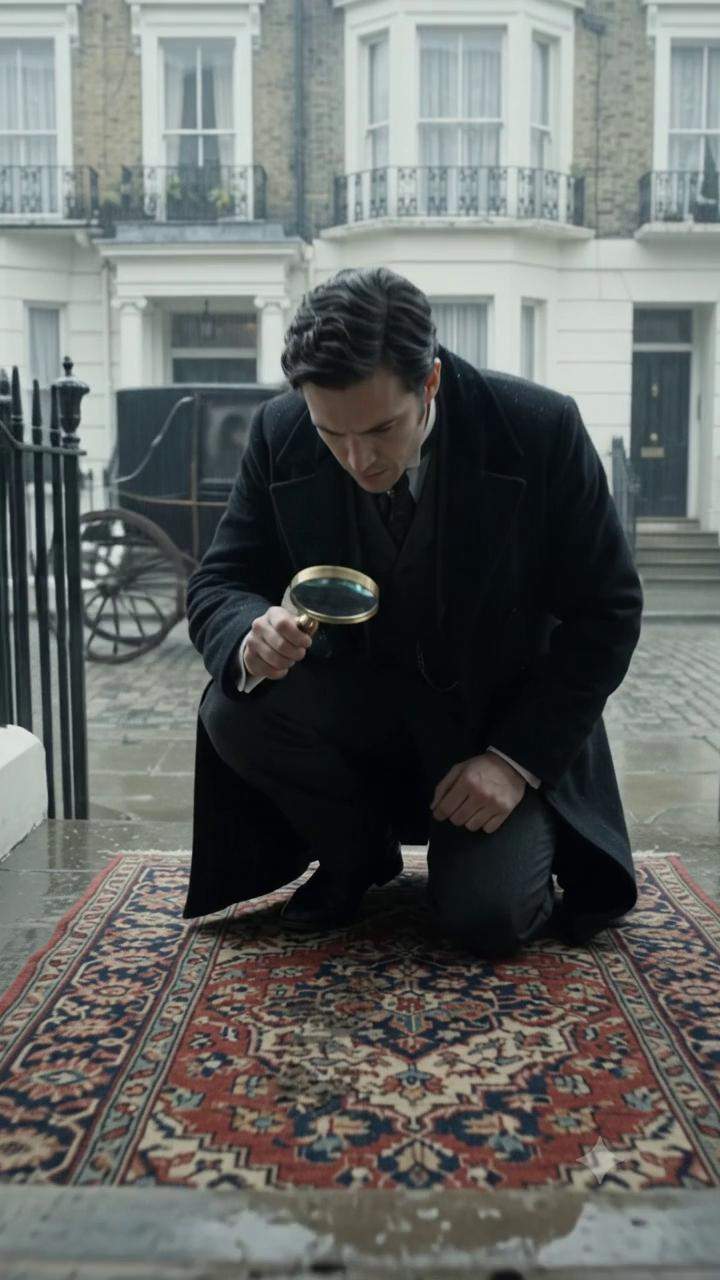
There, stark against the rich crimson and gold threads of the priceless Persian rug, was a single, muddy footprint.
It was distinct, the tread of a gentleman’s boot, pointing unmistakably towards Lord Ashworth’s slumped form.
A cold knot formed in Edmund’s stomach.
Advertisement
How?
How could mud from the sodden London streets appear in this hermetically sealed room?
He knelt, his magnifying glass glinting in the gaslight, examining the print with surgical precision.
The mud was dark, clotted, but entirely dry.
Not fresh, not tracked in.
It seemed to have appeared from nowhere, a ghost’s tread.
He ran a gloved finger along the delicate fibers of the rug around the print.
They were undisturbed, not matted down as if someone had walked through fresh mud.
It was as if the mud itself had materialized, then dried instantly, leaving a perfect, impossible impression.
His initial disquiet deepened into a profound sense of unease.
This was not merely an anomaly; it was a deliberate contradiction, an affront to reason.
The footprint mocked the locked door, the sealed windows, the very notion of a solitary, self-inflicted end.
This was no suicide.
This was a meticulously crafted lie.
The Logic of Impossibility
Edmund’s mind, a labyrinth of interconnected deductions, began to churn.
He rose and walked to the door, checking the lock again, tracing the tight seal of the frame.
He peered at the windows, noting the cobwebs that laced their outer sills, undisturbed.
There was no secret passage, no hidden panel in this old but sturdy townhouse.
He moved back to the footprint, his brow furrowed in concentration.
If no one entered, and the footprint pointed inward, how could it exist?
The mud’s dryness was key.
It implied time had passed since its placement, yet the scene suggested immediate discovery.
His memory palace, a vivid construct within his mind, sprang to life.
The room dissolved into a series of glowing lines and ghostly reconstructions.
He saw the door lock, heard its click.
He saw Ashworth slumping.
Then, in slow, deliberate motion, the muddy print appearing.
Not tracked in, but placed.
A chill coursed through him, a realization dawning: the footprint was a plant, an elaborate piece of misdirection.
But by whom?
And why leave such a glaring, impossible clue?
If it was meant to suggest an intruder, it failed spectacularly, instead screaming "stagecraft."
Whispers of a Hidden Hand
The implications were dizzying.
If the footprint was a deliberate plant, then Lord Ashworth’s death was no suicide.
It was either murder, ingeniously disguised, or something even more audacious: a faked death.
Ashworth was a man of immense power, but also immense secrets.
Rumors had spiraled for years about his shadowy business dealings, his vast network of clandestine contacts, and even whispered tales of a secret family in the countryside.
Could this elaborate deception be connected to a rival, or an attempt to escape his own entangled web?
Edmund recalled the subtle changes in Ashworth’s demeanor over the past few months.
A new tension in his shoulders, a guarded look in his eyes, a flicker of fear he'd once glimpsed at a society gala.
Advertisement
Ashworth had confided, vaguely, about "unscrupulous elements" threatening his latest railway expansion into the northern territories.
He spoke of an ambitious rival, a man named Silas Croft, Ashworth’s own protégé turned bitter competitor, whose ruthless ambition was legendary in the city's financial circles.
Could Croft be involved?
But how could he stage a crime in a locked room?
The Sky Above, The Earth Below
Edmund paced the room, his eyes scanning every surface, searching for the crack in the carefully constructed facade.
His gaze drifted upwards, instinctively.
The ceiling, usually an ignored expanse, suddenly drew his attention.
The plaster was a pristine cream, adorned with a delicate rococo pattern.
And there, directly above the impossible footprint on the rug, was another.
A faint, muddy imprint, identical in size and pattern to the one below, clinging impossibly to the ceiling.
His breath hitched.
It wasn't a trick of the light, nor was it debris.
It was a clear, undeniable muddy footprint, upside down, defying gravity and logic even more profoundly than the first.
He felt a sudden, cold wave of understanding.
"He didn't enter," Edmund whispered, his voice barely audible above the distant rumble of carriage wheels.
He wasn't referring to a killer entering the room.
He was referring to the origin of the footprints.
The ceiling footprint wasn't made by someone walking there.
It was a message.
A Signature in Mud
The identical nature of the prints, one on the floor, one on the ceiling, clicked into place like tumblers in a lock.
No human foot, no matter how acrobatic, could leave such a perfect, inverted mark on the ceiling without disturbing the delicate plasterwork, without leaving smudges or streaks.
This wasn’t a foot.
This was an impression from a device.
A stamp.
A tool designed to replicate a muddy boot print with chilling precision.
And the fact it was placed on the ceiling indicated a deliberate, almost taunting reveal, meant for someone discerning enough to look beyond the obvious.
This was the murderer’s signature, not in blood, but in mud.
Someone had used a sophisticated stamping device to create the illusion of an intruder.
But if it was a murder, why then the vial of poison and the locked room suggesting suicide?
The answer struck Edmund with the force of a physical blow.
The "suicide" was a cover.
The "intruder" footprint was a red herring to complicate the cover.
The ceiling footprint was the murderer’s own subtle, arrogant signature, meant to be discovered eventually by a mind like Edmund’s.
It was a frame.
The Unseen Architect
Suddenly, the pieces of Ashworth’s life, his secrets, and his ambition began to slot into place.
Lord Ashworth wasn't dead.
This entire scene was a theatrical masterpiece designed to fake his own demise, allowing him to escape his mounting debts, his legal troubles, and his powerful enemies, while simultaneously framing an unsuspecting party.
The poison vial was a theatrical prop, containing a harmless sedative, meticulously chosen to mimic the effects of a deadly poison.
Ashworth, meticulous as ever, had planned every detail.
But he hadn’t accounted for the brilliance of his own rival, Silas Croft.
Croft, a man of equal intellect and even greater ruthlessness, had foreseen Ashworth’s desperate plan.
Croft didn't want Ashworth merely gone; he wanted him ruined, disgraced, and utterly eradicated from public memory, while Croft seized control of Ashworth's empire.
Croft had discovered Ashworth’s plan, perhaps through a bribed servant, and had infiltrated the study before Ashworth sealed himself in.
He had used his own specialized stamp, meticulously crafted to mimic a generic gentleman’s boot, to add his own signature to Ashworth’s elaborate suicide ruse.
Beneath the Facade
Croft’s true stroke of genius lay in the timing.
He didn't kill Ashworth.
He merely modified Ashworth's staged suicide.
After Ashworth had placed the fake poison vial and prepared to disappear, Croft entered, subdued Ashworth (perhaps with a stronger, actual sedative), and then, using his unique stamp, added the footprints.
The one on the floor was to suggest an intruder, adding a layer of complexity to the apparent suicide.
The one on the ceiling was Croft's private taunt, a mark only a true investigator would find, signaling that he had seen through Ashworth's plot and taken control.
He then allowed Ashworth to "disappear," knowing that once the ceiling footprint was discovered, the entire "suicide" would unravel, and suspicion would fall on Ashworth for faking his death, effectively destroying his reputation.
Edmund’s gaze lingered on the face of the supposedly deceased industrialist.
Ashworth hadn’t truly committed suicide; he had been outmaneuvered, his grand escape plan hijacked and turned into a weapon against him.
Croft hadn't killed him, but he had orchestrated a fate far worse for a man of Ashworth’s pride: public humiliation and ruin.
The distant creak of a floorboard upstairs, unheard by Finch, now resonated with new meaning.
It was the sound of a new player, a shadow, moving in the labyrinthine game, perhaps a servant Croft had suborned, perhaps even Ashworth’s own hidden associate, making their escape or finalizing the deception.
A Debt Unpaid
Edmund straightened up, the solution crystallizing.
Ashworth had indeed planned to fake his death, but Croft had turned the tables, using Ashworth's own devices against him.
The muddy footprint on the floor was Ashworth’s intended red herring, but the identical one on the ceiling was Croft's brutal amendment, a silent declaration of his ultimate victory.
Ashworth, once a puppet master, was now the puppet, his reputation in tatters, his escape impossible, his empire stolen.
The "impossible footprint" was not a mystery of entry, but a story of betrayal, a signature left by the true architect of Ashworth’s downfall.
The real Lord Ashworth was likely still alive, a fugitive haunted by the ghost of his own failed escape and the chilling, muddy mark of his rival's triumph.
The game, Edmund knew, had only just begun.