I remember the crisp autumn air carrying the scent of burning leaves and something akin to dread, as I pulled my modest car into the sprawling, manicured driveway of my childhood home.
It was one of those obligatory family dinners, orchestrated by my mother, Eleanor, an event meant to project an image of perfect familial bliss that always felt like a carefully constructed lie.
My brother, James, was already there, his gleaming Porsche a stark contrast to my older, slightly dented sedan, a subtle but constant reminder of our differing paths and, more importantly, our mother’s differing affections.
James, the golden boy, the successful corporate lawyer, always impeccably dressed, always with the right answers, always the apple of Eleanor’s eye.
And then there was me, Clara, the artistic one, the free spirit, the one who chose passion over profits, empathy over ambition, much to my mother’s perpetual disappointment.
From a young age, I understood my place in Eleanor’s meticulously ordered world: a charming but ultimately flawed accessory, whereas James was the main exhibit.
My childhood was a constant, subtle competition I never signed up for, always feeling a need to prove my worth, to earn a fraction of the praise James received effortlessly.
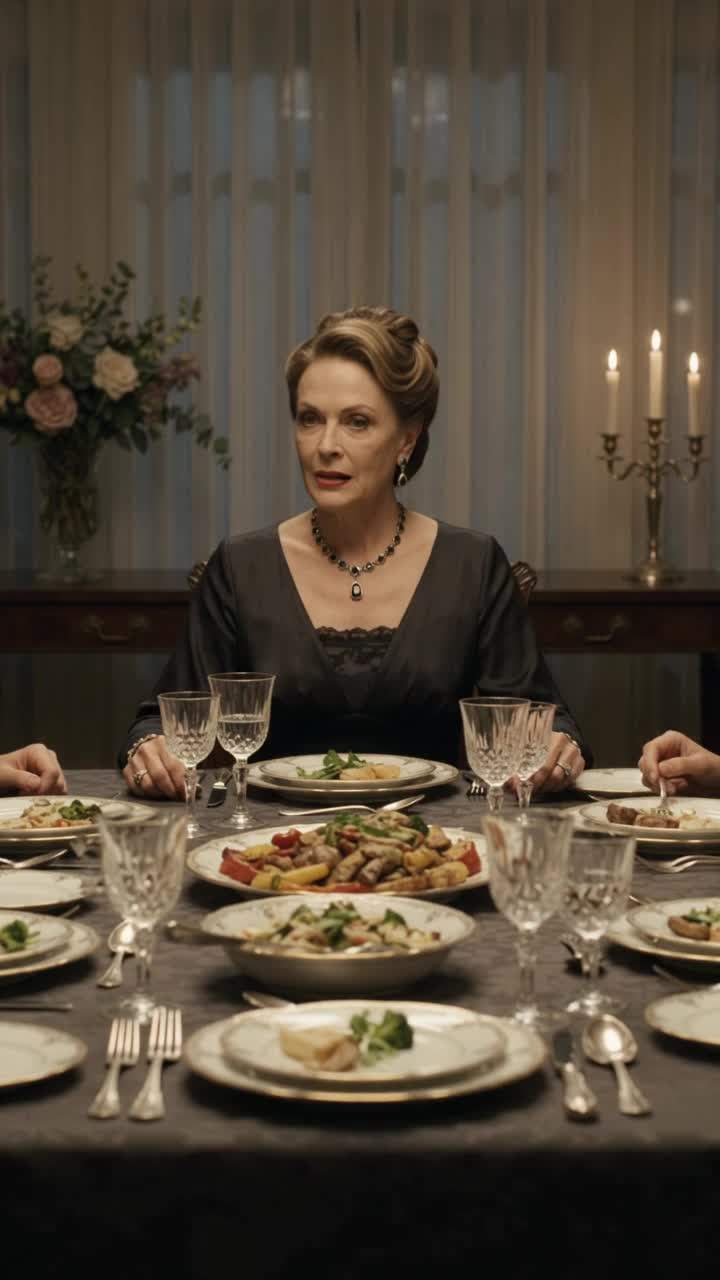
The dinner table itself was a battlefield tonight, adorned with heavy silverware and sparkling crystal, a feast prepared by caterers, reflecting Eleanor’s lavish taste and disdain for anything less than perfection.
Eleanor sat at the head, regal in her deep sapphire gown, her silver hair pulled back in a flawless chignon, her eyes, usually warm for James, held a cold, assessing gaze when they met mine.
James was seated to her right, his wife, Sarah, a petite woman perpetually uncomfortable under Eleanor’s scrutiny, beside him.
I was placed further down, opposite an aunt and uncle who always managed to make polite conversation feel like an interrogation.
The evening began with superficial pleasantries, forced smiles, and the clinking of glasses, a fragile veneer of normalcy.
I tried, as I always did, to engage, to contribute, to somehow bridge the silent chasm that existed between me and my mother.
But every topic I introduced seemed to be met with a subtle shift in conversation towards James’s latest achievement, his upcoming promotion, or his astute investments.
It was relentless, this slow, insidious erosion of my presence, a familiar dance of invalidation.
Then, halfway through the main course, after a particularly effusive monologue about James’s recent legal victory, Eleanor cleared her throat, her voice cutting through the polite chatter.
The silence that followed was heavy, expectant, the kind that precedes an important pronouncement.
I felt a cold knot tighten in my stomach, an instinctual dread.
Eleanor smiled, a thin, almost predatory smile, as she looked at James, then briefly, dismissively, at me.
“As you all know,” she began, her voice calm and authoritative, “my health hasn’t been what it used to be, and it’s time to finalize some affairs.”
James straightened in his seat, a flicker of excitement in his eyes that he quickly tried to mask.
I just braced myself, knowing instinctively where this was going.
“I’ve decided,” Eleanor continued, her gaze unwavering, “to transfer all my assets, the house, the investments, everything, solely to James.”
A collective gasp rippled through the table, quickly suppressed by a nervous cough from my aunt.
My heart pounded against my ribs, not from surprise, but from the raw, exposed wound of it all.
It wasn't the money; it was the outright public declaration of what I had always known but never wanted confirmed: I was not worthy.
Eleanor then turned her full attention to me, her voice dropping to a condescending murmur, a performance for the benefit of the gathered family.
“And honestly, Clara, after all your... unconventional choices over the years, James has simply proven himself more capable of managing the legacy.”
The words hung in the air, each one a sharp dart aimed directly at the accumulation of my life’s decisions, my entire being.
Advertisement
My art career, my decision not to marry a wealthy man, my refusal to conform to her expectations – all dismissed, all used as justification for my disinheritance.
I felt my blood run cold, then boil.
My hands, which had been resting calmly in my lap, clenched into tight fists, my knuckles turning white.
A tremor started deep within me, a seismic shift of years of suppressed anger, frustration, and profound hurt.
I took a sharp, ragged breath, my chest heaving, struggling to hold back the scream building in my throat.
My gaze swept over the table, over the pristine white tablecloth, the gleaming silver, the untouched, extravagant food, a symbol of all the wealth and status I had been deemed unworthy of.
Then my eyes locked onto James, who, despite his attempts to appear modest, wore a faint, smug smirk that sealed my fate.
His quiet triumph was the final insult, the last straw.
I felt something snap inside, a breaking point that had been building for decades.
I slammed my hands down onto the table, the delicate crystal glasses rattling violently.
“My choices?” I heard my own voice, low and dangerous, shaking with barely contained rage.
“You mean my entire life? You want to talk about my choices now?”
My voice rose with each word, losing its composure, gaining a desperate, raw power.
Eleanor flinched slightly, her poised facade cracking just for a moment, surprised by my sudden defiance.
James’s smirk vanished, replaced by a look of alarm.
Then, with a guttural roar that ripped from the deepest part of my soul, a sound born of years of neglect and emotional violence, I lurched forward.
I gripped the heavy mahogany table by its edge, the sheer force of my despair fueling an unexpected strength.
With one explosive shove, I sent the entire structure, laden with its pretense and its precious cargo, crashing onto the polished hardwood floor.
Plates shattered, cutlery clattered, gravy splattered across the pristine tablecloth, glass goblets exploded into a thousand glittering shards.
James scrambled back, nearly overturning his chair, his face a mask of shock and indignation.
A collective shriek of horror and surprise erupted from the other relatives, but it was Eleanor’s face I focused on.
Her eyes, usually so composed, widened in a mixture of fury, disbelief, and perhaps, for the first time, a flicker of genuine fear.
I stood there, panting, surrounded by the wreckage, my chest heaving, a strange, intoxicating mix of regret and liberation washing over me.
“This isn’t just about money, Mother!” I screamed, my voice hoarse and broken, echoing in the sudden, ringing silence.
“It never was!”
The truth of it hit me with the force of a physical blow – it was never about the inheritance, it was about validation, about love, about being seen as worthy, something she had consistently denied me my entire life.
In that moment, standing amidst the shattered porcelain and spilled wine, I finally saw the truth: the inheritance was merely the physical manifestation of her emotional will, a final, public act of favoritism that stripped me bare.
My chest still heaving, tears blurring my vision, I turned and walked away from the chaos, from the stunned faces, from the wreckage of a family dinner that mirrored the wreckage of my own heart.
I didn't look back as I left the dining room, my footsteps crunching on a shard of glass, a sharp, clean sound.
I grabbed my coat from the entry hall, ignoring the bewildered house staff, and pushed open the heavy front door, stepping out into the cold night air.
The silence outside was profound, a stark contrast to the cacophony I had just left behind.
I drove away, not knowing where I was going, but feeling a strange, hollow sense of freedom.
The outburst had been ugly, undignified, but it was undeniably mine, a primal scream from a soul that had been silenced for too long.
In the days and weeks that followed, the phone calls and texts from my relatives were a mixture of outrage, pity, and a few hesitant expressions of concern.
James, predictably, called to condemn my "unhinged behavior" and warn me about legal repercussions, as if I cared about the scraps of a life I never wanted.
Eleanor remained silent, a silence that spoke volumes, confirming her ultimate disapproval, her final judgment.
I grieved, not for the inheritance, but for the mother-daughter relationship that had never truly existed, for the dream of acceptance I had unknowingly clung to for so long.
The table flip was not just an act of destruction; it was an act of liberation.
It was my final, desperate attempt to reclaim my narrative, to assert my worth, not through Eleanor's eyes, but through my own.
It was the moment I stopped trying to be the daughter she wanted and started living for the woman I truly was.
Advertisement
My path forward was uncertain, but for the first time in my life, it felt entirely my own.
I chose to embrace my art with renewed vigor, finding solace and strength in creation, building a life defined by my values, not hers.
The memory of that night, of the shattered porcelain and Eleanor’s stunned face, remained a vivid scar, a reminder of the cost of authenticity.
But it was also a badge of honor, proof that I had finally, fiercely, chosen myself.