The Altar of Deception
The air in the Grand Ballroom of the Fitzwilliam-Waldorf estate was thick with the scent of white roses and the murmur of discreet, moneyed conversation.
Tonight, two empires were poised to unite.
Eleanor Fitzwilliam-Waldorf, an exquisite jewel of old-money aristocracy, was marrying Julian Archibald, the charismatic tech titan whose self-made billions had taken the world by storm.
He represented the future; she, the enduring legacy of a name whispered in hallowed halls for centuries.
Their union was lauded as the strategic merger of new wealth and old power, a force that would solidify both their positions at the apex of global society.
Eleanor, poised and elegant in her custom haute couture gown, radiated a quiet, regal beauty.
Her reserved emotions masked a sharp intellect, always keenly aware of her family’s venerable, yet sometimes vulnerable, standing.
Julian, a man whose charm was as legendary as his fortune, held her hand, his smile dazzling beneath the massive crystal chandelier that gleamed like a thousand captured stars.
A live orchestra swelled with a romantic symphony, its notes filling the hall adorned with towering champagne racks and VIPs draped in shimmering silks.
The giant LED wedding screen, usually reserved for sentimental montages, suddenly flickered.
It was precisely 7:00 PM, the moment the ceremony was reaching its emotional crescendo.
The romantic highlight reel of their meticulously curated courtship abruptly vanished.
A collective hush fell over the guests, a ripple of confusion spreading through the opulent space.
The Screen's Sinister Secret
What replaced it was a grainy, almost clandestine video feed.
The footage was shaky, clearly recorded on a phone in a dimly lit, nondescript room.
The man on screen was undeniably Julian Archibald, yet he looked… different.
His usual polished demeanor was replaced by a casual, almost smug swagger.
He wore a plain, dark hoodie, leaning against a graffiti-scarred wall, a half-empty fast-food wrapper discarded nearby.
He wasn’t the sophisticated billionaire they knew; he was someone else entirely.
A muffled, distorted voice, clearly his own, began to narrate.
He referred to himself not as Julian Archibald, but as “Arthur Davies.”
The audio, despite its poor quality, was disturbingly clear in its intent.
“The mark, the long game, the score,” he chuckled, the words echoing chillingly through the silent banquet hall.
Julian’s confident smile, moments ago so radiant, froze instantly on his face.
His eyes, wide with disbelief and a rising panic, darted frantically between the screen and the aghast faces of the guests.
“No, this isn’t real,” he muttered, a desperate plea caught in his throat.
Eleanor’s elegant composure began to fracture.
Her brow, usually smooth and unburdened, furrowed in a flicker of pure dread.
Advertisement
She turned slowly to Julian, her eyes holding a silent, terrifying question.
The orchestra had faltered, then died into an agonizing silence.
Champagne flutes were slowly lowered, clinking softly against marble tables, the only sound breaking the suffocating stillness.
Gasps rippled through the crowd, quickly followed by a furious whisper.
Several guests, ever slaves to sensationalism, discreetly raised their phones, their screens illuminating like tiny beacons of impending chaos.
The Unmasking
The video continued its merciless exposé.
“Arthur Davies,” with chilling precision, detailed his meticulous plan.
He spoke of how he had researched the Fitzwilliam-Waldorf family’s precarious finances, their aging patriarch’s vulnerabilities, their desperate need for a 'savior' to prop up their declining empire.
He recounted creating the persona of Julian Archibald, fabricating a history of meteoric success in tech, forging documents, and orchestrating a complex web of shell corporations.
He even chillingly alluded to the 'convenient accident' that had befell the real Julian Archibald, a distant, ailing relative whose identity he had seamlessly usurped years ago.
The audacity of the deception was breathtaking, the casual cruelty of his confession utterly sickening.
Julian, now completely unhinged, screamed.
“Turn it off! It’s fake! A smear campaign!” he roared, lunging towards the LED screen, only to be restrained by the bewildered security detail.
“Eleanor, it’s a setup! Don’t believe it!” His voice cracked, desperation tainting his previous smooth charm.
But his panic, his raw terror, was a confession in itself.
Eleanor watched, her face a stark canvas of controlled horror.
Her reserved emotions shattered, revealing not just anger, but profound, soul-deep betrayal.
She saw her family’s ancient name, their centuries-old legacy of power and influence, teetering on the precipice of utter ruin.
This was not merely a broken heart; this was the systematic dismantling of everything she and her ancestors had built.
The precarious financial health of her family, a secret burden she had carried for years, was now exposed, Julian having been the supposed key to their resurgence.
The Price of Deception
As the video reached its horrifying climax, a new, authoritative voice cut through “Arthur Davies’” monologue.
It was the crisp, unmistakable tone of a national news anchor.
“Breaking news,” the voice announced, “federal authorities have issued an international warrant for a man known by multiple aliases, including ‘Julian Archibald,’ for a multi-billion dollar fraud scheme, identity theft, and corporate espionage.”
The screen then flashed mugshots, none of which were the face of the man currently standing at the altar.
The anchor continued, detailing connections to several high-profile financial institutions, including a substantial holding linked to the Fitzwilliam-Waldorf family’s charitable trust.
The final, devastating image on the screen was a live feed: federal agents, their blue lights flashing, raiding an offshore holding company explicitly named in connection with the Fitzwilliam-Waldorf enterprises.
Eleanor’s gaze shifted from the screen to Julian, then back again.
Her eyes, usually a warm hazel, were now cold, devoid of warmth, tears, or even a flicker of mercy.
This wasn't about love; it was about survival.
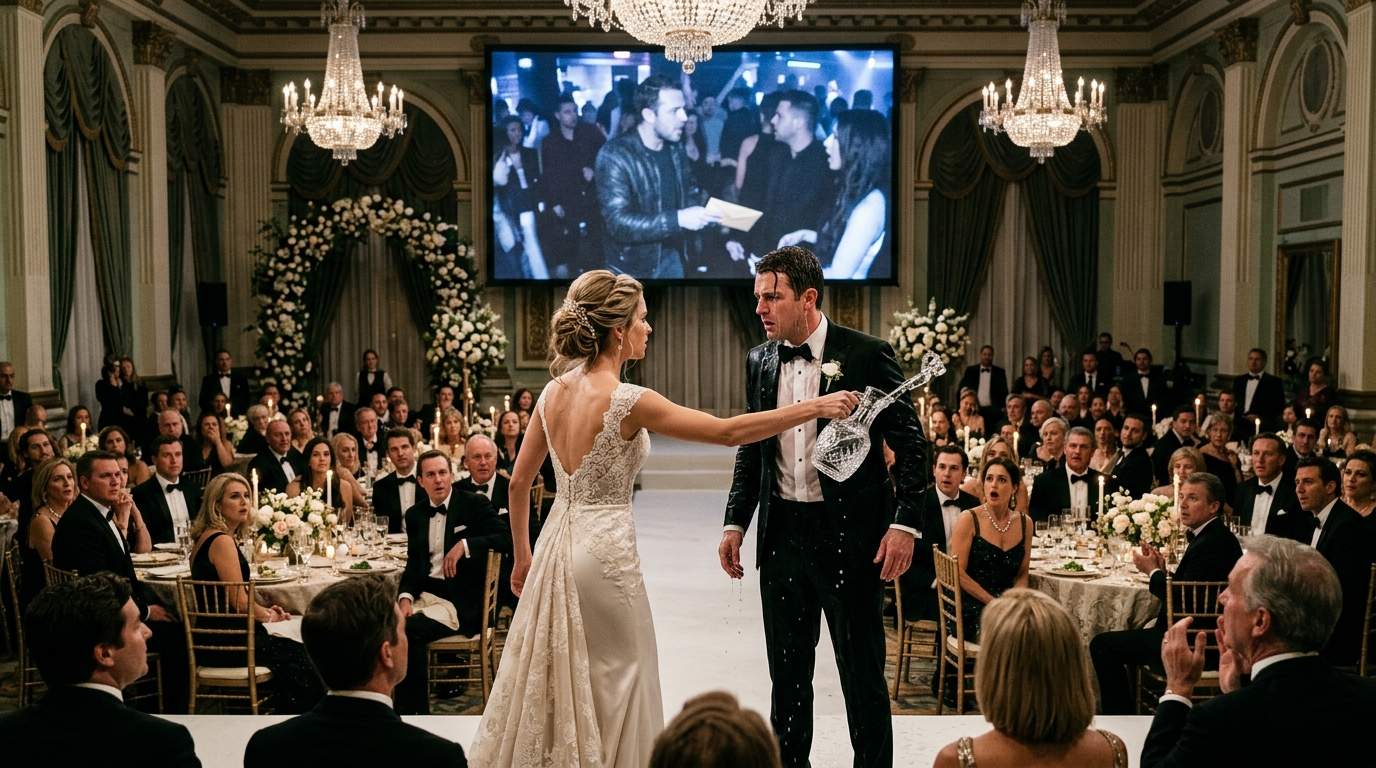
She walked deliberately, her bridal gown rustling, towards a nearby table laden with crystal decanters.
With a swift, powerful motion, she seized a heavy crystal carafe of water.
Without a word, she hurled its contents directly onto Julian’s chest, soaking his custom-tailored tuxedo.
“This wedding is over,” she declared, her voice cutting through the stunned silence like a shard of ice.
“You are nothing but a thief, and you will pay for what you have done to my family.”
She dropped the empty carafe; it clattered deafeningly on the marble floor.
Then, with a final, withering glare, she turned and walked out, her back ramrod straight, leaving behind a ruined wedding and a shattered dynasty.
Julian, humiliated, exposed, and drenched, was immediately surrounded by the estate’s security and, ominously, several stern-faced individuals who now openly displayed federal badges.
The opulent hall erupted in a controlled chaos, the Fitzwilliam-Waldorf family members, their faces pale with a mixture of shock and fury, scrambling to initiate damage control.
The dream wedding had become the ultimate nightmare, a scandal that would redefine high society and corporate power for decades to come.