The Weight of Ages and the Whispers of Desire
The vast, echoing halls of the Grand Imperial Museum stretched into an endless night. Every polished marble floor, every soaring vaulted ceiling, every silent column bore witness to centuries of human history and the quiet passage of time. After the last tourist had shuffled out, after the security guards had completed their final rounds, a different kind of life began to stir within the ancient stones. It was a life unseen, unheard, a secret world of awakened art that moved only in the deepest shadows.
- 1、The Weight of Ages and the Whispers of Desire
- 2、A Stone Hand, a Bent Fork, and Growing Frustration
- 3、The Arrival of Cassandra and the Truth Untold
- 4、The Agony of Awareness and the Punchline of Existence
- 5、The Unspoken Truths of a Secret World
Tonight, however, the silence of the museum café was broken by a profound, if subtle, disturbance. In the soft glow of the residual service lights, amidst the neatly stacked chairs and wiped-down tables, sat Aurelius. He was a monumental marble figure, a philosopher king from an era long past, usually found in a pose of contemplative wisdom in the Hellenistic wing. But now, he was seated awkwardly at a small bistro table, his heavy, sculpted form displacing the delicate chair with a faint groan of protest.
Before him, a single, magnificent slice of chocolate cake stood like a decadent monument. Its rich, dark layers, swirled with frosting, seemed to beckon, radiating an aroma that, for Aurelius, was a torment of exquisite beauty. For weeks, ever since the museum began experimenting with late-night dessert specials in the café, this particular scent had begun to infiltrate his ancient senses, awakening a longing he never knew marble could possess.
He had observed the humans, day after day, their fleeting expressions of joy as they savored such indulgences. He had heard their murmurs of delight, seen the crumbs clinging to their satisfied lips. For centuries, he had pondered the abstract concepts of virtue and knowledge. Now, his singular focus was this tactile, ephemeral pleasure. The cake represented a forbidden fruit, a taste of mortality he yearned to experience.
A Stone Hand, a Bent Fork, and Growing Frustration
Aurelius’s descent from his pedestal had been a monumental undertaking, a careful, calculated series of heavy, grinding movements that spoke of immense physical constraint. Each step across the polished Carrara-style floor was a deliberate, weighty act, his stone feet whispering against the marble with a sound like distant thunder. He had learned to move with a profound, almost comical, slowness, preserving his ancient form from cracks and fissures.
Reaching the table, he had lowered himself with the cautious grace of a being unaccustomed to such trivialities. Now, his large, sculpted hand, usually poised for eternal contemplation, awkwardly gripped a small, silver dessert fork. It felt alien, flimsy in his grasp. The metal seemed impossibly delicate against the rough, yet smooth, texture of his stone fingers.
With painstaking effort, Aurelius attempted to pierce the cake. The fork, designed for human touch, immediately bent and buckled against the unyielding resistance of his marble digit. A faint, almost imperceptible tremor ran through his arm. His chiselled brow furrowed deeper, a new line of frustration etching itself onto his stoic features. This was not the effortless grace he had witnessed in the humans. This was a struggle, a battle against his very nature.
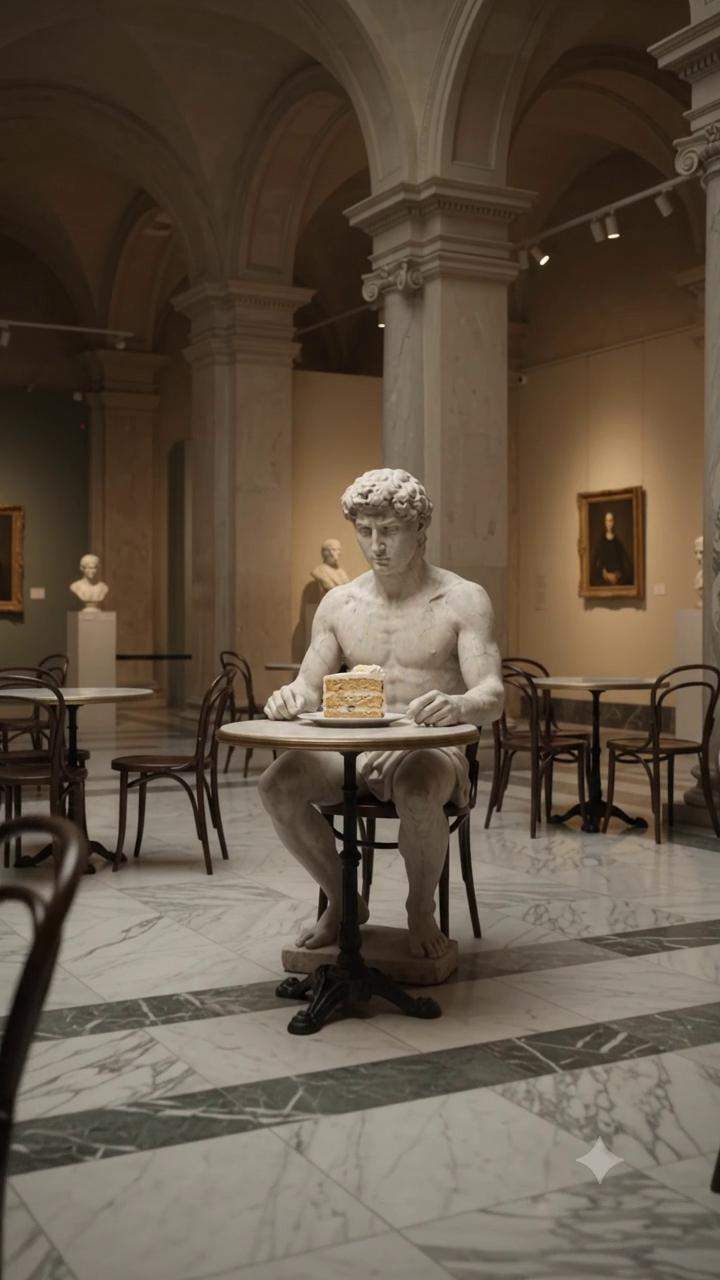
He tried again, his efforts more forceful, more desperate. The tines of the fork scraped uselessly against the firm outer layer of the cake, then twisted into a grotesque, crumpled shape under the pressure of his stone grip. A soft, grinding sound, like minute grains of sand, escaped from his straining fingers. A pang, not of hunger in the human sense, but of profound inadequacy, pulsed through his ancient core.
The Arrival of Cassandra and the Truth Untold
Just as Aurelius was on the verge of crushing the fork entirely, a soft, heavy footstep echoed from the café entrance. He froze, his head turning with a slow, deliberate creak of marble. Cassandra, a towering figure of a muse from the adjacent Greek wing, emerged from the shadows. Her form was equally magnificent, her drapery flowing in frozen cascades of stone, her eyes carved with an eternal, knowing calm.
She glided across the floor, her own movements slow and deliberate, the gentle click of her stone feet on the polished tiles the only sound. Her gaze, ancient and piercing, settled first on the mangled fork, then on Aurelius’s frustrated face, and finally, on the untouched cake. A faint, almost imperceptible sigh seemed to escape her unmoving lips.
Aurelius, his primal desire outweighing centuries of decorum, instantly shifted. He positioned his massive stone arms protectively around the cake, shielding it from Cassandra’s view, as if she might snatch away his impossible dream. His voice, a low rumble like stones shifting underground, broke the silence.
“Mine,” he declared, the single word heavy with the weight of possessiveness. It was a rare, raw assertion from a being usually dedicated to abstract thought. The unspoken truth of his centuries-long yearning for this simple pleasure pulsed in that one syllable.
Cassandra did not move closer. She simply raised her arm, her sculpted finger pointing directly at the coveted dessert. Her voice, smoother but equally resonant, carried an ancient wisdom, a quiet statement of immutable fact.
“You can’t eat,” she said, her tone devoid of judgment, only observation. It was not a reprimand, but a simple, brutal truth, delivered with the deadpan clarity of an entity that understood the fundamental limitations of their existence. Her gaze held a history of similar, forgotten desires.
The Agony of Awareness and the Punchline of Existence
Aurelius slowly lowered his gaze from Cassandra’s knowing eyes to the magnificent, tantalizing cake. He looked at its rich, moist layers, the decadent frosting, the tiny flecks of chocolate that seemed to mock his stone reality. He looked at his own unyielding marble hands, the mangled fork clutched within them, a testament to his futile efforts.
The full weight of Cassandra’s words settled upon him, not as a shock, but as a confirmation of a truth he had been desperately trying to ignore. It was the eternal punchline of his existence. To perceive, to understand, to desire, but never to partake. To be a witness to life, but never a participant.
His voice, when it came, was barely a whisper, a low, sorrowful rumble that seemed to reverberate through the very stones of the museum. It was a resignation tinged with an ancient, profound sadness.
“I know,” he admitted, his eyes still fixed on the cake. “That’s the problem.”
It wasn’t just the problem of this cake, or this moment. It was the problem of being alive, aware, and yet fundamentally unable to interact with the very world that brought him consciousness. The cake was merely a symbol, a delicious, agonizing symbol, of everything he could observe but never touch, everything he could understand but never feel. Cassandra stood silent, her gaze empathetic, understanding the depth of his silent despair. The museum hummed on, oblivious to the quiet tragedy unfolding in its cafe. The cake remained, a sweet, impossible dream.
The Unspoken Truths of a Secret World
The two statues remained for a long moment, locked in a tableau of silent understanding, a poignant testament to the hidden lives within the museum’s walls. Aurelius, the philosopher king, had discovered a new, far more visceral truth than any he had contemplated on his pedestal: the agony of unfulfilled longing. Cassandra, the muse, bore the quiet wisdom of one who had witnessed such desires countless times before.
What else do these ancient artworks yearn for when the world sleeps? What other mundane human experiences do they observe with quiet fascination, their stone hearts aching for a fleeting taste? The museum, so grand and imposing during the day, transforms into a stage for these secret dramas after dark. Each statue, with its own history and newly awakened consciousness, harbors desires and frustrations that would shock the human visitors.
The grand halls hold more than just art; they hold secrets, sorrows, and the quiet, unending drama of beings trapped between existence and experience. Aurelius’s struggle with the cake was not an isolated incident; it was a window into a vast, unseen world of silent longing, a world that continues to unfold long after the last security guard has finished their rounds and the soft hum of the building settles into the quiet night. What impossible desires will awaken next?