The grand ballroom of the Beaumont Estate glittered with understated opulence, a testament to Eleanor Beaumont's impeccable taste and the enduring legacy of her late husband, Arthur.
Crystal chandeliers cast a warm, golden glow over the assembly of the city’s elite, gathered to commemorate what would have been Arthur and Eleanor’s 60th wedding anniversary.
Eleanor, at 58, was a titan in a burgundy gown, her posture unyielding, her eyes scanning the room with the practiced authority of a matriarch who had built an empire alongside her beloved spouse.
At a prominent table, her daughter-in-law, Clara, sat like an ethereal vision in a delicate white lace dress, her 27 years exuding an innocent charm that captivated everyone present.
Clara, wife to Eleanor’s only son, David, had only been part of the family for two tumultuous years, yet she had woven herself into its fabric with remarkable speed.
Eleanor, however, had always held a sliver of unease about Clara, a nagging intuition she couldn't quite articulate.
The Serpent in the Garden
Arthur Beaumont’s passing five years prior had left a gaping void, not just in Eleanor’s heart, but at the helm of Beaumont Industries, a conglomerate built on shrewd investments and unyielding principles.
Eleanor, fiercely protective of Arthur’s legacy, had stepped in as CEO, navigating the treacherous waters of corporate succession with steely resolve.
David, while capable, lacked his father's strategic foresight, and Eleanor worried constantly about the future of their family's creation.
Clara had appeared during this vulnerable period, a beacon of light for a grieving David, but her sweet demeanor often felt... manufactured to Eleanor.
Small incidents had accumulated over months: Clara subtly suggesting changes to board members, pushing for divestment in key legacy sectors, always cloaked in the guise of modernizing the company.
Eleanor had dismissed them as youthful enthusiasm, albeit with a growing sense of disquiet.
But tonight, moments before dinner was served, a hushed conversation overheard in the study had shattered Eleanor’s complacency.
It was Clara’s voice, cool and calculating, discussing "finalizing the transfer of voting shares" with Mr. Sterling, the family’s long-standing legal counsel.
And then, the chilling phrase: "She signed the power of attorney over a year ago; she just didn't realize its full implications for Article Seven."
Eleanor’s blood ran cold; Article Seven was the succession clause, Arthur’s ironclad safeguard against a hostile takeover, requiring a unanimous board vote for major asset sales, unless a specific power of attorney was in place.
She remembered signing what she believed was a routine proxy document for a minor subsidiary deal months ago, something Mr. Sterling had assured her was a mere formality.
The realization hit her like a physical blow: Clara hadn't just married into the family for love; she was systematically dismantling Eleanor's control, piece by piece, using Eleanor's own trust against her.
This anniversary dinner was not a tribute to Arthur, but a coronation for Clara.
The Crimson Betrayal
The dining room buzzed with polite chatter, but to Eleanor, every voice now sounded like a conspiratorial whisper.
She watched Clara, laughing melodiously, her hand resting casually on David’s arm, projecting an image of perfect grace.
A crystal carafe of rich merlot sat before Eleanor, its deep red liquid mirroring the fury bubbling within her.
Her mind raced, desperately searching for a way to stop what was happening, to expose the duplicity before it was too late.
There was no legal recourse she could invoke immediately, no public statement that wouldn't be dismissed as a bitter outburst from an aging matriarch.
Then, a sudden, desperate impulse took hold.
A public act.
A defiant, unignorable statement.
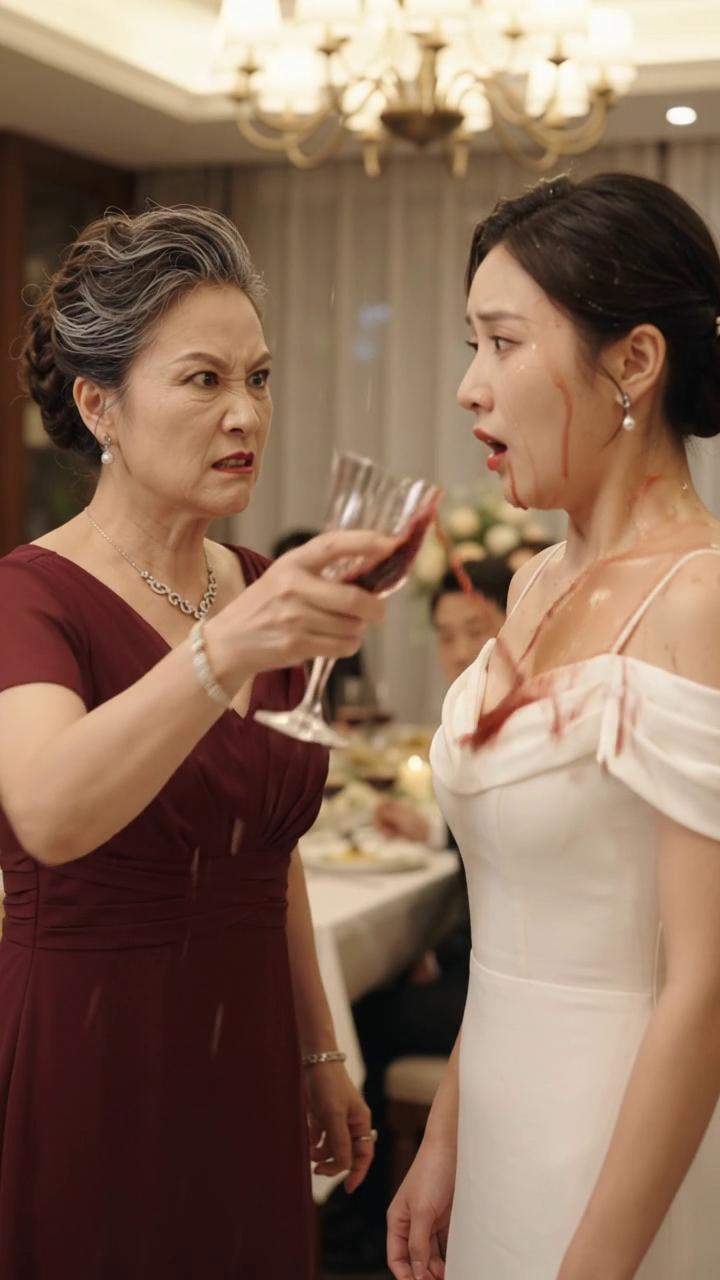
With a jolt, Eleanor grabbed the carafe, her hand trembling not from age, but from unadulterated rage.
Advertisement
She swung it, not with grace, but with raw, visceral force.
The crimson liquid arced through the air, a shocking streak against the warm, golden light.
It splashed across Clara’s pristine white dress, across her perfectly coiffed hair, across her porcelain-smooth face.
A collective gasp ripped through the room, silencing every conversation, freezing every smile.
The elegant gathering instantly transformed into a tableau of horrified shock.
Clara gasped, a sudden, sharp intake of breath, her eyes wide with a mixture of disbelief and, fleetingly, a flicker of cold, calculated fury.
Dark red wine dripped from her chin, staining the delicate lace, creating stark, ugly patterns on the pure white fabric.
Silence, profound and heavy, descended upon the ballroom, broken only by the faint, urgent strains of the string quartet, now sounding terribly out of place.
The Document of Defeat
From the head table, Mr. Sterling, the family lawyer, who had maintained a facade of polite detachment, moved with startling swiftness.
He had been discreetly preparing a leather-bound document, poised to present it at Clara's cue – likely a toast or a formal announcement.
As the wine splashed, his first instinct was to protect the crucial papers from the encroaching droplets.
He lifted the folder, pulling it away from the edge of the table, his movements precise and practiced.
Then, slowly, deliberately, he turned the document towards Eleanor, not to accuse her, but to confirm her worst fears, to solidify Clara’s victory.
It was a binding resolution, detailing the transfer of the controlling voting shares of Beaumont Industries, leveraging that very power of attorney Eleanor had unknowingly granted.
And there, prominently displayed on the final page, was Eleanor’s own signature, clear and damning.
Eleanor stared at the document, the bold, familiar script of her name a cruel mockery of her trust.
The blood drained from her face, leaving it ashen, ghostly white under the warm lights.
It was not merely the shock of her public outburst, nor the humiliation of the situation, that caused her to go pale.
It was the dawning, horrific realization that she had been utterly, completely outmaneuvered.
The splash was a desperate, impotent act; the document was the undeniable proof of her defeat.
A War Just Begun
Clara, now regaining her composure, dabbed delicately at the wine on her face with a pristine napkin, her eyes, once wide with shock, now holding a glimmer of triumphant malice.
She offered Eleanor a faint, almost imperceptible smirk, a silent acknowledgment of her cunning victory.
David, Eleanor’s son, finally stirred from his stunned silence, rushing to Clara’s side, his face a mask of confusion and anger directed at his mother.
"Mother, what have you done?" he hissed, helping Clara up from the table.
Eleanor barely registered his words; her gaze was fixed on the document, then on Clara, then back to the lawyer, Mr. Sterling, whose expression remained impassive.
Was he complicit, or merely the executor of a cunningly crafted legal snare?
The questions swirled, unanswered, creating a maelstrom of despair and fury within her.
The anniversary dinner, meant to honor a legacy, had instead witnessed its quiet, calculated theft.
The once-proud matriarch of Beaumont Industries now stood exposed, publicly humiliated, and legally stripped of her power.
But as the color slowly returned to Eleanor’s face, a new emotion ignited in her eyes: not defeat, but a cold, burning resolve.
The battle for Beaumont Industries had just begun.
This wasn't just a corporate takeover; it was a family betrayal, a fight for identity, and Eleanor Beaumont was far from finished.