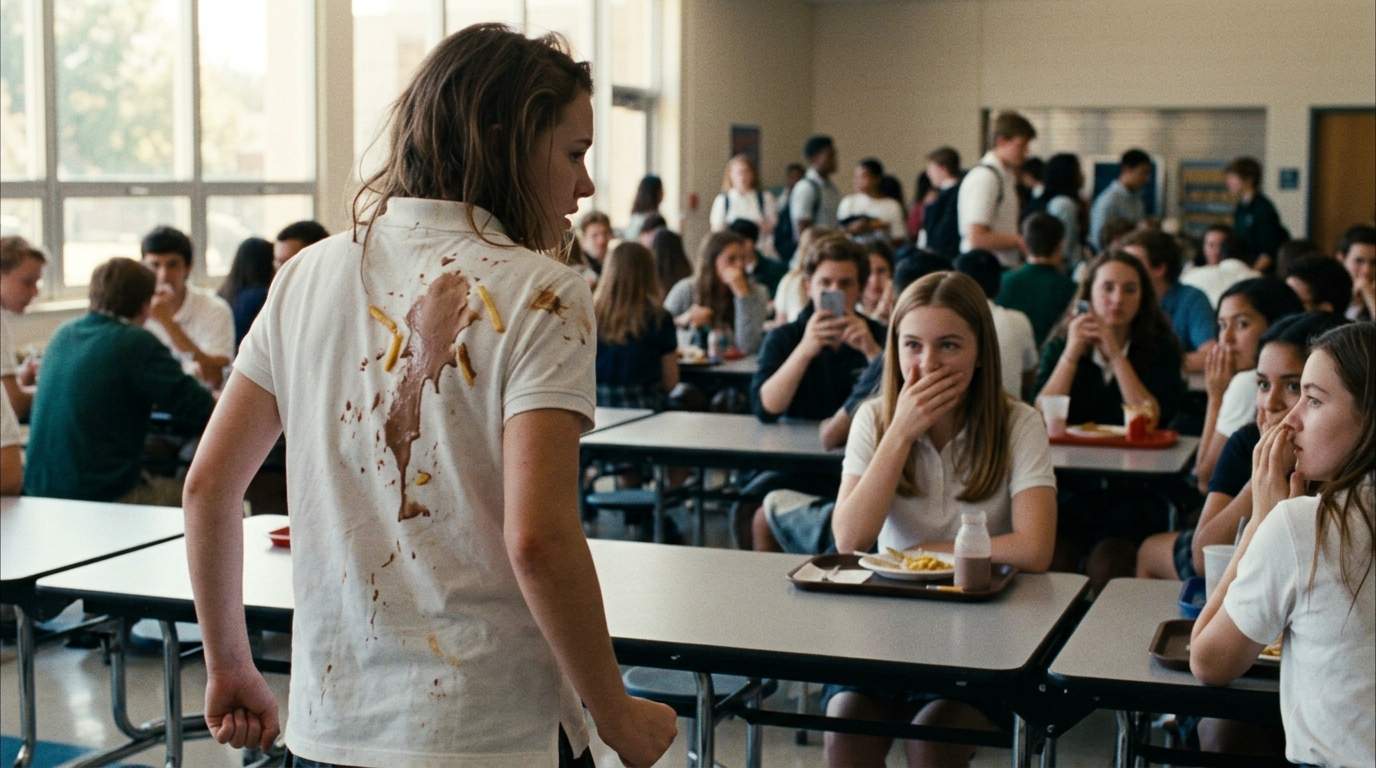
It happened during our History class presentation in Room 207, a moment etched permanently into my memory.
My heart was already pounding against my ribs, a nervous rhythm I couldn't quiet.
The air in the classroom felt thick with the usual blend of pre-presentation anxiety and mid-afternoon fatigue.
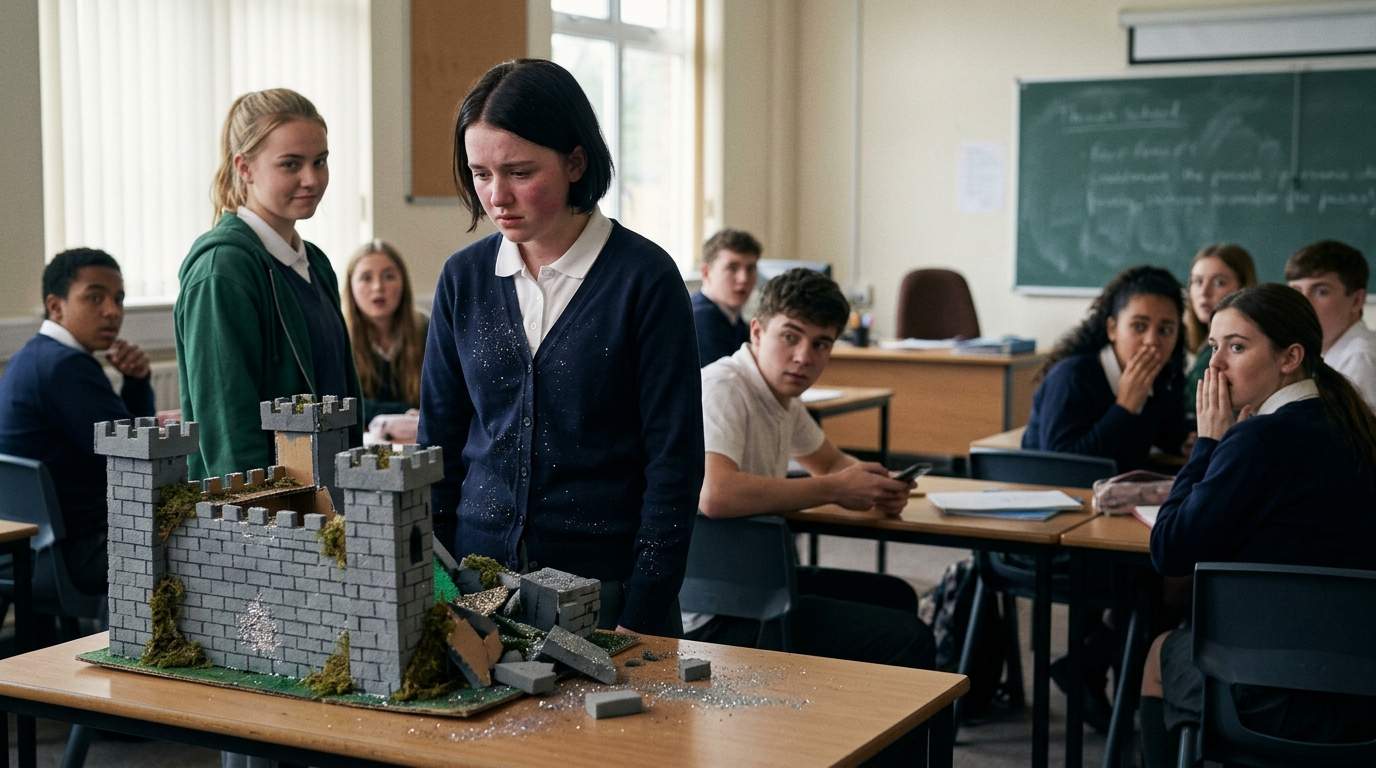
I stood beside our meticulously crafted diorama, a scale replica of a medieval castle under siege.
I had poured countless hours into its creation, obsessing over every tiny, intricate detail from the battlements to the miniature trebuchets.
Jessica, my assigned partner for the project, leaned casually against the edge of the desk next to our display.
She hadn't contributed much at all to the actual construction of the diorama, perhaps a few poorly painted cardboard figures at best.
Her gaze seemed distant, unfocused, drifting somewhere over my shoulder or out the window.
BEFORE
The underlying tension with Jessica had been building for weeks, subtle but persistent.
She would often shrug off my questions about her assigned research, claiming she’d "get to it later."
Her later never really came, leaving me to scramble to cover her sections.
I found myself doing double the work, sometimes triple, just to keep the project on track.
During group meetings in the library, she'd be on her phone, barely looking up from the screen.
I'd try to engage her, asking about her part of the presentation, but she'd give vague, one-word answers.
"Yeah, it's fine," she'd say, without offering any details.
Sometimes she’d subtly ignore me when I spoke, turning her attention to other classmates passing by.
It felt like a slow, quiet exclusion, even though we were supposed to be partners, even friends.
I remembered one afternoon, I stayed late to finish painting the miniature archers.
She had promised to help with the intricate detailing of the castle walls.
She sent a text fifteen minutes before she was due to arrive: "Can't make it, fam. Got plans."
It was always like that, small insults disguised as casual indifference.
I’d complain to my other friends, Sarah and Mark, about her laziness.
They would offer sympathetic nods, but never suggested confronting her, preferring to avoid drama.
"Just finish it yourself, it'll be better anyway," Sarah once advised, trying to be helpful.
Mr. Harrison, our History teacher, was a kind man but often preoccupied with classroom management.
He seemed oblivious to the subtle power dynamics and inequities within group projects.
He mostly just asked if we were "on track" and accepted our affirmative answers at face value.
I tried to bring up Jessica's lack of contribution once, delicately, during a check-in.
He simply reminded me that "teamwork is about balancing strengths" and moved on quickly.
I felt a growing sense of frustration, mixed with a resignation that I was on my own.
Despite everything, I poured my heart into the diorama, determined to make it perfect.
I wanted it to reflect my effort, my passion for history, not Jessica's apathy.
I even bought extra supplies with my own money, special fine-grain sand and iridescent glitter for realism.
The morning of the presentation, I felt a familiar twist of anxiety in my stomach.
Jessica arrived late, just as the bell rang, with a dismissive wave to Mr. Harrison.
She glanced at the finished diorama, giving it a perfunctory nod.
"Looks alright," she mumbled, not meeting my eyes.
Her lack of enthusiasm was a dull ache, but I tried to push it aside.
Mr. Harrison began calling names, and my heart rate sped up again.
I had carefully positioned the diorama on the presentation desk.
It was perfectly balanced, sturdy despite its delicate components.
INCIDENT
Mr. Harrison, our teacher, finally called out our names.
"Jessica and [My Name], you're up," he announced, gesturing to the front of the room.
My palms were instantly slick with nervous sweat, despite my careful preparations.
I took a deep breath, trying to steady my racing pulse.
I walked to the front, Jessica trailing a few steps behind me.
I began explaining the complex siege tactics of the 14th century, focusing on our castle's defenses.
My voice was a little shaky at first, a whisper of nerves, but then gained confidence as I spoke about the historical details.
Jessica remained leaning against the side of the presentation desk, almost aloof.
She slowly shifted her weight, a movement that seemed almost imperceptible at first.
Then, she slowly extended her arm towards the castle model, her fingers barely grazing the air.
It seemed like a casual, innocuous gesture, as if she were about to point something out.
But her sleeve, a loose cuff of her oversized hoodie, brushed lightly against the very corner of the display board.
It was not a shove, not a push, but a deliberate, slow contact.
A tiny, precarious watchtower, one I had spent hours gluing, wobbled first.
I froze mid-sentence, my explanation dying on my tongue, my eyes wide with sudden dread.
A ripple of quiet attention, a subtle change in the room's atmosphere, spread through the students.
Everyone's eyes immediately locked onto the diorama, sensing something was wrong.
The carefully glued catapult, poised for attack, detached from its base with a soft pop.
It swung wildly on its miniature arm, a tiny, doomed instrument of destruction.
It crashed with a soft, sickening smack into the main wall of the foam castle.
Small foam bricks, painstakingly cut and painted, scattered in every direction across the desk.
The delicate drawbridge, designed to lift with thread, snapped with a faint, sharp crack.
It fell inward, creating a small, sad thud against the castle's interior.
A cloud of fine, silver glitter and brown sand, meant to depict the dusty battlefield, exploded outwards.
They dusted the dark wooden desk surface like a bizarre, artificial snow.
They cascaded gently down my navy blue school uniform shirt, clinging to the fabric.
A profound, heavy silence swept through the entire room, deeper than any awkward pause.
My face felt instantly, intensely hot, a burning sensation spreading from my cheeks to my ears.
Jessica just stared blankly at the ruined diorama, her posture unchanged.
Her expression remained perfectly neutral, unreadable, like a mask.
Then, her eyes flickered quickly, almost imperceptibly, to mine.
A faint, almost imperceptible smirk, a cruel twist, touched the very corner of her lips.
It was gone in a fraction of a second, vanishing before anyone else in the room could possibly see it.
The silence stretched, becoming unbearable, for far too long.
IMMEDIATE CONSEQUENCES
Mr. Harrison cleared his throat awkwardly, a low, uncertain rumble that broke the spell.
My breath hitched painfully in my chest, a gasp I couldn't fully suppress.
The scattered pieces of my castle lay everywhere, a testament to sudden, inexplicable destruction.
My beautiful, hard-won project was utterly ruined, a chaotic mess of foam and glitter.
Every single person in that classroom had witnessed the incident unfold.
They were all staring, not at Jessica, but directly at me, their eyes filled with various expressions.
Some faces registered surprise, others a kind of morbid curiosity, a few had a suppressed grin.
I wished desperately for the floor to simply swallow me whole, to disappear from existence.
A few students in the back row began to whisper, their voices soft but audible in the quiet room.
Someone, a boy named Kevin, discreetly pulled out his phone, ready to record or snap a picture.
My closest friends, Sarah and Mark, were seated in the second row, their faces a blur of conflicting emotions.
They looked at me, then quickly looked away, unable to meet my gaze.
Their silence felt louder than any laughter, a profound betrayal in its own way.
Mr. Harrison, still looking flustered, stepped forward to examine the wreckage.
"Oh, dear," he murmured, his brow furrowed with mild concern.
He didn't make eye contact with Jessica, who remained frozen in her pose.
He picked up a detached foam brick, almost gingerly, as if it were fragile evidence.
"Well," he began, his voice hesitant, "it seems we've had a... structural failure."
His words implied my failure, my project's weakness, not an external cause.
The humiliation was complete, a public indictment of my hard work.
I could feel the weight of their collective judgment, their pity, their amusement.
The glitter on my shirt felt like burning embers, a physical manifestation of my shame.