The Grand Procession
The morning sun, a gilded disc in a sky of azure silk, cast long, shimmering shadows across the Royal Palace Square.
E.g. :I couldn't breathe when I saw my fiancé kissing my mother at the Grand Ball.
- 1、The Grand Procession
- 2、The Unlikely Obstruction
- 3、A King's Agony
- 4、The Architect of a Kingdom
- 5、The Burden of the Crown
- 6、A Desperate Plea
It was the Day of Solemn Adoration, a festival of unparalleled grandeur and spiritual devotion.
The vast expanse of white marble, usually a bustling thoroughfare, now pulsed with a reverent hush.
Towering spires, crowned with gleaming golden roofs, pierced the heavens, monuments to a dynasty believed to be divinely appointed.
Fountains sang their ancient songs, their waters catching the sunlight in dazzling displays.
Intricately sculpted gardens and heroic statues lined the route, while royal banners, emblazoned with the roaring lion of King Alaric’s house, fluttered gently in the breeze.
Hundreds of nobles, bedecked in velvet and jewels, mingled with commoners in their Sunday best, their faces alight with anticipation.
Then, a distant trumpet call echoed, signaling the King’s approach.
A regiment of royal knights, astride magnificent warhorses, their armor gleaming, slowly escorted the royal carriage forward.
The entire scene was an opulent, fairytale-like tableau, radiating power, piety, and absolute authority.
King Alaric the Just, as he was once known, now simply King Alaric the Resolute, was approaching.
His reign, though initially heralded as a golden age, had lately taken a darker, more pragmatic turn.
Whispers of dissent, swiftly silenced, had begun to ripple through the outer provinces.
The people still admired his strength, but the warmth that once defined his rule had begun to chill.
The Unlikely Obstruction
Amidst this carefully choreographed splendor, a jarring discord emerged.
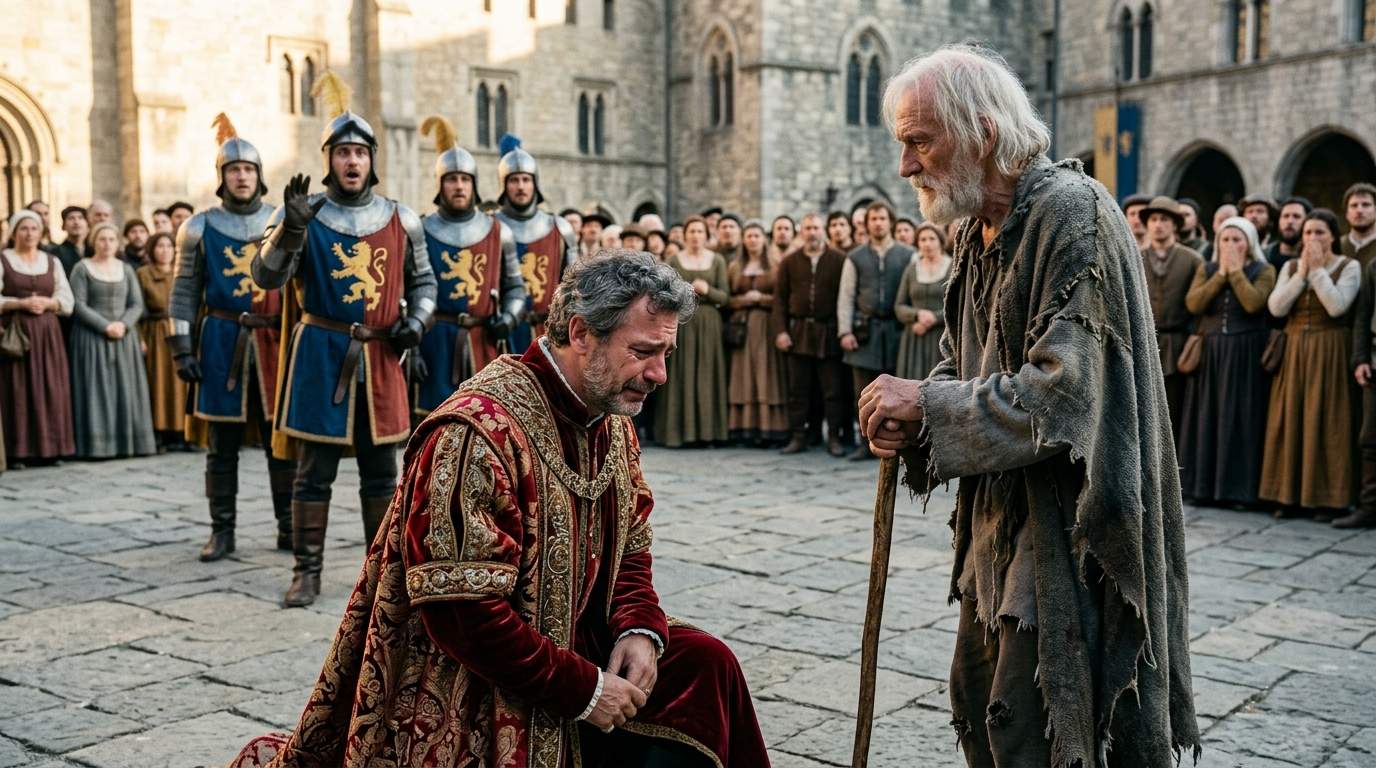
Directly in the path of the royal procession, a solitary figure stood, utterly oblivious or uncaring of the encroaching pomp.
He was an old man, frail and hunched, his once-white hair now a matted, unkempt cloud around his face.
His clothes were mere rags, patched and stained, and he leaned heavily on a gnarled, worn-out wooden cane.
He was a specter of poverty in a vision of wealth, a stark, unwelcome contrast.
Two towering royal guards, their expressions stern and unyielding, spurred their warhorses forward.
Their polished spears crossed before the old man’s face, a clear and menacing barrier.
“Back off! Back off now! The King is here!” one soldier barked, his voice accustomed to instant obedience.
He dismounted, striding purposefully towards the old man, his hand already reaching to shove.
The old man stumbled, nearly losing his balance, but did not cry out.
His gaze, ancient and strangely serene, was fixed on the slowly approaching royal carriage.
There was no fear in his eyes, only a profound, almost knowing calm.
A collective murmur rippled through the crowd.
Some onlookers winced, unable to watch the inevitable humiliation.
Others frowned in irritation, thinking the old man was about to be forcibly removed, perhaps even arrested, for his insolence.
They expected the King, in his regal majesty, to simply pass by, perhaps issuing a dismissive command.
This was a king who ruled with an iron fist beneath a velvet glove.
A King's Agony
The royal carriage drew nearer, its ornate wheels barely whispering across the marble.
King Alaric sat within, his posture impeccably dignified, his magnificent royal robes a cascade of deep crimson and gold.
His crown, heavy with jewels, reflected the golden sunlight.
His face, usually a mask of resolute authority, held a faint, almost imperceptible tension.
He had been distracted lately, haunted by shadows from his past and the growing weight of his crown.
He saw the disturbance ahead, the ragged old man, the stern guards.
He prepared to issue a curt command for the obstruction to be cleared.
But then, his eyes met the old man’s.
And in that instant, the world seemed to tilt on its axis.
His expression, previously stern, slowly fractured.
A cascade of emotions, shock, disbelief, profound sorrow, and an overwhelming, desperate hope, washed over his face.
The King abruptly signaled his carriage to a halt.
A gasp went through the crowd as the royal procession froze.
Alaric dismounted, his movements unusually stiff, as if burdened by an invisible weight.
He walked directly towards the old man, the murmurings of the crowd dying into an astonished silence.
The royal guards, their mouths agape, stood motionless, spears still crossed.
Then, in the next second, under the unwavering gaze of hundreds, King Alaric reached up.
With a trembling hand, he removed his heavy, gleaming crown.
It felt suddenly like a burden, a symbol of a life he had twisted beyond recognition.
He sank, slowly, deliberately, onto one knee before the ragged old man.
His head bowed, not in prayer, but in a gesture of profound, aching respect, almost reverence.
The heavy silence of the square was broken only by the distant, echoing peal of the palace bells, sounding like a lament.
The camera zoomed in on the King’s face, now devoid of all regal pretense.
His eyes were slightly red, brimming with tears that he no longer bothered to hide.
His voice, usually resonant with authority, was now a fragile, barely audible whisper, thick with emotion.
“...I’ve finally found you,” he choked out, the words carrying the weight of years of regret and longing.
The royal guards, trained for unflappable vigilance, stared, their eyes wide with incomprehension.
The assembled nobles and commoners gasped, a collective sound of utter shock and bewilderment.
The Architect of a Kingdom
Years ago, before he was King Alaric the Resolute, he was Prince Alaric, a bright but naive young man.
His kingdom suffered under the cruel, tyrannical hand of his father, King Oberon.
Oberon’s rule was marked by brutal suppression, exorbitant taxes, and a callous disregard for his people.
Alaric, torn between filial duty and moral outrage, found solace and guidance in Master Elias.
Elias was a reclusive scholar, a philosopher, and a brilliant strategist who lived in the palace's shadow.
He was more than a tutor; he was a mentor, a spiritual guide, and a surrogate father to the prince.
Elias instilled in Alaric the ideals of a just ruler, a king who served his people, not exploited them.
He spoke of freedom, equity, and the true meaning of leadership.
Together, in utmost secrecy, they meticulously plotted a revolution.
It was not a bloody uprising, but a carefully orchestrated political coup, designed to remove Oberon without plunging the kingdom into civil war.
Elias, with his vast network of contacts and his unparalleled intellect, was the true mastermind.
He navigated the treacherous currents of court intrigue, manipulating loyalties and weaknesses.
He convinced key nobles, rallied disillusioned commoners, and sowed seeds of doubt among Oberon’s advisors.
Alaric, guided by Elias, became the public face of this silent revolution.