The physics classroom always felt a little colder than the rest of the school, its tall windows overlooking the football field.
I remembered the thrill of the assignment, building a balsa wood bridge model that could withstand a certain amount of weight.
It felt like a challenge I could excel at, a place where my quiet dedication could shine.
My initial partner was Maya, my friend since middle school, who had a knack for art and design.
We had sketched out ideas together for a few days, laughing over impossible cantilever designs.
But then, something shifted in her, a new group of friends pulling her into their orbit.
They were louder, more fashionable, and always had plans after school.
"I just don't have time for this, you know?" she’d said one afternoon in the cafeteria, her eyes darting to her new crowd.
Her voice was soft, apologetic, but her gaze never quite met mine.
It was a quiet kind of betrayal, one that didn't involve shouting or drama, just a slow fade.
I ended up building the bridge alone, meticulously cutting, sanding, and gluing every tiny piece.
Each joint was reinforced, each angle perfected, a testament to countless hours spent hunched over my desk.
I envisioned its triumph, bearing the weights Mr. Harrison would stack on it, a silent victory for my solitude.
Mark, a star on the football team, was in that new group Maya was hanging out with.
He wasn't mean, not directly, but his presence always added a subtle layer of pressure.
His circle often shared jokes at others’ expense, glances that made you feel vaguely inadequate.
I usually just tried to be invisible in class, doing my work, avoiding attention.
But this presentation, it was impossible to hide.
I practiced my speech in front of my bedroom mirror, trying to sound confident, articulate.
My stomach fluttered with nerves every time I thought about standing up there, everyone watching.
The bridge sat in its special cardboard box all morning, a fragile secret waiting for its moment.
I carried it carefully through the crowded hallways, clutching it close like a precious, breakable dream.
Mr. Harrison, a man of few words and even fewer expressions, had simply listed our names on the board for the day’s presentations.
He seemed more interested in his coffee cup than our elaborate engineering attempts.
I wished I could just submit the bridge and a written report, bypassing the public speaking altogether.
The air in the physics classroom felt thick with anticipation as I stood beside my balsa wood bridge model.
Mr. Harrison had just called my name, signaling it was my turn to present our design.
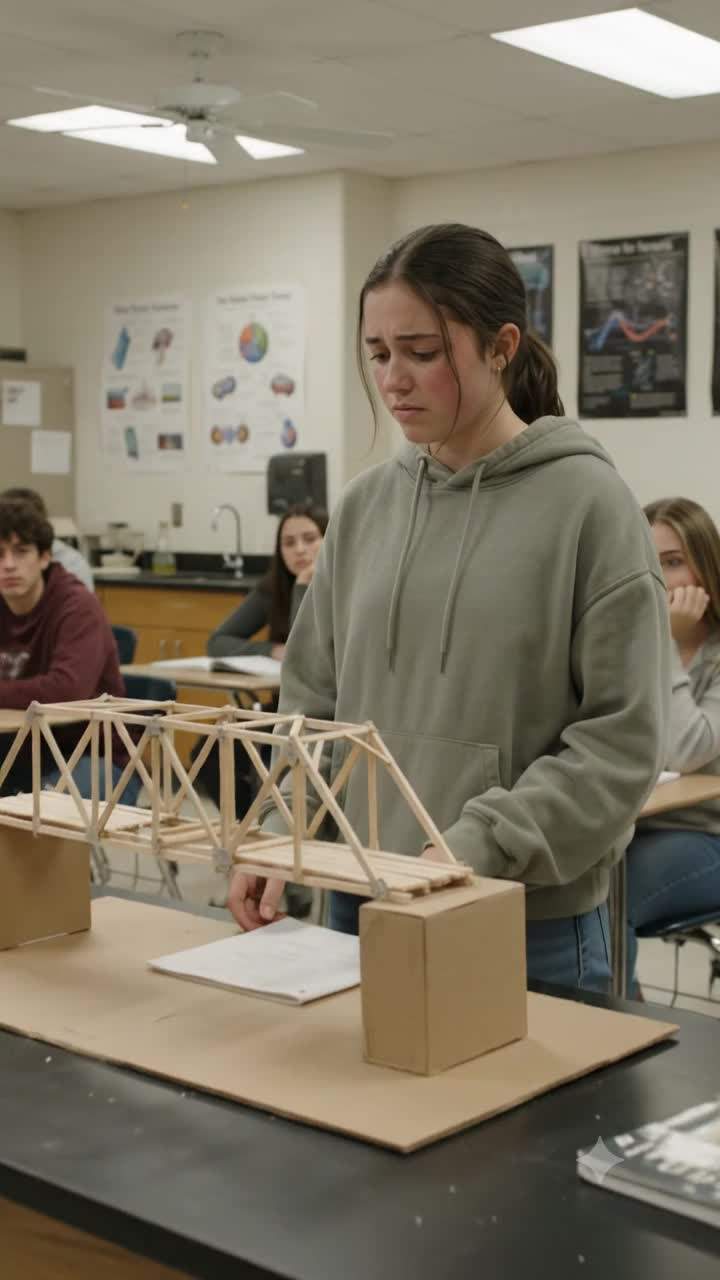
My hands were sweating, but I knew my lines by heart, rehearsed countless times in front of the bathroom mirror.
Across the room, Maya, who was supposed to be my partner until she bailed last minute, gave me a small, almost imperceptible nod.
She was sitting in the third row, next to Daniel, pretending to be absorbed in her textbook.
My eyes scanned the class, a sea of faces waiting to be bored or impressed.
The bridge, a carefully constructed marvel of tiny glued struts, sat proudly on the demonstration desk.
It had taken me weeks to build, countless late nights hunched over the dining room table.
I cleared my throat, ready to begin my opening statement about load distribution.
Then, a shuffle to my left broke my concentration.
It was Mark, one of the football players, heading back to his seat after sharpening his pencil.
He walked past the demo desk, closer than he needed to be.
His backpack, a bulky thing stuffed with textbooks, swung loosely behind him.
I watched it with a strange, slow-motion dread.
His elbow, or maybe the corner of that heavy bag, brushed the edge of the bridge’s main span.
It wasn't a hard hit, barely a nudge, but it was enough.
A soft, almost inaudible snap echoed in my ears.
My gaze fixed on the tiny balsa wood piece that had just given way.
A main support beam, meticulously measured and glued, began to buckle inward.
The entire structure, designed for strength under compression, trembled violently.
For a split second, it hung there, defying gravity, a fragile monument to impending disaster.
Then, with a sickening crackle of breaking wood, the whole thing gave way.
It didn't just fall; it imploded.
Tiny balsa wood pieces, painstakingly assembled, exploded outwards in a shower of splinters and dust.
My bridge, my project, my weeks of effort, disintegrated right before my eyes.
It collapsed into a pathetic heap on the desk, a graveyard of broken dreams.
A gasp rippled through the classroom, followed by an immediate, chilling silence.
My mouth was open, but no words came out.
My heart hammered against my ribs, a frantic drumbeat of pure shock.
I looked at Mark, who had stopped mid-stride, turning slowly.
His face was a mask of wide-eyed innocence, almost perfectly theatrical.
"Oh my God," he muttered, his voice barely a whisper, but loud enough for the first few rows to hear.
"I am so, so sorry."
But the way he said it, the faint, almost-a-smirk flicker in his eyes, told a different story.
The silence lingered, heavy and suffocating.
I could feel everyone’s eyes on me, then on the wreckage.
The weight of the moment crushed me.
It felt like my entire world just crumbled with that bridge.
Mr. Harrison, startled by the sudden noise, finally looked up from his desk.
He blinked slowly, adjusting his glasses, his gaze moving from the heap of wood to my stunned face.
"Well," he said, his tone flat, "that's... unfortunate."
He didn't ask Mark what happened.
He didn't ask if I was okay.
"Can you explain what happened, [Narrator's Name]?" he asked instead, his voice devoid of sympathy.
It was a rhetorical question, almost a demand for me to account for the disaster.
A few stifled giggles broke the silence from the back row.
I saw Daniel cover his mouth, his shoulders shaking with silent laughter, Maya beside him looking down at her desk.
My cheeks burned, a deep, painful blush spreading across my face.
My throat felt impossibly tight, like a knot of humiliation was lodged there.
I wanted to scream, to cry, to vanish into thin air.
All I could do was stare at the broken pieces, my eyes blurring.
"It... it collapsed," I finally managed to whisper, the words barely audible.
My voice sounded thin and reedy, completely unfamiliar.
"Yes, I can see that," Mr. Harrison replied, an edge of impatience in his voice.
"But what was the structural failure? Where did your design go wrong?"
He was treating it like a design flaw, not an external incident.