My life was a perfectly constructed facade of success, a towering monument built on ambition and ruthless decisions. I had the penthouse overlooking the city, the corner office with panoramic views, and a garage filled with cars that cost more than most people's homes. My latest acquisition, a sleek, dark-colored luxury sedan, purred beneath me as I navigated the familiar city streets, my mind already five steps ahead on my next billion-dollar deal. The world outside my tinted windows was a blur of noise and anonymous faces, a backdrop to my personal triumph. I barely registered the individual tragedies that played out on the sidewalks, the homeless figures I’d learned to filter out of my vision, just another part of the urban landscape.
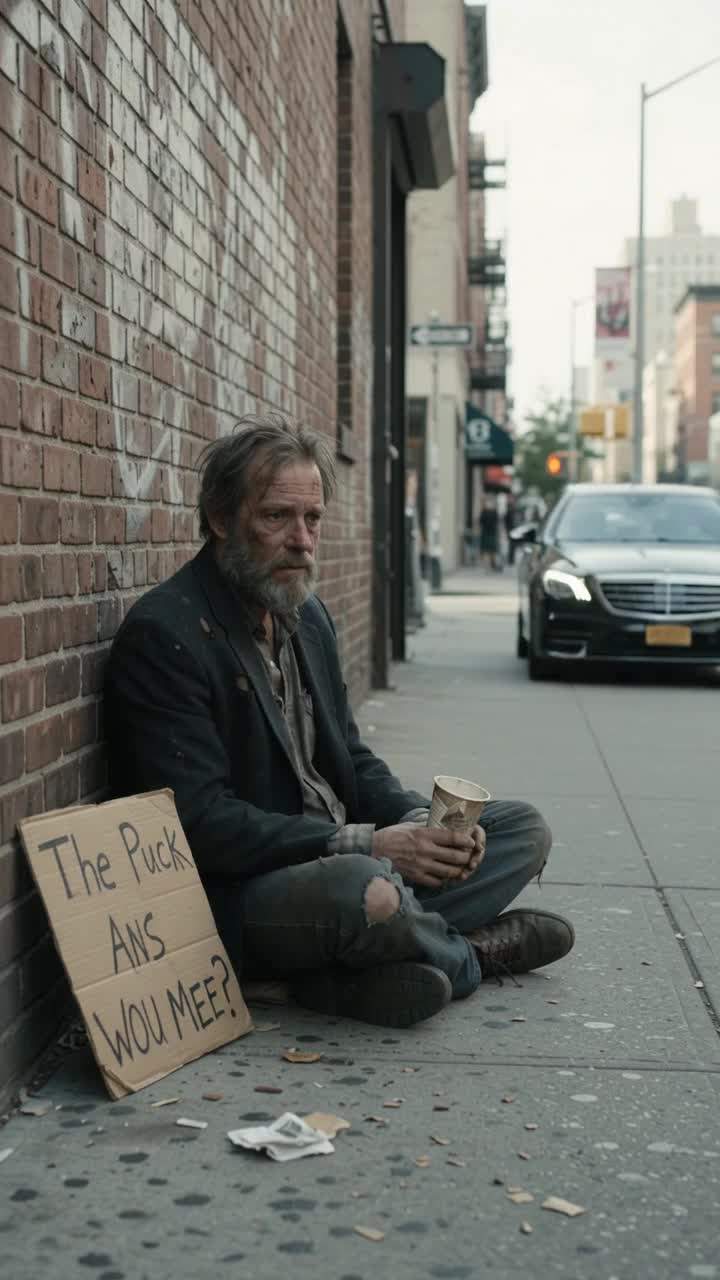
Then, the world stopped. It wasn’t a sudden brake in traffic or an unexpected obstacle. It was a man, hunched against a grimy brick wall, a worn cardboard sign resting beside him, a crumpled paper cup in his trembling hand. My eyes, usually so adept at dismissing such sights, snagged on something in his posture, a familiar curve to his back, a hint of something I’d buried deep. I shook my head, dismissing the fleeting thought as a trick of the light, a figment of my guilt-ridden subconscious. But then, as I slowed to a crawl at a red light, he lifted his head slightly.
The breath caught in my throat, a sharp, painful gasp. The man’s face was ravaged by time, hunger, and despair, framed by unkempt gray hair and a beard matted with dirt. But beneath the grime, beneath the hollowed cheeks and haunted eyes, I saw him. Arthur. My brother. My oldest friend. The only person who truly knew me before I became this polished, powerful version of myself. No, it couldn’t be. It was impossible. Arthur was... gone. I’d convinced myself he was.
My foot slammed on the brake, the luxury car screeching to an abrupt halt, jarring my senses back to the harsh reality. The muffled city noise outside suddenly seemed deafening, pressing in on me. I stared, my jaw slack, my expensive watch glinting on a hand that had suddenly gone cold. My initial disbelief morphed into a raw, visceral horror. He was real. He was here. He was begging.
He looked up, startled by the sudden stop, his eyes still avoiding mine. Then, slowly, painfully, his gaze lifted. Our eyes met through the tinted glass, and in that agonizing second, the last twenty years evaporated. I saw the mischievous glint from our childhood, the shared dreams of two brothers inheriting a small, struggling printing business from our parents, the hope we once had for our future. All of it was there, overlaid with the crushing weight of his current existence, and the sickening realization of my own complicity.
I hit the button, and the window hummed down a fraction, letting in the cacophony of the street and the cold, unforgiving air. The proximity only intensified the shock, the smell of stale clothes and neglect reaching me, a stark contrast to the leather and polish of my car’s interior. Arthur’s face registered a flicker of recognition, a brief spark of the brother I knew, quickly extinguished by an overwhelming wave of shame and a hardened defiance. His eyes, once so full of life and artistic dreams, were now just empty pools reflecting my own terror.
"Arthur? Is that... really you?" My voice was strained, barely a whisper, thick with disbelief and a rising tide of guilt. My hand clenched on the steering wheel, knuckles white. The words hung in the air, heavy and unwanted, between the gleaming car and the desolate pavement.
He flinched, a subtle tremor running through his thin frame, but he held my gaze for a moment longer than I expected. Then, he shook his head, a gesture of silent refusal, a plea for denial, or perhaps an unspoken wish to simply be left alone in his misery. His lips, cracked and dry, parted, and a voice I barely recognized, hoarse and gruff, emerged. "Go on. Nothing to see here." It was a dismissal, sharp and self-deprecating, a broken man’s last attempt at dignity. The traffic behind me honked impatiently, a symphony of indignation at my stalled vehicle, but I barely heard it. My world had irrevocably tilted on its axis, and there was no going back.
I was Julian, the man who had it all. He was Arthur, the brother I’d left behind, stripped of everything. Our parents had left us that small printing business, a legacy of hard work and modest dreams. Arthur, the elder, was meant to inherit more, but he was always the dreamer, the artist, not the businessman. He loved to sketch, to write poetry, to lose himself in books. I, the younger, was the pragmatic one, the one who saw numbers and opportunities where he saw beauty.
After our parents passed, Arthur spiraled. He’d always struggled with a quiet melancholy, an inability to cope with the harsh edges of reality, which escalated into severe depression and an undiagnosed mental illness. He started gambling, a desperate escape from his pain, and the business began to bleed money. I saw the potential, the chance to modernize, to expand, to truly make something of our parents’ legacy. But Arthur’s struggles were a constant, debilitating drain. He was a good man, a kind soul, but he was drowning, and he was taking the business down with him.
I made the hard decision, the pragmatic one. I convinced myself it was for his own good, for the good of the company, for the good of our family’s name. I offered to buy him out, a paltry sum compared to what I knew the business could become, but it was enough to get him help, I told myself. I promised him a trust fund, a secure future once he got clean, once he sought treatment. He was too broken, too lost to resist. He signed the papers, his eyes vacant, his hand trembling. He took the money, but it evaporated quickly, swallowed by his addiction and his inability to manage anything. Then, he simply vanished. I looked for a while, made a few calls, but my business was booming, demanding all my attention. I told myself he was a lost cause, that I had done all I could. I buried him, not in the ground, but in the deepest recesses of my mind, a phantom limb of guilt that occasionally ached. I built my empire, becoming Julian Thorne, the titan of industry, admired, respected, feared. But inside, Arthur’s ghost always lingered.
Now, that ghost stood before me, flesh and bone, a stark, undeniable indictment of my choices. I couldn't just drive away. The incessant honking of impatient drivers faded into the background as I threw open my car door, leaving it askew in the middle of the street. Pedestrians stared, but I was oblivious. All I saw was Arthur, trying to melt back into the shadows.
"Arthur!" I called out, my voice raw, a desperate plea. He flinched again, trying to scurry away, but I was faster. I grabbed his arm, my grip surprisingly gentle despite my desperation. His skin felt like brittle paper beneath my fingers, his clothes thin and threadbare. He smelled of rain and forgotten corners.
He tried to pull away, his eyes wide with a mixture of fear and shame. "Leave me alone, Julian. Just go." His voice was raspy, laced with years of defeat.
"No," I insisted, my own voice breaking. "No, I can't. Not again." The word 'again' hung between us, heavy with unspoken history. "What happened? Arthur, why are you here like this?"