In Mrs. Davison’s humid, buzzing science lab, a familiar tension often hung in the air, a blend of chemical fumes and unspoken social hierarchies.
I had always found a strange comfort in the precise measurements and predictable reactions of chemistry, a stark contrast to the unpredictable social dynamics of high school.
My project for the week involved a delicate titration, a process requiring steady hands and an even steadier nerve, two things I often struggled to maintain outside the lab.
Liam, a popular jock with an unsettling knack for targeting people’s insecurities, had been an intermittent presence in my peripheral vision since middle school.
He wasn’t a classic bully who shoved you into lockers, his methods were far more insidious, relying on subtle digs, well-timed snickers, and an unnerving ability to make you feel like the punchline of a joke you didn’t understand.
Just yesterday, in the cafeteria, he’d "accidentally" tripped near my table, causing my milk carton to topple, soaking a corner of my history textbook.
He’d apologized profusely, but his eyes, when they met mine, held a glint of something cold and knowing.
This morning, before class, I’d overheard him talking loudly with his friends about "nerds who think they’re too good for everyone else," and I’d felt his gaze on me, a prickle on the back of my neck.
Mrs. Davison, a woman more concerned with the periodic table than playground politics, generally maintained a policy of benign neglect, as long as no one was actively setting off fire alarms or distilling illicit substances.
She had a way of looking past students, directly at the textbook, which made her a poor arbiter of the subtle social cruelties that festered beneath the surface of our classroom.
I had spent hours carefully setting up my titration apparatus, ensuring every clamp was secure, every piece of glassware pristine, a small act of defiance against the chaotic hum of the school day.
The delicate glass tubing was just where it needed to be, precisely aligned above the flask, waiting for the chemical ballet to begin.
As I made a final, nervous adjustment to the clamp holding the beaker of reagent, my fingers felt unusually clumsy, anticipating some unseen obstacle.
Liam then entered my personal space, his approach a deliberate breach of the unspoken boundary I usually kept around my workstation, his shadow falling over my carefully arranged equipment.
He mumbled something about "little scientist," a phrase delivered with a dismissive air that was more mockery than genuine inquiry.
His voice was low, laced with that familiar, understated sneer that always made my stomach clench.
Before I could even register his presence fully, his heavy backpack, which always seemed to be dangling at precisely the wrong height, swung wide.
It connected with my elbow, not a violent shove, but a precise, calculated nudge, barely noticeable to anyone not looking directly.
The retort stand, previously stable, began to wobble, the delicate glassware atop it dancing a horrifying jig.
My breath hitched in my throat, a dry, rasping sound that only I could hear.
I reached out, my hands flailing uselessly, trying to catch the falling pieces, but it was like moving through thick mud.
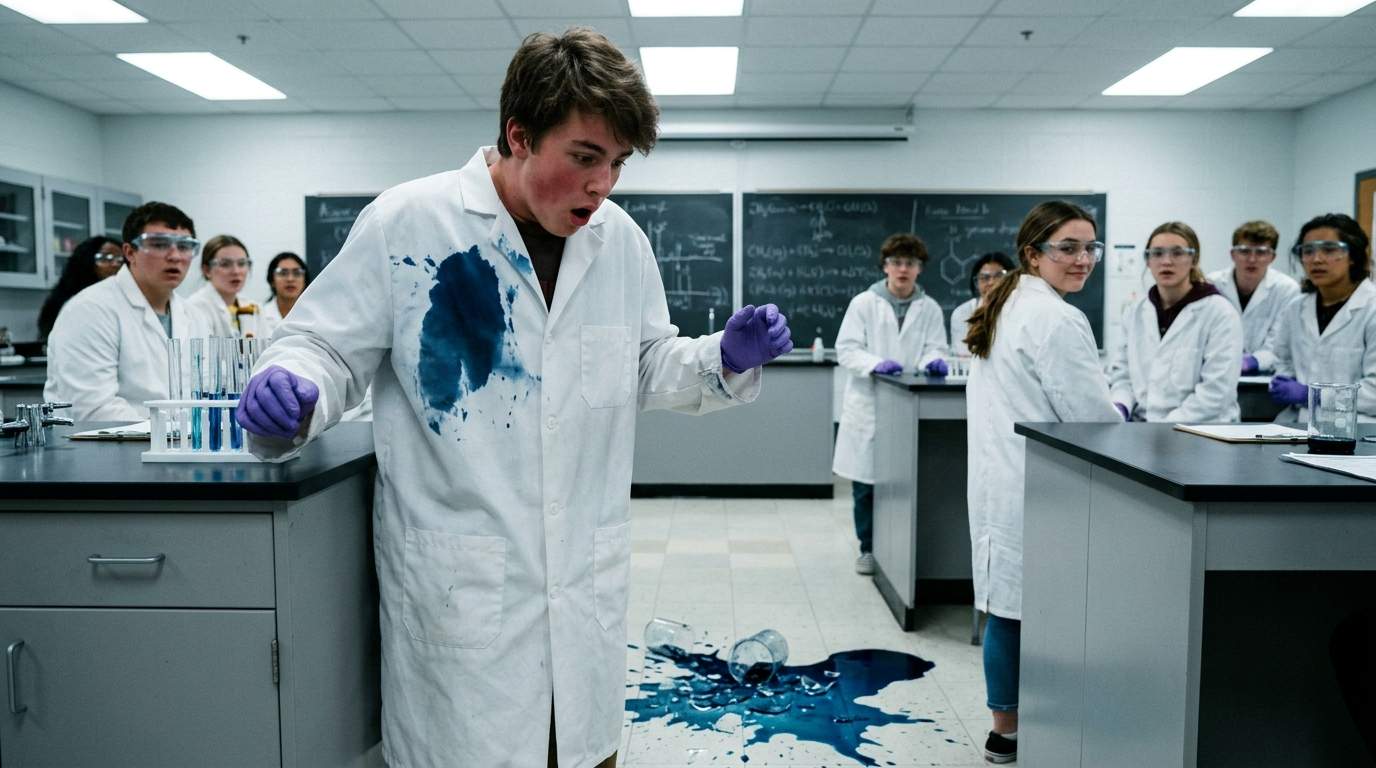
The beaker of dark blue liquid, the carefully prepared reagent for my experiment, slipped from its precarious perch.
It seemed to hang in the air for a terrible, prolonged second, a slow-motion catastrophe.
Then, with a sickening crack, it struck the edge of the lab bench before shattering into a hundred glittering shards on the tiled floor.
A loud, wet splash followed, sending a spray of dark blue liquid across the pristine white of my lab coat, spotting my jeans and shoes.
The sound of the crash cut through the gentle hum of the lab, silencing conversations and drawing every single pair of eyes in the room.
Liam jerked back, his expression morphing instantly into one of theatrical shock, his mouth forming a perfect 'O'.
"Whoa! My bad, totally didn't see it!" he exclaimed, his voice booming slightly in the sudden silence, a performance for the benefit of the now-watching audience.
His words were an echo of his cafeteria apology, perfectly rehearsed and utterly devoid of genuine remorse.
A wave of heat surged through me, starting in my chest and rushing up to my face, a furious, humiliating blush.
I could feel the burn of it, a physical manifestation of my mortification.
Across the aisle, Maya and her friends giggled, their hands half-covering their mouths, their eyes darting between me and Liam.
Mrs. Davison, startled by the noise, finally looked up from her conversation with another student, her glasses perched on her nose.
Her gaze swept over the messy scene, then settled on me, a look of tired exasperation already forming on her face.
The blue liquid was spreading, an ugly, indelible stain on the clean floor, a mirror to the shame now spreading through my entire being.
I stared down at the mess, the shattered glass reflecting the harsh fluorescent lights like cruel, mocking eyes.
And in that agonizing, frozen moment, as Liam turned away, I caught the briefest, most fleeting flicker of a smirk on his lips.
It was gone in an instant, replaced by a picture of innocent concern as he gestured vaguely towards the broken glass.
But I had seen it, a tiny, almost imperceptible curl of satisfaction, confirming what my gut already knew: it was no accident.
The humiliation was immediate and absolute, a public unraveling of my carefully constructed composure.