
I never truly understood my grandmother until she was gone.
The sprawling old mansion she left me felt more like a mausoleum than a home.
For weeks after the funeral, I just stared at the listing, ready to sell the dark, imposing place.
But something tugged at me, a feeling that I couldn't quite shake.
Her lawyer had mentioned her "eccentricities," a polite term for her guarded nature and solitary life.
I decided to spend one last week there, just to clear out the last of her things before the realtors moved in.
Dust motes danced in the sparse sunlight that pierced the grand, uncleaned windows.
Every creaking floorboard and shadow felt like a whisper from the past.
One afternoon, in a forgotten corner of her study, I noticed a slight discoloration on the hardwood floor.
It was almost imperceptible, a faint line where two planks didn't quite meet.
A strange intuition compelled me to get down on my hands and knees.
My fingers traced the edges, feeling a slight give, a tiny space.
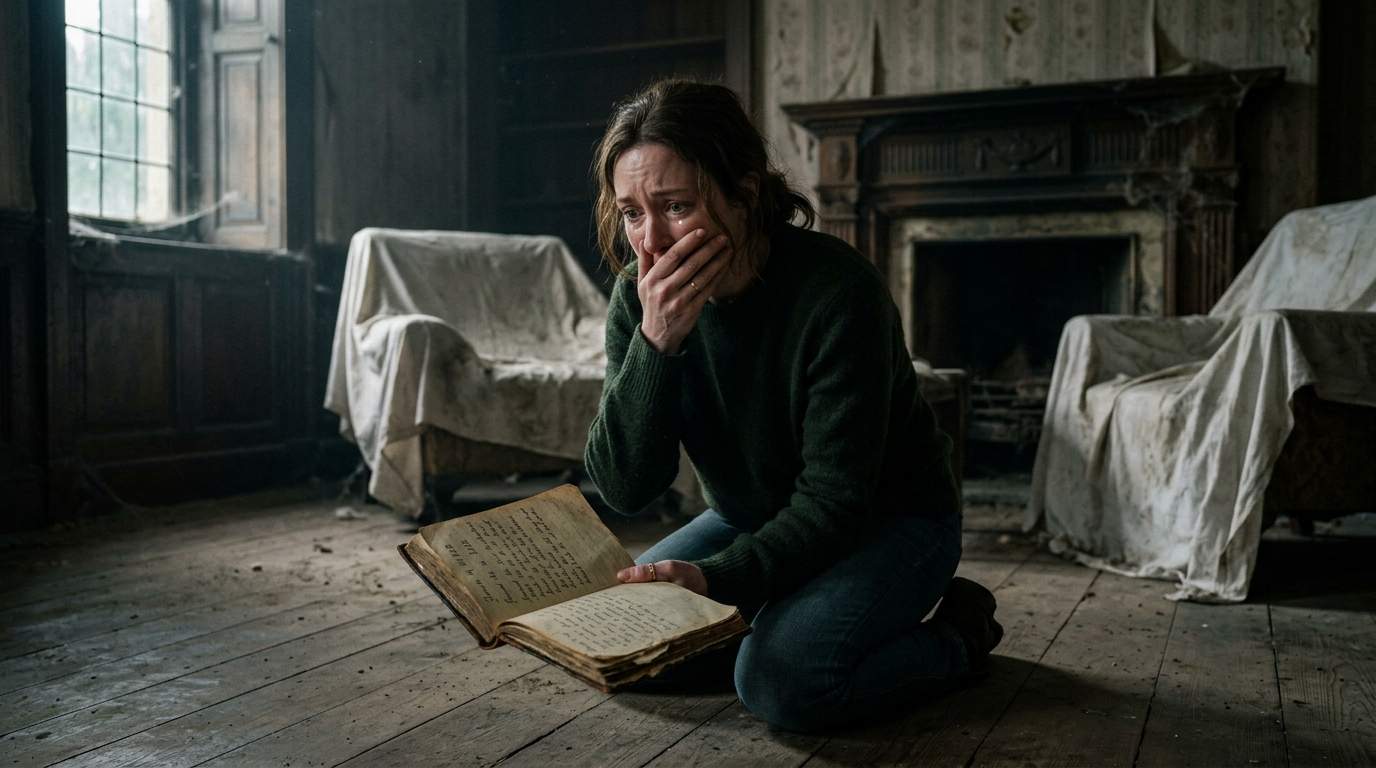
With a rusty old letter opener, I began to pry at the aged wood.
It was surprisingly easy; the planks had been loosened over time, almost waiting for me.
Beneath them, tucked into a narrow cavity, lay a small, velvet-covered box.
My heart hammered against my ribs as I pulled it out, covered in a fine layer of dust.
It felt impossibly heavy, both in weight and significance.
Inside, nestled among yellowed lace, was a faded leather-bound diary and a handful of old letters.
There was also a tarnished silver locket, cold against my palm.
The diary was her handwriting, unmistakable but strangely formal.
I opened it to the first page, my breath catching in my throat.
The date was years before my parents were even born.
Her elegant script began to tell a story I never knew.
A story of a different life, a forbidden love, and a child she’d given away.
My grandmother, the stoic matriarch, had a secret child.
A son, given up for adoption in the desperate years of post-war poverty.
The letters were from him, later in life, expressing his longing to meet her.
Her replies, tucked within, were always distant, filled with regret, but never offering reunion.
But the most shocking discovery came from the locket.
Inside were two tiny, almost identical photographs.
One was a young, striking version of my grandmother.
The other was a man, unmistakably my grandfather, but with a different woman beside him.
And then it clicked.
The diary mentioned not just a secret child, but a vast inheritance, stolen from her rightful family.
My grandmother hadn't just given away a child; she had married my grandfather for his money.
She had built our entire family’s fortune on a lie, a betrayal so profound it echoed through generations.
The woman in the locket photo was my grandfather's first wife, the true heir, who had disappeared mysteriously.





