
My hands still shake when I think about that day.
It started like any other afternoon in Uncle Thomas’s old mansion.
He’d passed away peacefully in his sleep a few months prior, leaving the grand, sprawling estate to our family – a collective inheritance, a symbol of our unity, or so I thought.
We were tasked with sorting through his affairs, an overwhelming but oddly comforting ritual of grief.
Every dusty antique, every faded photograph, felt like a whisper from the past.
The mansion, built generations ago, was a labyrinth of forgotten corners and hidden nooks, filled with a scent of old books and something vaguely floral.
I volunteered to tackle his study, a room I’d always found intimidating with its towering bookshelves and heavy, imposing desk.
It was a cold, rainy Tuesday when I started, the kind of day that makes you want to curl up with a blanket and forget the world.
Instead, I was sifting through stacks of financial documents, feeling a profound connection to the man who’d been like a second father to me.
He was a stern but kind man, a pillar of our family, the one who always seemed to hold us all together.
I remembered him telling me stories by the fireplace in that very room, his eyes twinkling.
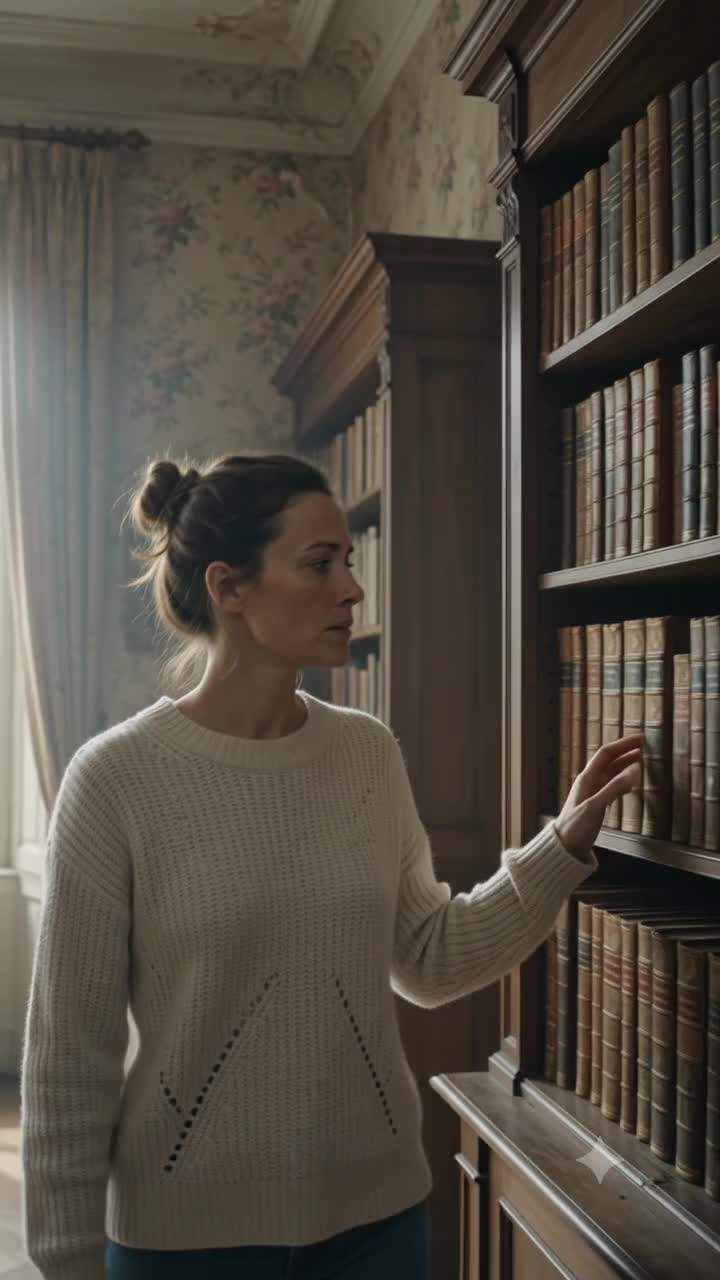
Lost in thought, I ran my hand along a section of the wall behind a particularly large, ornate bookcase.
My fingers brushed against something, a slight unevenness, a faint seam I'd never noticed before.
Curiosity piqued, I pushed gently.
To my astonishment, a small, cleverly disguised panel clicked inward, revealing a dusty, old-fashioned safe embedded in the wall.
It wasn't a modern, digital safe; it was an antique, with a heavy brass dial and intricate carvings.
My heart began to pound with a mixture of excitement and trepidation.
Uncle Thomas had always been a man of secrets, but never anything malicious, just quiet eccentricities.
After an hour of careful, anxious work, following a faint clue I'd found in an old diary, I managed to crack the code.
The heavy door groaned open, releasing a stale, musty smell that seemed to carry the weight of decades.
Inside, it wasn't gold or jewels, but a neat stack of yellowed envelopes and a single, leather-bound journal.
My hands trembled as I pulled out the top envelope.
It contained a will, dated five years before the one Uncle Thomas had officially signed and which the family was now trying to execute.
This earlier will was drastically different, leaving the mansion and a substantial portion of his fortune to my mother's side of the family, specifically to my branch.
The official will, the one everyone knew, distributed everything far more broadly, significantly reducing our share, almost as if to punish us.
A cold dread began to seep into my bones, a feeling far worse than the musty air.
Then I opened the journal.
Uncle Thomas’s elegant, familiar handwriting filled the pages.
He detailed his failing health, his increasing confusion, and his growing dependence on my cousin, Robert.
Robert, the golden boy of the family, the one everyone admired, the one who had always seemed so devoted to Uncle Thomas.
The journal entries painted a horrifying picture: Robert subtly manipulating his weakening uncle, isolating him from our side of the family.
He described conversations where Robert twisted facts, sowed discord, and slowly but surely convinced Uncle Thomas that my mother and I were ungrateful, greedy, and only after his money.
Uncle Thomas, in his declining lucidity, believed these lies.
He wrote about feeling betrayed by us, about the pain of thinking his beloved niece and nephew had turned against him.





