
My heart still pounds whenever I think about that dusty old mansion, a place I once thought was just full of quirky memories and the scent of lavender.
Aunt Eleanor had passed away quietly in her sleep a few months prior, leaving the sprawling, gothic house to me, her only living relative.
I had always loved visiting her there as a child, enchanted by its towering ceilings and the whispers of history in every creaky floorboard.
But after her funeral, as I began the daunting task of sorting through her belongings, a different kind of silence settled over the house, heavy and watchful.
I was in the study, a room Aunt Eleanor rarely let anyone into, filled with ancient books and the scent of aged paper.
A specific bookshelf, tucked away behind a heavy velvet curtain, caught my eye, looking oddly newer than the others.
My fingers traced along the spines, and then, almost by accident, I pressed on a small, disguised button.
With a soft click, a section of the shelf slid inward, revealing a small, hidden compartment.
Inside, nestled amongst yellowed letters and a faded silver locket, was a leather-bound journal.
Its cover was soft and worn, adorned with intricate, swirling gold leaf that seemed to shimmer even in the dim light.
I pulled it out, my hands trembling slightly with a mix of excitement and a strange apprehension.
This wasn't just any journal; it was Aunt Eleanor's, and the dates inside stretched back over fifty years.
I settled into her old armchair, the velvet surprisingly soft beneath my fingers, and began to read.
The first entries were mundane, observations about the garden, notes on recipes, and the occasional musing about her neighbors.
Then, the tone shifted.
The handwriting became more frantic, the sentences shorter, punctuated by dashes and exclamation marks.
She wrote about someone named "Thomas," a name I didn't recognize in our family tree.
He was a permanent fixture in the mansion, not as a guest, but as a secret, a prisoner.
My breath hitched in my throat; prisoner?
Aunt Eleanor described how Thomas had been brought to the mansion as a young man, severely injured, after a terrible accident that was no accident at all.
His memory was shattered, fragmented, and he couldn't recall his own name or where he came from.
She, then a young woman, was tasked by her parents—my great-grandparents—to care for him, to keep him hidden.
The journal entries detailed a life lived in shadows, a young man confined to the hidden rooms of the mansion, never seeing the light of day.
He wasn't a threat; he was a victim, a boy whose past was deliberately erased to protect another family’s reputation, a powerful family that had committed a heinous crime.
My great-grandparents, it seemed, had witnessed the "accident" and had been bribed, coerced, into hiding Thomas away, fearing for their own lives if they spoke up.
The betrayal wasn't just to Thomas; it was to truth, to justice, to the very notion of what a family should stand for.
Aunt Eleanor confessed her torment, her love for Thomas, a love born of shared isolation and profound pity.
She had secretly taught him, cared for him, even tried to help him remember, but the fear of her parents, and the powerful family's reach, kept them both trapped.
The last entry about Thomas was chilling, a single sentence: "He finally found peace, here, in the mansion he never left."
Advertisement
I stared at the words, unable to process the full weight of what I had just read.
A hidden life, a decades-long cover-up, a boy lost to the world, all within the walls of my family home.
My great-grandparents, the people I had been taught to revere, were accomplices to an unimaginable cruelty.
Aunt Eleanor, my sweet, eccentric aunt, had carried this horrific secret, this unbearable burden, her entire life.
I felt a wave of nausea, a profound sense of wrongness that permeated the very air of the study.
The mansion, once a place of childhood wonder, now felt like a tomb, a silent witness to a terrible injustice.
Every creak, every shadow, suddenly seemed to hold a darker meaning.
The antique furniture, the faded tapestries, the ornate paintings—they were all accomplices, silent guardians of a horrifying truth.
My perception of my family, of history, of everything I held dear, shattered into a million pieces.
This wasn't just a discovery; it was an irreversible consequence, a stain on our legacy that could never be washed away.
What did Aunt Eleanor expect me to do with this truth?
Did she want me to expose it, to rip open old wounds and bring down a powerful family, potentially endangering my own?
Or did she simply want me to know, to understand the silent suffering she had endured?
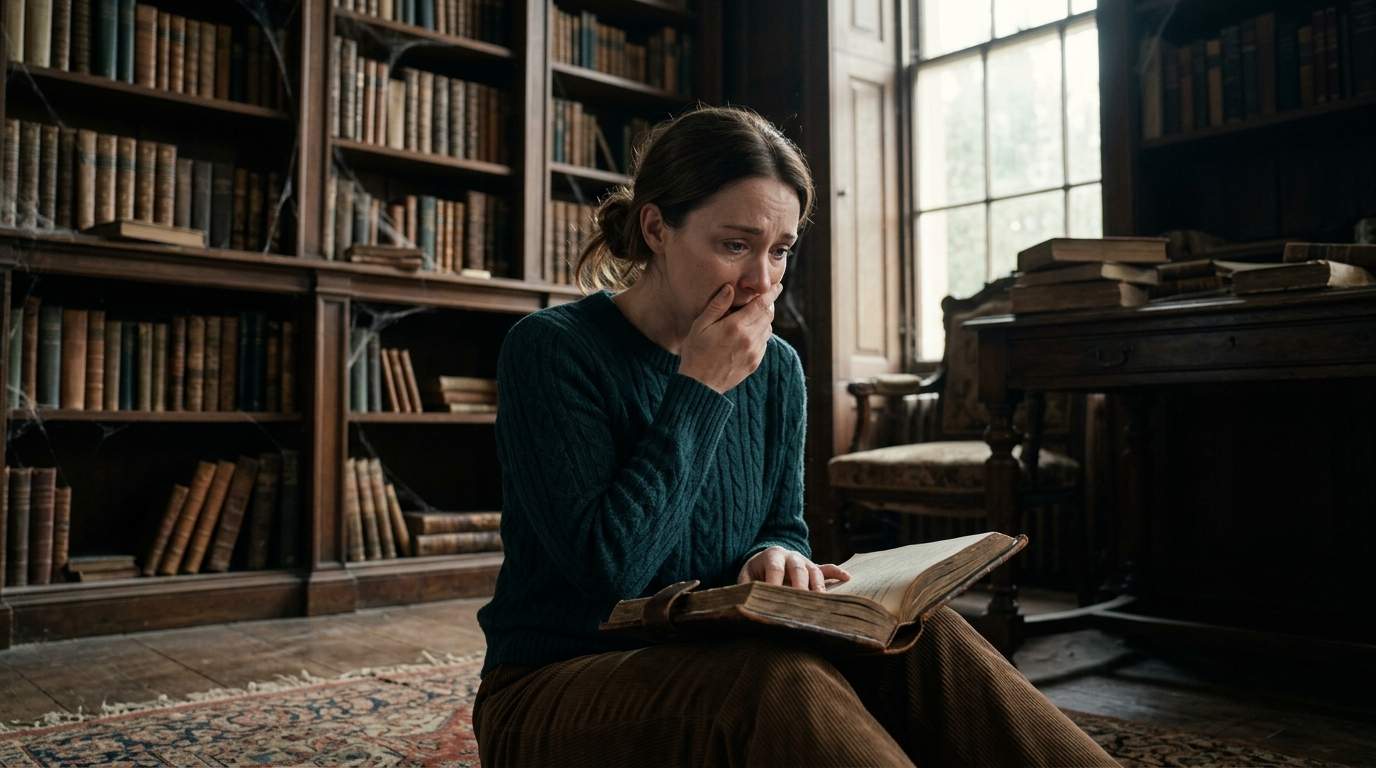
The journal lay open on my lap, its brittle pages now seeming to pulse with a dark energy.
My hands were shaking so violently I could barely hold it steady.
I looked around the grand, yet desolate room, feeling utterly alone with a secret that felt too immense to carry.
The ghost of Thomas, a boy who never truly lived, now haunted every corner of the mansion, and my soul.
I thought of my parents, who had always spoken of Aunt Eleanor with such fondness, never suspecting the depths of her pain or the darkness she concealed.
They knew nothing of Thomas, nothing of the crime that had stained our family's past.
How could they?
The weight of this secret settled on my shoulders, heavy and suffocating.
It was a truth that would change everything, for everyone, if it ever saw the light of day.





