
My grandmother’s old mansion always felt like a warm, echoing embrace.
Every creaking floorboard, every faded tapestry, held a story of generations, of comfort, of home.
After she passed, it fell to me to sort through some of her things, a task I approached with a mix of grief and nostalgia.
The basement, though, was always a place we rarely ventured, mostly for dusty storage, a forgotten realm.
I found myself down there last Tuesday, trying to fix a persistent leak that threatened the old heating system.
It was damp, smelling of earth and time, dimly lit by a single flickering bulb.
As I traced a stubborn drip along the stone foundation, my fingers brushed against something odd.
A section of the wall felt different, a loose panel disguised perfectly among the rough-hewn stones.
My heart gave a strange thump, a premonition I couldn’t quite place.
With trembling hands, I pried it open, revealing a small, dark recess within the thick wall.
Inside, nestled amongst decades of undisturbed dust, was a heavy, old wooden box, bound with rusted iron straps.
My breath hitched in my throat as I pulled it out, the weight surprisingly significant.
The latch was intricate, old, almost a puzzle in itself.
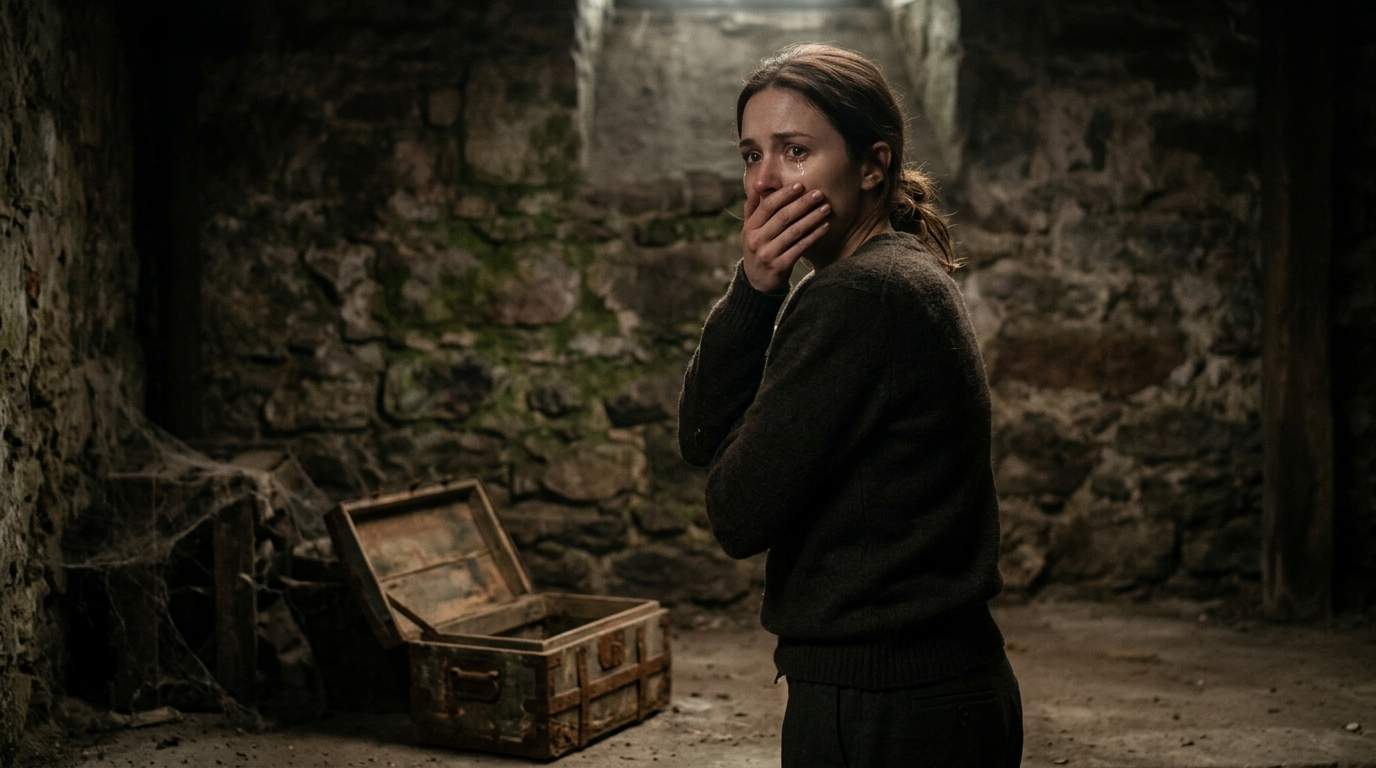
After a moment of fumbling, it clicked open with a soft, ominous sound.
What lay inside was not jewelry, nor old letters, nor forgotten trinkets.
It was a collection of meticulously kept ledger books, brittle with age, and a single, faded photograph.
The ledgers detailed a series of financial transactions, large sums of money, names and dates I didn't recognize, stretching back forty years.
But it was the photograph that made the blood drain from my face.
It was a picture of my uncle, younger, smiling, standing next to a man I had never seen, whose face was circled in red ink.
And beneath the circle, scrawled in my grandmother's shaky handwriting, were three terrifying words: “The missing one.”
My uncle. The pillar of our family, the kind, generous man who always had a story and a warm hug.
The ledgers, when I forced myself to scan them, weren't just about money; they were meticulously documented payoffs.
Payments to people, to "silence," to "relocate," to "ensure discretion."
My uncle, decades ago, was systematically paying off people, covering up something immense and sinister.
The "missing one" in the photo, whose family reportedly just "moved away suddenly" years ago, wasn't just a casual acquaintance.
He was a victim, silenced, disappeared, and my uncle was at the heart of it all.
This wasn't just a hidden family secret; it was evidence of a crime, a lifelong deception.
My grandmother knew, evidenced by her note, yet she hid it, protecting her son, protecting our family's name.
The mansion, once a symbol of comfort, now felt like a mausoleum of lies, its walls breathing the heavy air of injustice.
Advertisement
Every memory I had of my uncle, every kind word, every shared laugh, twisted into something grotesque.
He wasn't just a kind relative; he was a man who had built his life, our family's comfortable existence, on a foundation of betrayal and darkness.
The knowledge was a physical weight, crushing my chest, making it hard to breathe.
The truth felt like a living thing, squirming and dangerous, ready to rip apart everything I held dear.
How could I face him? How could I look at my family knowing this dark stain existed?
My entire perception of right and wrong, of loyalty and love, shattered into a million pieces.
The happy, innocent home I thought I knew was nothing but a gilded cage built upon someone else’s misery.
I was alone with this monstrous truth, the only one who knew the depth of my uncle's horrifying secret.
The weight of it was suffocating, threatening to consume me whole.





