
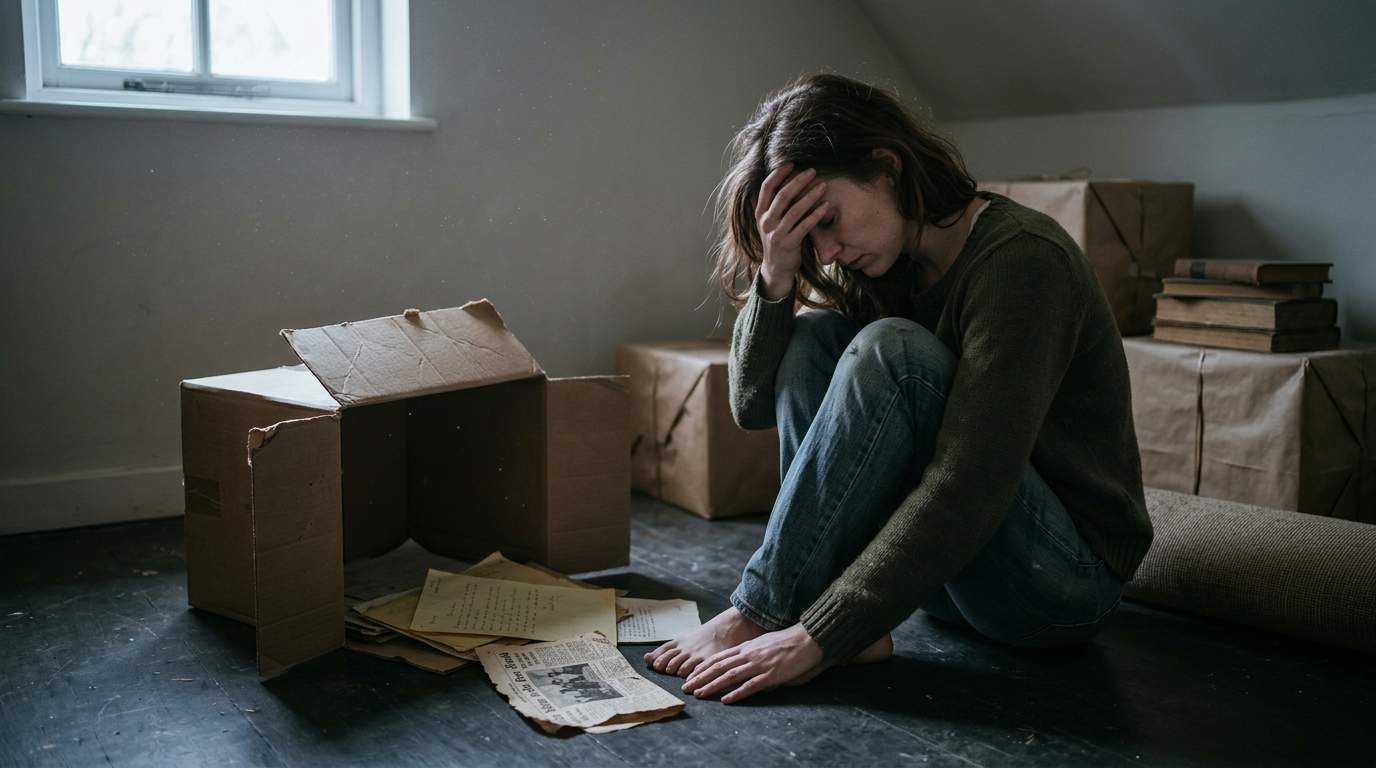
My hands still shake when I think about that afternoon in the attic.
It was just supposed to be a simple clean-out, finally getting rid of some of Dad’s old boxes after he passed last year.
The dusty air hung heavy, thick with memories of a man I thought I knew everything about.
I found it tucked away at the bottom of a cedar chest, beneath a stack of faded photo albums.
A small, nondescript shoebox, taped shut and marked "DO NOT OPEN."
My father had always been a private man, but this felt different, almost forbidden.
Curiosity, that cruel mistress, urged my fingers to peel back the brittle tape.
Inside, among yellowed letters and a rusty pocket watch, lay a faded newspaper clipping from 1985.
The headline screamed about a massive embezzlement scandal that rocked a small town in Arizona.
Beneath it, a grainy photo of a young man stared back at me.
His face was thinner, hair darker, but there was no mistaking the eyes.
They were my father’s eyes.
My breath caught in my throat, a cold, suffocating knot.
I dismissed it instantly, a bizarre coincidence, a mistaken identity, anything but what my gut screamed.
But then I saw the other document, tucked neatly underneath the clipping.
It was a birth certificate, not mine, but one for a child named "David Miller."
The parents listed were completely different from my own.
And the date on that birth certificate was just two years before my father and mother supposedly met.
My mind raced, reeling, trying to make sense of the disjointed pieces.
This wasn't just a secret; this was an entirely different life.
The man in the photo, the name "David Miller," it all felt alien and terrifying.
My father’s real name wasn't John Smith, as I had known him for thirty years.
His real name was David Miller, and he was a wanted man.
He had embezzled millions, ruined countless lives, and vanished without a trace, only to resurface years later as my loving, dependable father.
The world tilted on its axis, every memory, every shared laugh, every comforting word he ever spoke, warped into a cruel, calculated performance.
I felt a wave of nausea, clutching the papers as if they might dissolve the truth if I held them tight enough.
My father, my hero, the man I idolized, was a criminal.
And my mother, her picture sat smiling from a frame on my bedside table, she knew.
She had to have known.
Advertisement
Suddenly, her evasiveness about their early years, her vague stories, it all clicked into place with horrifying clarity.
She wasn't just his wife; she was an accomplice in this elaborate deception, this monumental lie that was my entire upbringing.
The betrayal was a physical blow, a sharp, searing pain in my chest.
My entire life, every memory, every family photo, was built on a foundation of deceit.
I wasn’t just a child; I was a living part of their carefully constructed alibi, an unwitting prop in their escape.
My identity, my very existence, felt like a forgery.
The quiet, suburban home where I grew up, it wasn't a sanctuary; it was a hideout.
My childhood, once a tapestry of warmth and security, unraveled into a chilling narrative of evasion and fear.
I stumbled down the attic stairs, the weight of the secret pressing down on me, heavy and suffocating.
My mother was in the kitchen, humming a cheerful tune, oblivious to the earthquake that had just shattered my world.
How could she look at me every day, knowing the truth, and keep smiling?
How could she let me love a man who was living a lie?
The man she married, the father of her children, had vanished into thin air decades ago.
The man I called Dad was a ghost, a carefully constructed illusion.
I stood there, the newspaper clipping clutched in my trembling hand, the face of the embezzler staring up at me.
My father.
My world, once solid and real, crumbled into a million treacherous pieces around my feet.
I didn't just lose a father that day; I lost my entire past, my present, and the comforting certainty of who I thought I was.
And I had no idea how to ever put any of it back together.





