
I never truly knew my Great-Aunt Eleanor.
She passed away peacefully at ninety-eight, leaving me her sprawling Victorian mansion, a house steeped in silence and forgotten memories.
It was an overwhelming inheritance, a monument to a life I only glimpsed through faded photographs and hushed family stories.
I decided to restore the old place myself, hoping to find a connection to the dignified woman everyone revered.
Every dusty antique, every creaking floorboard, felt like a whisper from the past.
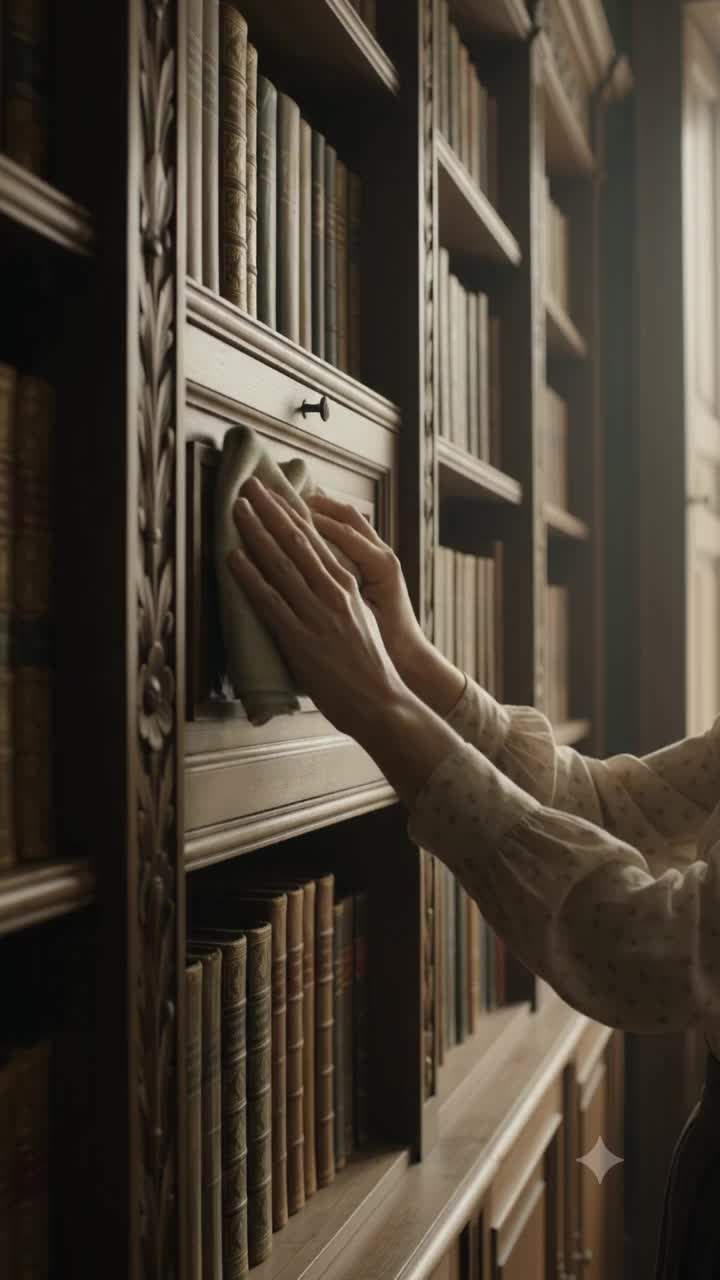
One blustery October afternoon, I was in Eleanor's old study, meticulously cleaning built-in bookshelves that spanned an entire wall.
The wood was dark, heavy oak, carved with intricate, almost sorrowful designs.
As I ran my hand along a particularly ornate section, my fingers brushed against a faint seam I'd never noticed before.
A small, nearly invisible lever, disguised as part of the carving, clicked softly under my touch.
With a low groan, a section of the bookshelf slowly pivoted inward, revealing not another room, but a small, dark recess within the thick wall itself.
My heart hammered against my ribs, a primal fear mixing with an undeniable, urgent curiosity.
I peered into the gloom, a scent of aged paper and forgotten secrets filling my nostrils.
Inside, nestled on a small, dusty shelf, was a beautifully carved wooden box, surprisingly light.
My hands trembled as I lifted it out, brushing away the fine layer of almost seventy years of dust.
It was locked, of course, but the key was tucked underneath, a tiny brass relic hidden in plain sight.
The lid creaked open, revealing not jewels, but a meticulously folded silk handkerchief, yellowed with time.
Beneath it lay a baby's silver locket, tarnished but still gleaming faintly in the dim light.
I pulled out the locket, its tiny weight heavy in my palm, and saw delicate engraving: "Daniel."
Then, a bundle of yellowed newspaper clippings, brittle with age, tied with a faded ribbon.
The headline on the top clipping screamed from 1948: "Prominent Local Family's Baby Vanishes from Crib."
A chill, colder than any autumn draft, snaked up my spine.
My family, prominent?
A missing baby?
This was not a story I had ever heard.
I read quickly, my eyes devouring each word, the details painting a horrifying picture of a frantic search that yielded nothing.
The baby's name was Daniel Thorne.
Thorne was Eleanor's maiden name.
My mind reeled, trying to connect these disparate, shocking pieces.
Then, at the very bottom of the box, tucked beneath all the other relics, was a single, sealed letter.
Advertisement
It was addressed simply: "To My Lost Child."
The handwriting was Eleanor's, elegant and precise, yet imbued with an almost unbearable sadness.
My fingers fumbled, tearing open the fragile seal, the paper almost disintegrating in my haste.
The letter began, "My dearest Daniel, if somehow you ever find this, know that I loved you more than life itself."
Eleanor, a mother?
The shock hit me with the force of a physical blow, stealing the air from my lungs.
She went on to explain the shame of an unmarried pregnancy in 1948, the pressure from her family to hide it.
Then came the part that truly shattered me, the truth that turned my world upside down.
It wasn't a stranger who took Daniel.
It was her own brother, my Great-Uncle Arthur, the revered patriarch, the community pillar, the man whose framed portrait hung proudly in our living room.
Arthur, to protect the family's "good name" and avoid scandal, had orchestrated Daniel's removal.
He had paid a nurse to take the baby, convincing Eleanor that Daniel had died shortly after birth, a tragic lie.
Eleanor, heartbroken and devastated, believed him for years.
The letter then detailed her later, horrifying discovery, through a chance encounter, that Daniel had not died but had been adopted by a family in another state.
She never saw him again, never knew his fate, consumed by grief and the terrible secret.
Arthur had buried the truth, not just from the world, but from his own sister, condemning her to decades of silent suffering.
The dignified, quiet Eleanor I thought I knew was a woman broken by a monstrous deception.
The image of Great-Uncle Arthur, the kind, honorable man celebrated in our family's history, crumbled into dust.
He wasn't a hero; he was a villain, a perpetrator of unimaginable cruelty.
The mansion, once a symbol of legacy, now felt like a tomb, holding not just memories, but a terrifying injustice.
Everything I thought I knew about my family, about who we were, was a carefully constructed lie.
The past wasn't just hidden; it was actively suppressed, brutalized, and buried by those I trusted most.
My world didn't just crack; it splintered into a million irreparable pieces.





