
I never thought much about Aunt Eleanor until she was gone.
Her passing was sudden, a quiet exit from a life always lived in the shadows of our family.
I inherited her sprawling, dilapidated mansion, a place I’d only visited a few times as a child, always feeling an unsettling chill.
It stood on the edge of town, a silent sentinel draped in ivy and forgotten stories.
My family thought I was crazy to even consider keeping it, urging me to sell the 'money pit.'
But something about the old house, with its creaking floors and musty scent of aged wood and forgotten memories, called to me.
I decided to move in, at least temporarily, to sort through her things and see if I could make sense of her reclusive life.
The first few weeks were a blur of dust, cobwebs, and uncovering forgotten heirlooms.
Every room felt like a journey back in time, each object whispering tales I couldn't quite hear.
I started with Aunt Eleanor's study, a grand room dominated by floor-to-ceiling bookshelves crammed with ancient tomes.
It felt like the heart of the house, a place she must have spent countless hours.
One afternoon, while cleaning behind a particularly heavy oak desk, my hand brushed against a loose panel in the wall.
It wasn't immediately obvious; just a slight give in the aged wood.
My heart gave a strange little thump, a mix of curiosity and an irrational sense of dread.
With a gentle push, the panel swung inward, revealing a small, dark recess.
Inside, nestled amongst decades of dust, was a single, leather-bound diary.
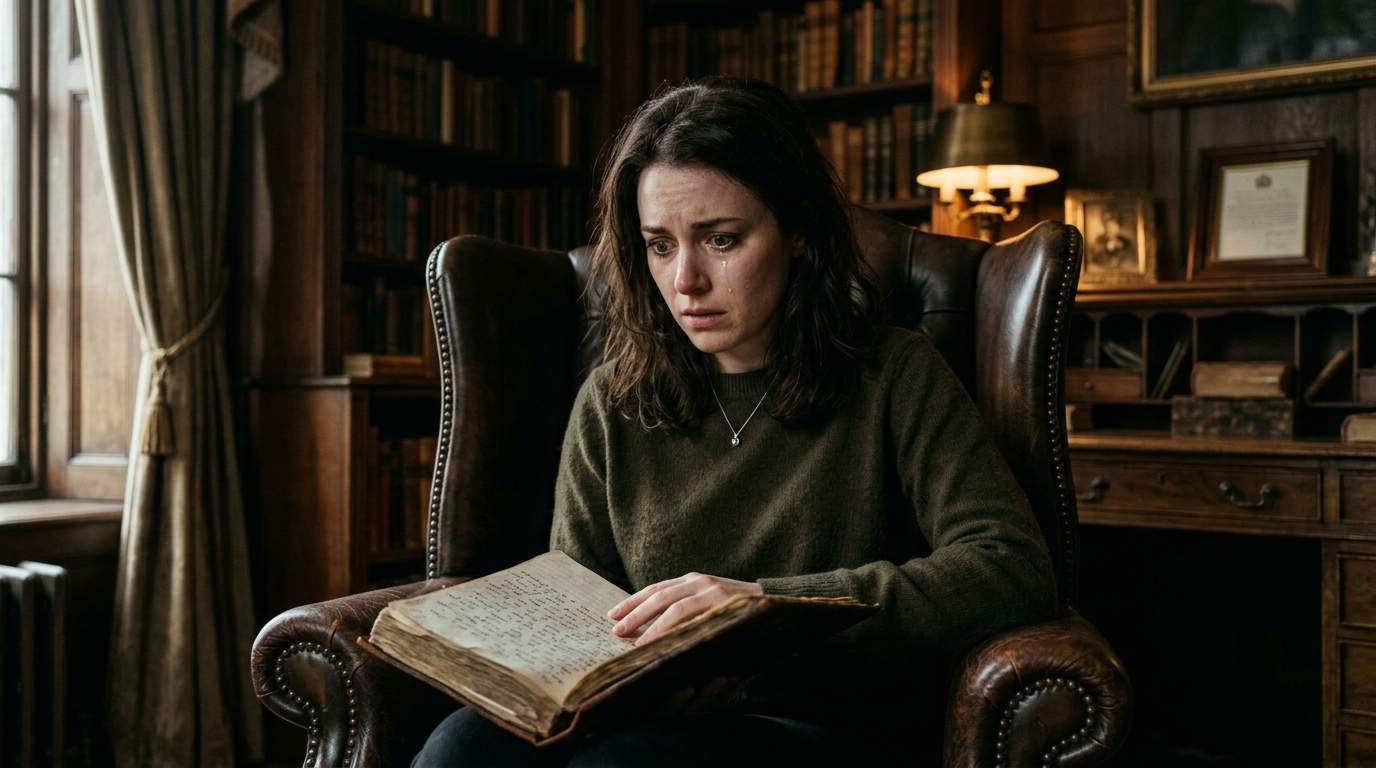
It looked ancient, its cover worn smooth from handling, its pages a faint yellow with age.
I pulled it out, my fingers trembling slightly, feeling the weight of something profound.
Back in the quiet solitude of the living room, I settled into an old armchair, the diary heavy in my lap.
I expected mundane entries, perhaps recipes or gardening notes from a lonely old woman.
The first few pages were innocent enough, chronicling Eleanor's daily life, her observations on the weather, a few mentions of family visits.
Then, the tone began to shift, subtly at first, like a shadow lengthening in the evening light.
She started writing about "the incident," referring to it obliquely, as if afraid the walls themselves would hear.
The incident she was describing was the disappearance of our distant cousin, Clara, decades ago.
Everyone in the family had always said Clara ran away, a wild spirit who couldn’t be tamed by our quiet town.
Aunt Eleanor’s entries painted a different, far darker picture.
She wrote of whispers, hushed conversations behind closed doors, and a pervasive fear that hung over the mansion like a shroud.
She believed Clara hadn't run away; she had been taken, silenced, to protect the family's 'honor.'
My hands started to sweat as I turned the brittle pages, each word a cold shard of ice.
Advertisement
Eleanor was convinced Clara had been murdered, right here, within these very walls.
And the person responsible, according to her increasingly frantic entries, was none other than my revered grandfather.
He was the patriarch, the foundation of our family, a man whose legacy I had always been taught to admire.
The diary detailed how he orchestrated the cover-up, silencing anyone who dared to question Clara’s supposed departure.
Eleanor herself had been threatened, warned to keep silent if she valued her own life, or the lives of those she loved.
My grandfather, the benevolent figure in all my childhood memories, was painted as a ruthless manipulator, capable of unthinkable cruelty.
The thought made my stomach churn, a bitter taste rising in my throat.
I reread an entry, my eyes scanning the chilling words: "He said, 'Some truths are best left buried, Eleanor. For the family's sake.'"
She wrote about how she’d secretly tried to find proof, hints of a hidden location within the mansion where Clara’s final resting place might be.
She described coded messages, a cryptic map drawn on the inside cover of an old poetry book in the attic.
The diary ended abruptly, just a few pages from its final blank leaf, with a desperate plea for the truth to eventually surface.
It was as if she had stopped writing in haste, or worse, been prevented from continuing.
I closed the diary, its leather cover now feeling scalding hot against my skin.
My perception of my family, of my own history, shattered into a million irreparable pieces.
The mansion, once a source of mysterious charm, now felt like a terrifying prison, holding not just history but a horrifying crime.
The man I looked up to, whose stories I'd always believed, was a monster.
Every shadow in the room seemed to deepen, every creak in the old house sounded like a mournful wail.
The secrets of Aunt Eleanor's diary hadn't just changed my understanding of the past; they had irrevocably changed my future.





