
My hands still shake when I think about that day in Uncle Robert’s old mansion.
It started like any other duty after a family loss, sorting through a life that had quietly ended.
Everyone in our family always painted Uncle Robert as the quiet eccentric, a bachelor who preferred solitude over society.
He lived out his days in the grand, drafty old house, a place both fascinating and eerie since my childhood.
I remember my mother always saying, “Poor Robert, always so alone.”
We all believed it, accepting it as his chosen path.
After his passing, it fell to me, his niece, to go through his things, to prepare the estate for whatever came next.
The mansion felt heavy with his absence, the air thick with dust and forgotten memories.
I started in the library, a vast room with floor-to-ceiling bookshelves that held more than just books; they held decades of accumulated quiet.
One afternoon, running my hand along a particularly old, built-in shelf near the back wall, my fingers snagged on something.
It wasn't a loose book, but a small, almost invisible seam in the wood paneling.
Curiosity, that dangerous little imp, took hold.
I pushed, gently at first, then with more force.
With a soft click and a groan of old hinges, a section of the bookshelf slid inward, revealing not a hidden safe, but a dark, narrow passage.
My heart hammered against my ribs, a nervous, exciting rhythm.
Flashlight in hand, I stepped into the gloom, my breath catching in my throat.
The passage was short, leading to a small, unassuming door, almost swallowed by the shadows.
It opened into a room I had never known existed within the mansion’s sprawling footprint.
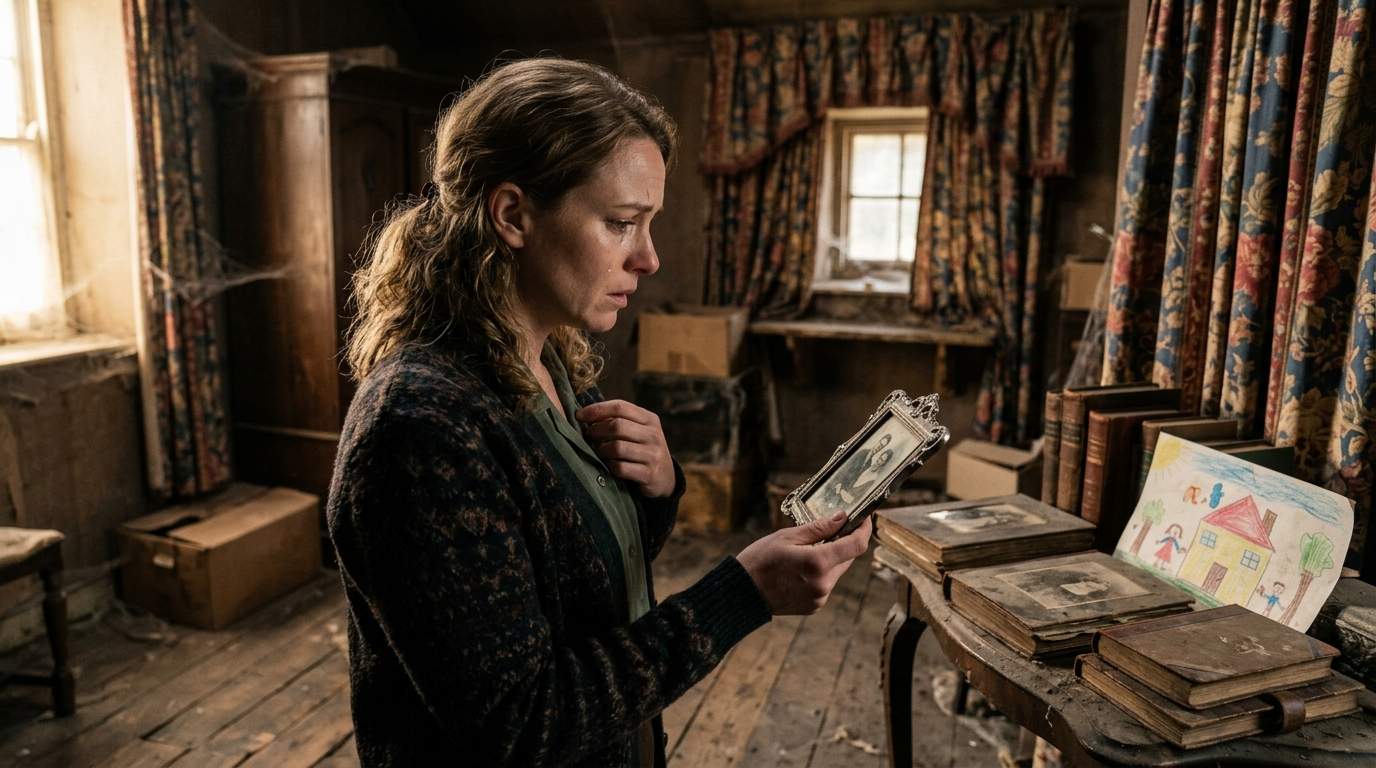
This wasn’t a dusty storage room or another forgotten study.
This was lived-in, vibrant, and utterly foreign to everything we knew about Uncle Robert.
Sunlight, muted by heavy, unfamiliar floral curtains, spilled into a cozy sitting area.
There were cheerful, embroidered cushions on an armchair, not the stern, dark fabrics of the main house.
On a small, polished table sat a vase, though long empty, and beside it, a stack of worn photo albums.
I picked up the top album, my fingers trembling.
Inside, the faces staring back were unmistakably Robert, but not the Uncle Robert I knew.
He was younger, smiling broadly, an arm slung around a beautiful woman I had never seen before.
Her eyes sparkled, her laughter almost audible through the faded print.
And then, children.
Little ones, two girls and a boy, growing up through the pages, year after year.
Advertisement
Birthday parties, Christmas mornings, summer picnics in a garden that looked nothing like the overgrown wilderness outside the mansion’s main windows.
Their faces, bright and innocent, bore faint resemblances to my uncle’s.
It wasn't a fleeting affair, not a single secret.
This was a whole life, meticulously documented, spanning decades, a parallel universe hidden just beyond a bookshelf.
Letters tied with ribbons, addressed to “My Dearest Robert” from “Your loving Eleanor,” spoke of a deep, enduring love.
Children’s drawings, yellowed with age, bore crayon scribbles like "Best Daddy Ever."
My vision blurred, not just from the dust, but from the searing heat of disbelief and betrayal.
Everything I thought I knew about Uncle Robert, about our family, shattered into a million sharp pieces right there on that velvet-lined page.
He wasn’t alone; he had chosen to be alone from us, while building another entire existence.
Who was Eleanor?
Who were these children?
Did they know about us, the other family, the one he presented to the world?
Or were we the secret, the inconvenient truth he kept locked away behind a hidden door?
The weight of this discovery pressed down on me, heavy and suffocating.
This wasn't just a secret; it was a profound deception, a carefully constructed lie that had shaped all our lives, and perhaps theirs too.
My grief for Uncle Robert transformed into a confusing mix of anger, sorrow, and an aching sense of bewilderment.
The mansion, once a symbol of his quiet eccentricity, now felt like a mausoleum of lies.
I stood there, surrounded by the remnants of his hidden happiness, feeling like an unwitting intruder in a sacred, stolen life.
What was I supposed to do with this truth?
How do you tell a family that their beloved, lonely uncle wasn’t lonely at all, but a master of deceit?
The consequences of revealing this would be immense, irreversible, shattering our family’s peace, perhaps even destroying the legacy he left behind.
But keeping it secret felt like perpetuating his lie, becoming an accomplice to a deception that spanned generations.
My world, once neatly ordered, was now a chaotic mess of questions, loyalty, and an unbearable burden of truth.
The silent mansion echoed with the ghostly laughter of a family I never knew, a family that, for all I knew, still existed somewhere, oblivious to their secret patriarch’s other life.
This discovery didn't just change my perception of Uncle Robert; it changed everything I understood about trust, about family, and about the hidden depths of human hearts.





