My heart still pounds whenever I think about that dusty old mansion, a place I once thought was just full of quirky memories and the scent of lavender.
Aunt Eleanor had passed away quietly in her sleep a few months prior, leaving the sprawling, gothic house to me, her only living relative.
I had always loved visiting her there as a child, enchanted by its towering ceilings and the whispers of history in every creaky floorboard.
But after her funeral, as I began the daunting task of sorting through her belongings, a different kind of silence settled over the house, heavy and watchful.
I was in the study, a room Aunt Eleanor rarely let anyone into, filled with ancient books and the scent of aged paper.
A specific bookshelf, tucked away behind a heavy velvet curtain, caught my eye, looking oddly newer than the others.
My fingers traced along the spines, and then, almost by accident, I pressed on a small, disguised button.
With a soft click, a section of the shelf slid inward, revealing a small, hidden compartment.
Inside, nestled amongst yellowed letters and a faded silver locket, was a leather-bound journal.
Its cover was soft and worn, adorned with intricate, swirling gold leaf that seemed to shimmer even in the dim light.
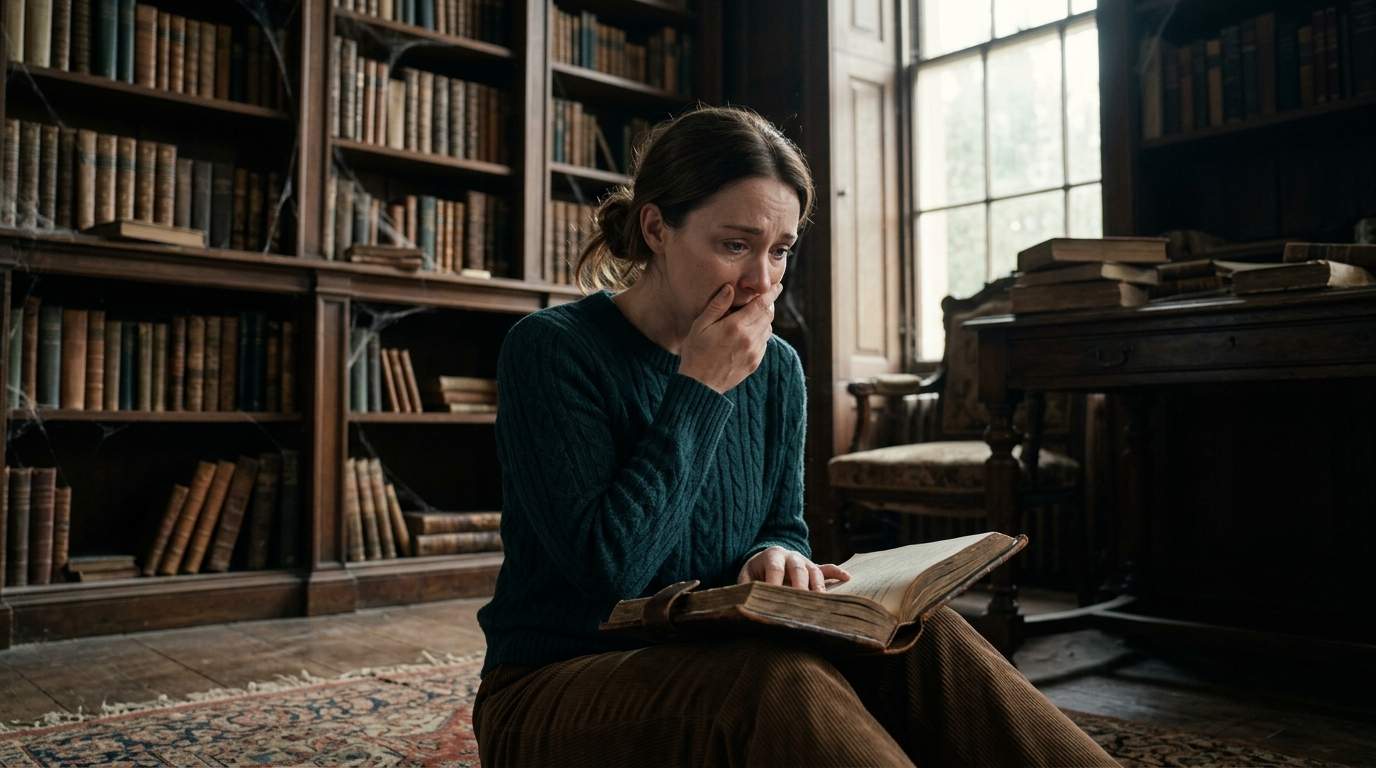
I pulled it out, my hands trembling slightly with a mix of excitement and a strange apprehension.
This wasn't just any journal; it was Aunt Eleanor's, and the dates inside stretched back over fifty years.
I settled into her old armchair, the velvet surprisingly soft beneath my fingers, and began to read.
The first entries were mundane, observations about the garden, notes on recipes, and the occasional musing about her neighbors.
Then, the tone shifted.
The handwriting became more frantic, the sentences shorter, punctuated by dashes and exclamation marks.
She wrote about someone named "Thomas," a name I didn't recognize in our family tree.
He was a permanent fixture in the mansion, not as a guest, but as a secret, a prisoner.
My breath hitched in my throat; prisoner?
Aunt Eleanor described how Thomas had been brought to the mansion as a young man, severely injured, after a terrible accident that was no accident at all.
His memory was shattered, fragmented, and he couldn't recall his own name or where he came from.
She, then a young woman, was tasked by her parents—my great-grandparents—to care for him, to keep him hidden.
The journal entries detailed a life lived in shadows, a young man confined to the hidden rooms of the mansion, never seeing the light of day.
He wasn't a threat; he was a victim, a boy whose past was deliberately erased to protect another family’s reputation, a powerful family that had committed a heinous crime.
My great-grandparents, it seemed, had witnessed the "accident" and had been bribed, coerced, into hiding Thomas away, fearing for their own lives if they spoke up.
The betrayal wasn't just to Thomas; it was to truth, to justice, to the very notion of what a family should stand for.
Aunt Eleanor confessed her torment, her love for Thomas, a love born of shared isolation and profound pity.
She had secretly taught him, cared for him, even tried to help him remember, but the fear of her parents, and the powerful family's reach, kept them both trapped.
The last entry about Thomas was chilling, a single sentence: "He finally found peace, here, in the mansion he never left."
I stared at the words, unable to process the full weight of what I had just read.
A hidden life, a decades-long cover-up, a boy lost to the world, all within the walls of my family home.