The glare from the stage lights always felt like a physical weight, but today, it was different.
It was a spotlight on my own trembling hands, hidden beneath the cheap plastic of the backstage laptop.
Richard Vance, our CEO, was a master of performance, a titan of industry with a smile that could charm angels and a handshake that promised fortunes.
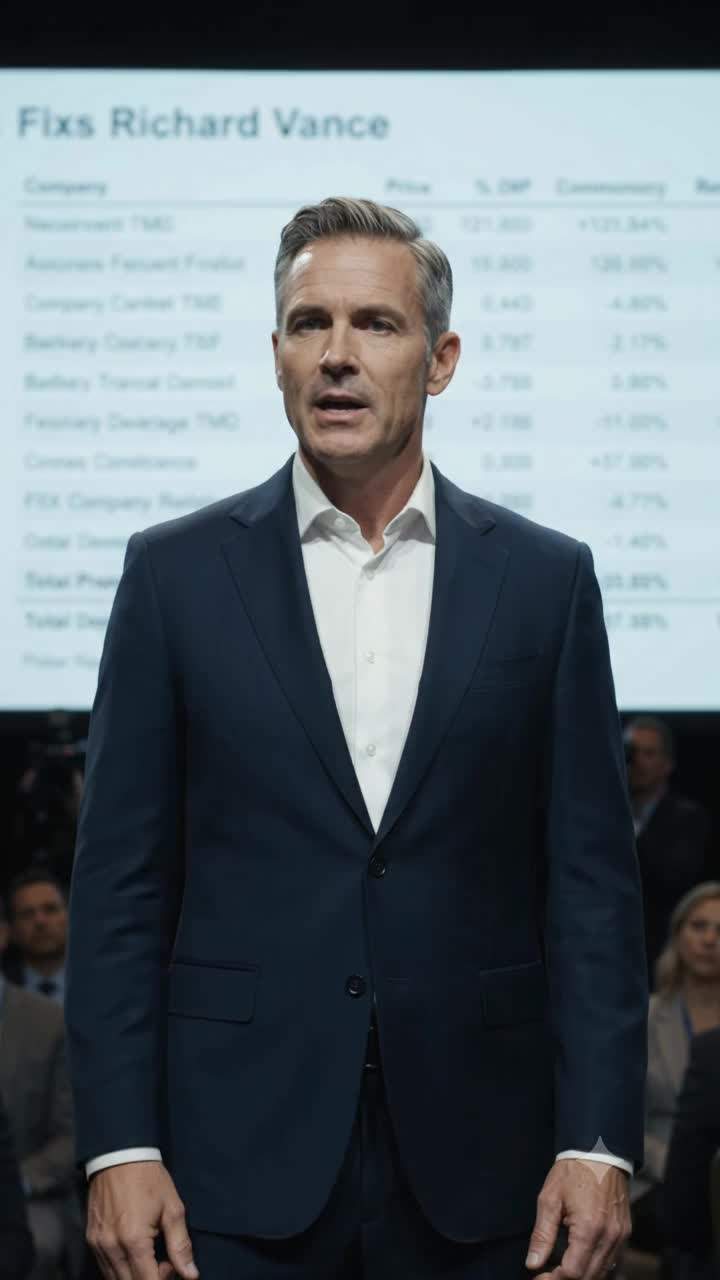
He stood on stage, radiating his usual aura of unshakeable confidence, his voice smooth and resonant, painting a future for our company that was as dazzling as it was, to me, utterly hollow.
I had believed in him once, in the early days when I joined Sterling Innovations as a bright-eyed financial analyst.
He had built this empire from nearly nothing, or so the legend went, and I was proud to be a cog, however small, in its mighty machinery.
I worked long hours, fueled by ambition and the genuine belief that my efforts contributed to something meaningful.
My desk was a fortress of spreadsheets and market reports, a place where logic and numbers reigned supreme.
It was within this fortress that the first crack appeared, a tiny fissure that would eventually shatter my entire world.
It began subtly, a discrepancy in a supplier invoice for the new European expansion project.
I flagged it, thinking it was a clerical error, just another loose thread in the vast tapestry of our corporate finances.
But when I dug deeper, the thread didn't just lead to an error; it unspooled into something far more sinister.
What I found was a systematic siphoning of company funds, disguised as legitimate business expenses, routed through a labyrinth of shell corporations.
It wasn't just a few thousand dollars; it was millions, bleeding away from our employee pension fund, from the promised year-end bonuses, from the very budgets meant to secure our collective future.
Richard Vance, the visionary leader, was a thief.
The realization hit me like a physical blow, stealing my breath and churning my stomach.
My hero, the man I had admired, was systematically dismantling the trust of every single employee who dedicated their lives to this company.
I couldn’t unsee it.
The numbers screamed at me from the screen, cold, hard proof of his betrayal.
For weeks, I lived in a state of quiet terror, poring over files late into the night, cross-referencing bank statements, tracking IP addresses, building a case brick by painful brick.
Every click of the mouse felt like a step further down a dark, irreversible path.
I considered reporting it internally, tried to imagine a scenario where the company’s ethics committee would actually hold Richard accountable.
But the corporate structure was too hierarchical, too loyal to its figurehead.
Richard had cultivated an inner circle of unswerving devotion, men and women whose careers were inextricably linked to his success, or perhaps, his silence.
I knew my anonymous whispers would be drowned out, perhaps even traced back to me, and then I would be the one facing ruin, branded a disgruntled employee, a liar.
The fear was a constant, icy companion.
I imagined myself jobless, reputation shredded, watching Richard continue his reign of deception, laughing all the way to his offshore accounts.
But then I looked at my colleagues – Sarah in accounting, who was scrimping to pay her daughter’s college tuition, or Mark from sales, who had just put his life savings into a down payment for a house, both relying on those promised bonuses.
I thought of the recent layoffs, the official reason being "market adjustments," while Richard was buying another yacht.
Advertisement
Their faces flashed in my mind, their trust, their vulnerability.
My silence felt like complicity.
The injustice burned, hotter than any fear.
I had to act.
The annual shareholders’ meeting and press conference was Richard’s stage, his moment of triumph, where he always unveiled grand visions and even grander financial projections.
It was also the perfect stage for the truth.
I spent weeks meticulously planning, leveraging my access as a systems administrator for our department, learning the intricacies of the main presentation setup.
It was risky, audacious, borderline insane.
One wrong move, one missed detail, and it would all crumble, taking me with it.
The night before, I barely slept.
My apartment felt suffocating, filled with the ghosts of my past decisions and the daunting shadow of the one I was about to make.
I packed a small bag with just the essentials, a contingency for the inevitable chaos that would follow.
Today, the conference hall buzzed with an electric anticipation.
Journalists from every major publication were present, cameras flashing, microphones angled towards the podium.
I was backstage, officially listed as technical support, a convenient cover for my true mission.
My heart hammered against my ribs, a frantic drumbeat against the silence of my resolve.
Richard took the stage, soaking in the applause, the flashbulbs.
He began his speech, his voice booming with feigned sincerity, reciting figures that were, in his private ledgers, nothing but lies.
My fingers hovered over the keyboard of the auxiliary laptop connected to the main projector system.
This was it.
My moment.
He was just wrapping up his usual flowery promises, his voice hitting a crescendo.
"…and with these results, we confidently look forward to a future of unparalleled growth," he declared, a triumphant smile plastered on his face.
That was my cue.
My breath hitched, a knot of fear and exhilaration tightening in my chest.
I took a deep, shaky breath, channeling every ounce of courage I had.
My finger descended, firm and deliberate, pressing the enter key.
A soft click echoed, almost imperceptible amidst the ambient hum and the muffled applause.
On the massive screen behind Richard, the Sterling Innovations logo flickered once.
Then, it dissolved.
In its place, stark white text on a black background, accompanied by a damning financial spreadsheet, glowed with an undeniable truth.
"Unauthorized Transfers to Personal Accounts," the headline read.
Below it, red highlights blazed over columns detailing millions siphoned off, followed by bullet points listing offshore accounts, dates, and amounts.
"Evidence of Embezzlement."
The words hung in the air, damning and absolute.
Richard’s voice, which had been trailing off in a triumphant flourish, suddenly died in his throat.
He froze, mid-gesture, his eyes widening in horror as he slowly processed the impossible image over his shoulder.
His face drained of all color, the confident mask dissolving into a ghastly pallor of shock and utter disbelief.
"…what… what is… this?" he stammered, his voice a broken whisper, utterly unlike the booming tone he’d used moments before.
A collective gasp swept through the hall, followed by a cacophony of camera shutters clicking wildly, a furious storm of flashes illuminating Richard’s crumbling facade.
Advertisement
The murmuring began, a low, ominous rumble that quickly escalated into shouts and questions.
My job was done.
I watched, numb, as chaos erupted.
Security guards rushed towards the stage, looking bewildered.
Reporters surged forward, shouting questions, their initial shock turning into a hungry frenzy.
Richard stood there, a statue of ruin, his empire collapsing around him in real-time.
A strange mix of triumph and terror coursed through me.
A weight had lifted, a colossal burden of secret knowledge finally released.
But in its place, a new, terrifying emptiness emerged.
I knew my life, as I knew it, was over.
I quietly unplugged the laptop, slipped it into my bag, and moved towards the emergency exit, lost in the pandemonium.
No one noticed me.
The next few days were a blur of news headlines, legal investigations, and the inevitable fallout.
Richard Vance was arrested, his carefully constructed public image shattered beyond repair.
Sterling Innovations was plunged into crisis, its stock plummeting, its future uncertain.
My name eventually surfaced, whispered in the news, then reported as the whistleblower, Chloe Davis, the analyst who dared to challenge the untouchable.
I lost my job, of course.
My apartment felt too small, too filled with the echoes of my old life.
Some colleagues praised me as a hero, others scorned me as a traitor who destroyed their livelihoods.
I faced threats, but also unexpected messages of support from strangers, from people who had also been wronged by powerful figures.
My future is still uncertain, a blank canvas waiting to be painted, but I don’t regret it.
Not for a second.
The price I paid was high, but the price of my silence, the price of letting a powerful thief continue to steal from the vulnerable, would have been far greater.
I stood up for what was right, and that, in the end, is a legacy no one can take away from me.